“Hamnet” Composer Max Richter on the Song That Gave Director Chloé Zhao an Epiphany to Rewrite the Film’s Ending
The bard and his muses live again. Director Chloé Zhao’s Hamnet, the film adaptation of Maggie O’Farrell’s award-winning 2020 historical novel, is enrapturing audiences in theaters now. Zhao both co-wrote the screenplay with O’Farrell and co-edited the film, which follows the passionate but complicated relationship between a young scribe named William Shakespeare (Paul Mescal) and his incandescent wife, Agnes (a phenomenal Jessie Buckley). It is a story loosely based on what is known of Shakespeare’s life. Hamnet centers on Agnes and Will, who fall madly in love—despite Shakespeare’s brutish father’s concerns—and create a family together. Agnes struggles, however, when Will leaves their home in the country to make theatrical history in London, leaving her to raise their children alone. The impact of their son Hamnet’s illness and death results in nearly insurmountable loss for both parents, but also leads to Shakespeare’s creation of one of the enduring classics of literature, Hamlet.
Zhao builds her drama with naturalistic, mystical elements that evoke the divine feminine, while anchoring the story with phenomenal Oscar-worthy performances by Buckley and Mescal. Hamnet also benefits from the exceptional work by her below-the-line collaborators, from the visually sumptuous cinematography by Lukasz Zal, production design by Fiona Crombie, costumes by Malgosia Turzanska, and the score created by renowned classical composer Max Richter. Though Richter has composed music for a number of films, he is best known for his post-minimalist and contemporary classical works, particularly Sleep. Sleep is an 8.5-hour-long, 31-composition project that has been performed live around the world. One outdoor performance of the piece in Los Angeles included 560 beds, and was timed so the final movement took place at dawn. In films and TV, his song “On the Nature of Daylight” has been used in Martin Scorsese’s Shutter Island, Denis Villeneuve’s Arrival, The Handmaid’s Tale, and The Last of Us, and is once again leveraged to great effect for an important scene in Hamnet.
Richter explains the fascinating story of why the song replaced cues he’d already written for the film in an exclusive interview with The Credits.
Hamnet is about the duality and cycle of birth of death, what is natural and supernatural. Your score affirms that. How did you tap into all that in terms of approaching the subject matter?
For me, exactly that dynamic was the starting point of the writing. I read the script and I loved it, and I made a bunch of sketches straight away. The raw materials were partly things from that period in ethnomusic culture. That included some vocal ideas and some Renaissance instruments like viols, nyckelharpa, hurdy-gurdy, and all these kind of scratchy string instruments, which are also, in a way, folkloristic. I wanted to have a language in the film that could float between different worlds. There’s the emotional storytelling, the family story, and the story of motherhood, grief and loss, and the passing of time. There’s also this other story, which is to do with how all of that is embedded in the natural world, and how this world, and the beyond, or what I’d call the undiscovered country, how those worlds are connected. So I was trying to make a kind of amniotic fluid, a sort of musical vessel, that these worlds could all float in. For me, I think the choral voices are really key in the film, because it’s only women’s voices, and at one level, the film is about motherhood, so it’s the voice of Agnes, but it’s also the voice of the forest, or of Mother Nature.
There are certainly archetypes at play in the story, the virgin, mother, and crone, as represented by Agnes, and the universal feminine. How did you leverage that musically in your themes?
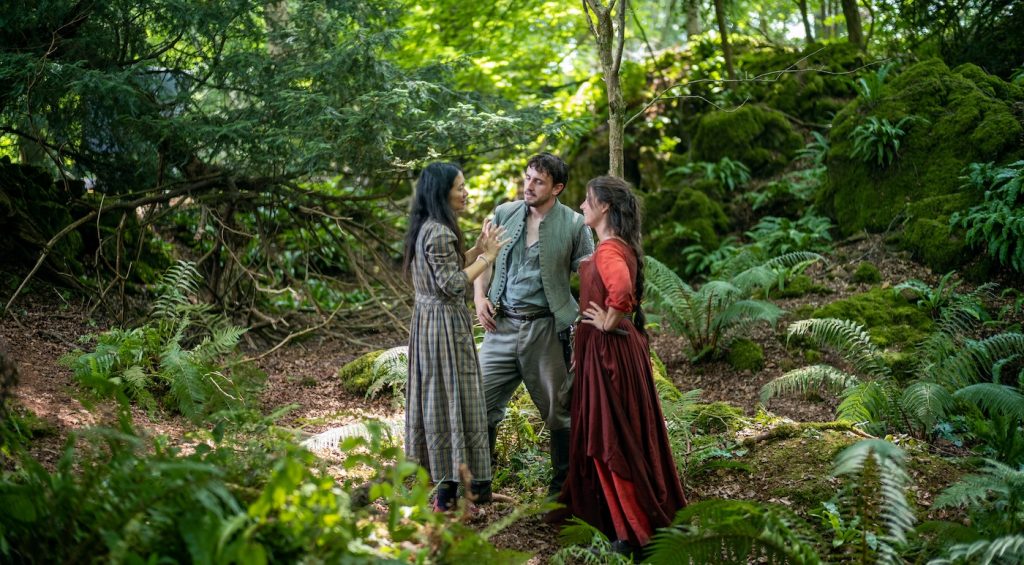
The film opens with Agnes in what feels like the womb of the forest, so it’s a birth scene, in a way, and the first thing you hear is this abstract choral music. The intention is that it’s coming not from the actual forest, but from the mythic forest beyond, and that acts as a vessel for her generally. As the story develops, there are electronic musical elements that start to happen. For example, when she and Will first meet in the forest, underneath that, there’s an abstract electronic color. A lot of the big scenes with Agnes, like the birth scene with the twins, also have electronic music, because I wanted to get away from things we know. If you hear the sound of a violin or piano, your brain sees a violin and a piano. Those are part of the known world, but then there are sounds which are from the other world, which is a huge part of the movie. I wanted to play into that.
Hamnet is definitely rooted in naturalism, but also in folklore and earth-based spirituality. How did you highlight that aspect of the film in your music with specific cues?
In the middle of the film, there’s a sequence where Will is swimming, and then he goes into the house. Agnes is there with the baby, and he goes upstairs to work with his father. There’s a nervous twitchiness across all that. The baby is crying. It’s not domestic bliss. I made a lot of that with recordings of viols and hurdy-gurdy, and manipulated them so they aren’t played straight. They’ve been sampled and processed to make these nervous textures. It’s actually the imperfections and scratchiness of those old instruments that appealed to me for this story, because the characters are all a bit broken, so I think it’s an eloquent way to express that.
In terms of the vocalizations, you worked with frequent collaborator soprano Grace Davidson, who specializes in early music.
Yes. The choral music is performed by Grace and Tenebrae Choir, which is also focused on early music. Grace is an amazing singer. She’s the soloist in Sleep. Honestly, a lot of the time, I write something for her, and she’ll sing it, and I don’t know how she’s done what she’s done. We’ll do a take, and afterwards nobody can speak. She’s just that extraordinary. The way it worked was that I had written a load of material in a kind of modular form, so I could assemble things in different ways depending on how the picture developed. It was an incremental process with her recording a lot at the beginning, making these little modules, then assembling those modules as the film progressed.
It’s not common to have music from the scoring artist being played during the filming, but that was the case for Hamnet, and the actors said it was very influential in their performances.
The material they were playing on set was the sketches I’d made right at the beginning, plus I had a record out around that time called Landscape, and they were playing that because it actually fit thematically. I visited the set on almost the last day, when they were at the Globe Theater doing the Hamlet scene and playing “On the Nature of Daylight.”
And the inclusion of that piece of music, which has been used in other films, wasn’t planned for this one. How did it come to be used in Hamnet?
I’d scored the end of the film in the normal way, but Chloé said she got nearly to the end of the shoot, and wasn’t satisfied with the ending of the film from the point of view of the script. Originally, on the page, it was very different than what you see. Onstage, Hamlet dies, and that’s the end.
That would have been a very different movie.
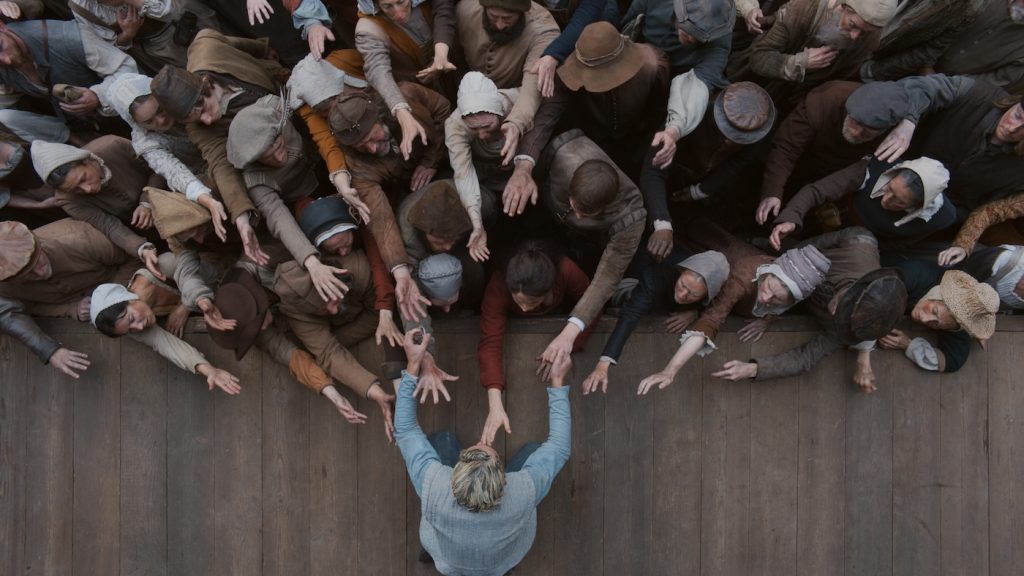
Right? So she was agonizing about what to do with it, and Jessie sent her “On the Nature of Daylight,” which Chloé didn’t know. She said she had this epiphany on the way to the set, listening to the music. She told me she had a breakthrough moment, and rewrote the end of the film.

Credit: Agata Grzybowska / © 2025 FOCUS FEATURES LLC
That piece of music is so hopeful, and so much about expansion or an opening. It’s perfect for how the film actually ends.
She said they played it on the set for 10 hours a day, and that all the reaching out stuff comes from the music. At first, I wondered why they’d chosen that when I’d already written a new cue, but then she explained that the film’s ending was inspired by the music. She is this artist who had made all these decisions through the movie, and somehow that piece just fit her vision. Once I saw the completed film, I found it very moving. She was absolutely right, because it really works. Overall, I think the film is a masterpiece, and I loved being a part of what she created. It’s an important film in terms of what it’s saying about the world.
Credit: Courtesy of Focus Features / © 2025 FOCUS FEATURES LLC
Hamnet is in limited release now and expands to wider release on December 12th.
Featured image: Jessie Buckley stars as Agnes and Paul Mescal as William Shakespeare in director Chloé Zhao’s HAMNET, a Focus Features release. Credit: Agata Grzybowska / © 2025 FOCUS FEATURES LLC