From Nirvana to Nebraska: Composer Stephanie Economou on Giving “Lanterns” Its Gritty, Soulful Heart
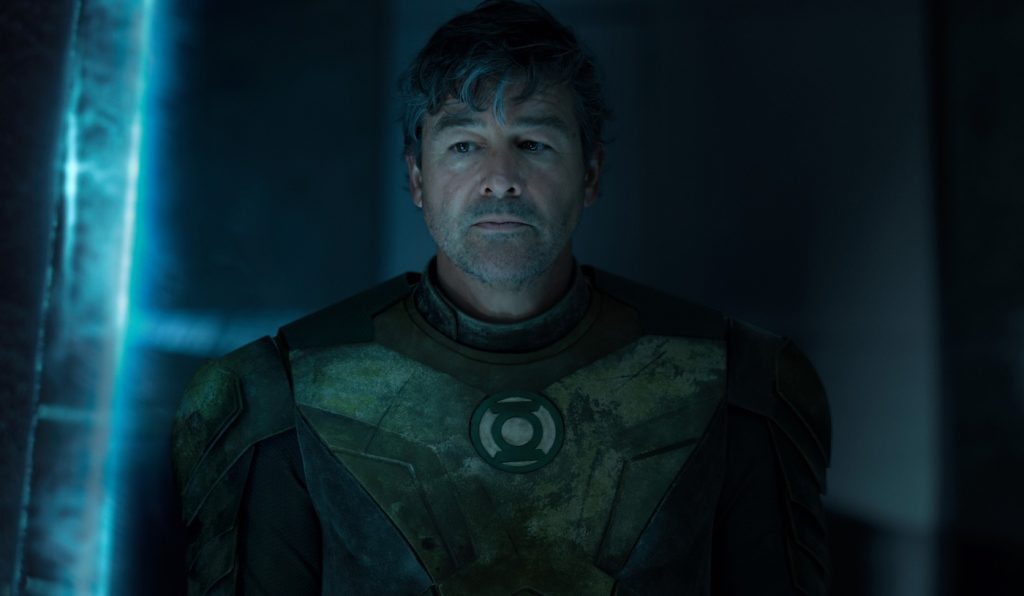
When the Green Lanterns took flight on HBO, composer Stephanie Economou heard rock and roll. The composer leaned on guitars and drums—wearing ‘90s influences on her sleeve—to bring together the superhero odd couple: the grizzled, garrulous old hand Hal Jordan (Kyle Chandler) and his mentee, the meticulous, meritorious former U.S. Marine John Stewart (Aaron Pierre). Created by Damon Lindelof, Chris Mundy, and Tom King, Economou felt that Lanterns‘ mismatched heroes needed more electric riffs than the typical swelling strings that accompany most men and women in capes.
The murder mystery places its flawed Lanterns in the seemingly ordinary small town of Rushville, Nebraska (spoiler alert—Rushville is not ordinary), where they search for an extraterrestrial threat known as a Manhunter amongst Nebraskans who view the two newcomers with a well-earned suspicion. While the threat to Rushville is massive, Jordan and Stewart butt heads with each other and locals alike as they search for what may be Earth’s greatest threat.
Though set in the Midwest, Lanterns was shot largely in Los Angeles, where Economou not only composed from her home studio but also worked with some of the city’s most talented musicians. We spoke to her about giving Lanterns its rock and roll heart and soul.
How did rock music become a major influence for your work in the series?
There was a lot of ’90s and 2000s rock influence. There was quite a bit of Radiohead, Mark Lanegan, Nine Inch Nails, and Alice in Chains. There was even some Massive Attack, Portishead, and trip-hop-leaning music that gave it a little edge. A lot of that music is deeply emotional and lonely, heavy and gritty, and that really spoke to the tone of Lanterns.
A part of that emotional and gritty side of rock is often what’s tangible, what crackles and what’s handmade. Was that ability a part of your overall approach to scoring Lanterns?
With a lot of Nirvana, you hear Kurt on the guitar, you hear the gravel, you hear the player touching the instrument, and that’s what I wanted. I didn’t want the score to feel pristine. You hear hiss and a lot of static. Even though the show was shot so beautifully, in the environment and in the portrayal of the characters, there’s a lot of that same sense of imperfection.
For the otherworldly sights and sounds we see and hear on Lanterns, did you want to lean more into the ethereal?
The grounded themes, like John’s theme and Hal’s theme and the Rushville theme, are rock-blues-inspired. With sci-fi, we got to go somewhere different. There’s a theme for the aliens that came from an organic source. I was hearing these little musical ideas in my head, these little motifs, and I wanted to reverse the audio once I recorded it. I recorded it backward from what I was hearing.
What did that effect achieve?
Once you reverse audio of something, it gives it edges and unexpected shape. I recorded viola, a bunch of layers of viola, and then I used a trombone mouthpiece. I made really strange sounds through the mouthpiece, then degraded, pitched, and heavily affected both of those organic elements. That’s what became the alien theme.
Which instruments conveyed John Stewart’s loneliness for you?
I picked up this instrument called a baritone rubber bridge guitar. It’s lower than a standard guitar, and it has this incredible muted sound that implies intimacy and loneliness. I started strumming these simple chords, very Nirvana-inspired. The rhythm is very straight, but it’s solitary. The measured nature of those strums, plus the electric bass riff on top, shows how dedicated he is to his training, his military career, and even his art.
For Hal Jordan, your rock and roll sounds just right for him.
Not polished. It’s a band together in a room making it happen. I’ve never written anything like Hal’s before, and I hope people feel like it suits him.
When you get to the penultimate episode and the finale, what cues and themes did you really want to pay off?
When you have a nonlinear show with so many peaks and valleys, you want themes to pay off. Episodes did get switched around kind of late in the process. The big action episode in episode five was initially episode seven. When I worked on it and wrote the score, episode seven had a lot of themes playing out in a big way and had evolved to this greater place, especially all of these action cues around the Macon Ranch. But what’s really nice is that when they reordered the episodes, in the penultimate episode, you get them going to the alien planet. The alien theme evolved from those small, insidious ideas that I recorded on viola and the trombone mouthpiece thing. I got to expand it to be something operatic that reflected the tragedy of the planet and Antaan’s (Paul Ben-Victor) people destroyed by the Manhunter.
The alien theme was one of the first you wrote for Lanterns. How’d you make it more operatic?
I tried to reframe it so it had harmony underneath that gave it a sense of longing and mourning. You get to put that theme through its paces and bring it to a place that’s, hopefully, dramatic and rewarding for the audience. It’s a sub-theme, not one of the big character themes, but it gets played a lot.
Once you completed a lot of your writing for the score, which local Los Angeles musicians did you want to collaborate with for Lanterns?
My husband, Jon Monroe, is a brilliant guitarist, and wrote additional music on Lanterns. He recorded most of the guitars that you’re hearing, and the basses. I knew that I wanted him as a main collaborator. There were only a handful of soloists; I picked up a ton of instruments and recorded a lot throughout the score. Two vocalists were Ari Mason and Wayne Ingram. Ari records vocals on pretty much everything that I’ve ever done. She also plays viola da gamba, which is a really cool instrument. And then Wayne Ingram recorded some of the guitars, like the Macon Ranch guitars, those twangy things, and the gritty basses. Then the duduk and the bass player, Ashley Jarmack and Francisco Ojeda.
Did you ever record outside your home studio?
At the Village Studios, we recorded with a brilliant drummer, Adam Christgau. He recorded all of Hal’s percussion. We did everything else remotely or here at my studio. So, it was a grassroots thing, and it felt really cool. I recorded all of the strings right here. It was the vibe of the whole score.
What an intimate scoring experience, especially for a property this big.
It would’ve been different had it been a more orchestral score. With the rock influence and these more experimental sci-fi themes, that didn’t require a ton of studio time. But having that studio time with the drummer was important. Having the space to do it in a recording studio, and the chance to experiment together, was great.
What does that mean to you, being a composer in Los Angeles, to collaborate with fellow artists in the city?
It’s everything. I love recording orchestras in LA. I wish I could do it more. I really do. I wish that there were more flexibility to do that here, but I’m hoping things will change for the better so that we can keep our scoring stages alive and keep our amazing musicians working. Some of the best musicians in the entire world live here.
It’s a funny and sad thing where you grow up thinking, I gotta go to LA; that’s where the dream and work is, but now it’s like, Oh, that work went elsewhere.
It sucks, man. It really does. Trust me, I love going to London, but I want to work here. I want to work where I live and work with all of the insanely talented people who play music here.
Featured image: Aaron Pierre and Kyle Chandler. Photograph by John Johnson/HBO Max