
Making the Argument Sing: Editor Alan Baumgarten on Editing Aaron Sorkin’s “The Social Reckoning”
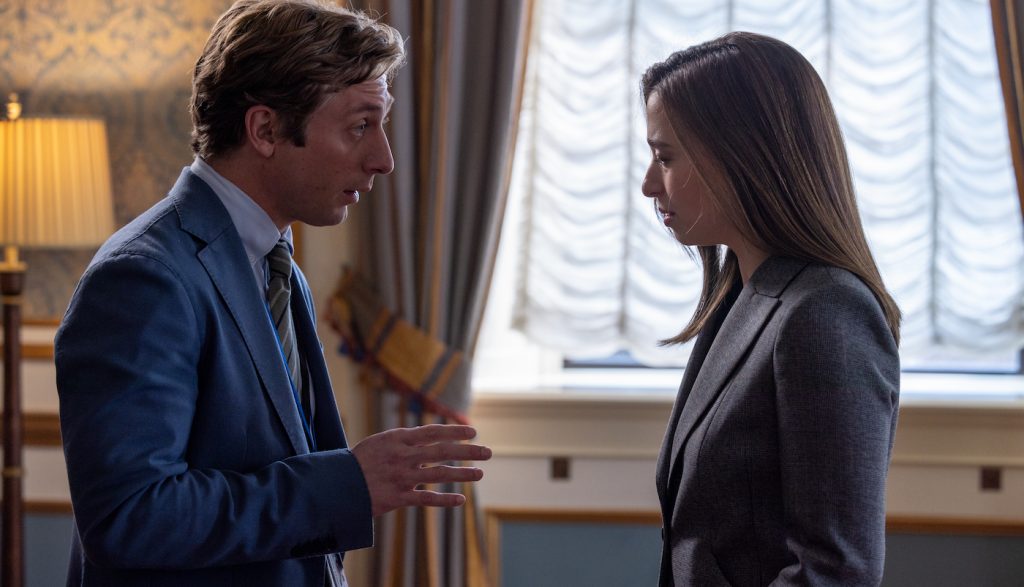
Oscar-winning screenwriter Aaron Sorkin recently recalled legendary movie director Mike Nichols telling him that every good scene must contain a “negotiation, a fight, a seduction or a discovery.” Any or all of those ingredients figure into Sorkin’s specialty: “argument.” He dispatches ping-ponging dialogue peppered with sarcasm, humor, insults, obscure references, exposition, and anger as if wielding a rapier. His latest, The Social Reckoning (in theaters now), follows Nichols’ directive and then some in tracking the fallout from Facebook whistleblower Frances Haugen (Mikey Madison) reaching out to Wall Street Journal reporter Jeff Horwitz (Jeremy Allen White) with bombshell revelations about the inner workings of Facebook, under the leadership of Mark Zuckerberg (Jeremy Strong). As usual, writer-director Sorkin relied on his go-to editor Alan Baumgarten to maximize tension and drive the story forward.
Baumgarten, who earned an Oscar nomination for editing Sorkin’s The Trial of the Chicago 7, describes their post-production collaborative process. “Aaron doesn’t prescribe exactly where to cut or exactly what the shot should be,” he says. “Sometimes he’ll have a favorite shot, but otherwise he’ll sit with me for a few hours, we’ll go through footage, and then he’ll wrap up, and I’ll be left with a lot of notes. Then he’ll continue to email me notes throughout the rest of the day: ‘I just thought of another thing!’ or ‘I’ve changed my mind.’ He’s constantly thinking and rethinking, almost arguing with himself, so there’s a constant back and forth. Aaron’s a great person to argue with, but he’s not easy.”
A Los Angeles native who studied film at NYU, Baumgarten also serves as David O. Russell’s go-to editor, having worked on American Hustle and the upcoming Madden. Speaking from his home office in L.A.’s Silver Lake neighborhood, Baumgarten discusses The Social Reckoning’s tense “Prologue,” the art of the callback, and the power of Jeremy Strong’s hyper-focused performance.
The “Prologue: White Girl Wasted” packs so much tension into a few minutes! It starts out as a routine traffic stop involving a drunk woman and two cops. How did you approach that editorially?
Aaron really prides himself on hooking people as strongly as he can, as quickly as he can, with a powerful opening. He feels that if you get the opening right, hopefully it will get people invested in the piece all the way through. There was a lot that went into that.
The interaction becomes so toxic so fast!
At the beginning, she’s on the side of the road having some mechanical issues with her car. But then we see the situation escalate and get completely out of control. We got pretty close early on but continued to tinker, trying to make the scene tighter. Announcing it as the Prologue, we want to start there and then get the film going after that.
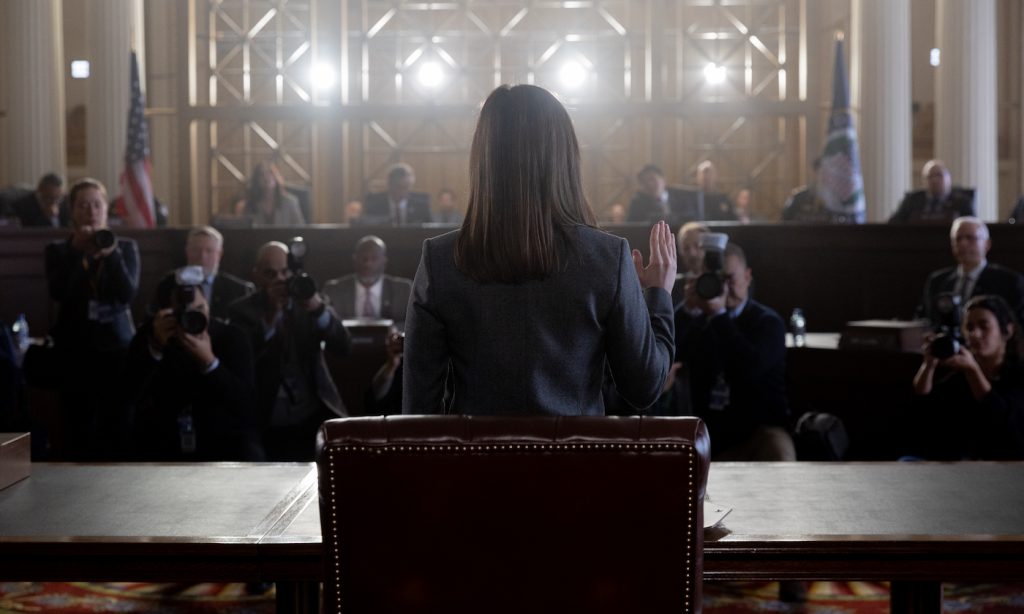
Jumping to the middle of the movie, you edit this low-key scene where Jeff mutes the basketball game he’s watching in his hotel room when Frances Haugen arrives to talk strategy. At some point, she sees a player on the TV screen pump his fist and says she can’t understand how someone can feel so much joy. Cut to an hour later. After she’s given her testimony to Congress, Frances walks down the hallway and gives a fist pump of her own. Were you mindful about setting up that fist-pump moment so it resonates emotionally, without being too clunky?
That basketball game on TV was a deliberate setup we knew would pay off at the end, but you’re not meant to see it coming. It was a fine line for us, figuring out how much emphasis to place on that moment so that it registers. We played with different amounts [of screen time] and at one point didn’t actually show what Frances sees on the TV. We just stayed on Mikey’s face, and she described what she saw. “Why is that guy doing that with his fist in the air?” But in the end, we went with that screen insert of the basketball player because it registers with the viewer a little more strongly for later on.
The Social Reckoning takes place in the world of technology, yet the movie manages to avoid too many scenes where people stare at computer screens or look at their phones. Was that intentional?
I’ve heard other filmmakers say that watching people engage with screens isn’t very interesting. If you’re doing it yourself, I guess it’s okay, but seeing that in a film isn’t very cinematic, and you can’t really make it exciting. But for Aaron, it wasn’t about the tech per se. For him, it’s always about the characters and what they’re thinking and their reactions to what’s going on. We had screens only to show some of the data and move things forward, because that is part of this world. But what we really wanted to do was to see the people within it.
The movie jumps around chronologically. How did you address that in editing?
The timeline was actually the bigger challenge because we do jump around. At first, we put dates, months, how many days or years after or before the scene we’d just watched. But that became too complicated. In the end, Aaron came up with this simple slider.
It’s a white horizontal line on the black screen marked like a ruler, from 2019 to 2023.
Just to give a sense that we were going back to the same place or going forward. We used it judiciously because we didn’t want to overlay too many elements on top and make things unnecessarily cluttered. We wanted to give the viewer just the right amount of assistance in following our timeline.
In the third act, you intercut Frances’ testimony before Congress with footage dramatizing the January 6th riots in Washington, D.C. Where did that footage come from?
All that original photography capturing the chaos and violence was shot on the first two days of filming. They used a lot of cameras, so there was quite a bit of footage. I went through it all with my assistants and sorted the footage into groups, but those shots weren’t really going to be used until we had the rest of the film put together.
You needed to narrow hours of footage down to maybe three minutes’ worth of money shots. What were your criteria?
It’s just a matter of reacting to what punches through. You’re not looking for the perfect shot. You’re looking for what’s most unusual or organic or real in a way that you might not expect. Camera whips, pans, dynamic movement of people moving through the frame—that helps. The hard part is deciphering what is essential, because you don’t want to overdo it. Fortunately, we had a lot of very good material to work with.
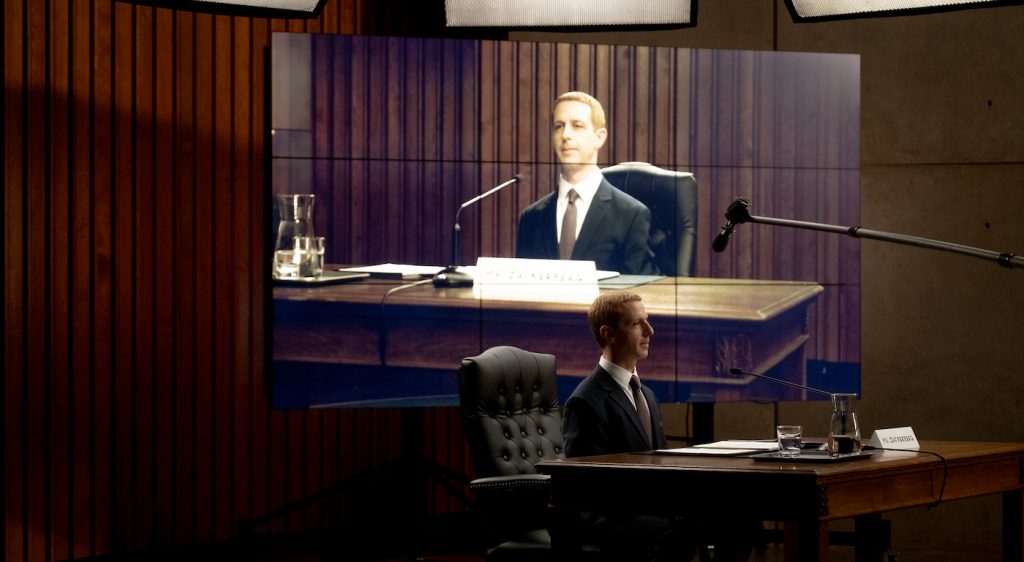
We have to talk about Jeremy Strong, who gives arguably the best intentionally stiff performance of the year as Mark Zuckerberg. You’re accustomed to assessing acting performances. What’s your take on Strong?
Jeremy’s almost unmatched as an actor because he’s so riveting. Mesmerizing, really. And he gives you so many subtle differences. He gets a little hotter, he gets a little slower, but he’s always in the zone. The strike zone. He’s always in the ballpark.
On a tangent for a moment, you recently edited David O. Russell’s next movie Madden and earlier earned an Oscar nomination for American Hustle. I have to imagine Sorkin and Russell have different ways of working. What’s it like collaborating with Russell?
David’s a real pleasure because he’s constantly evolving creatively, trying to tell the story almost invisibly, as if the hand of the filmmaker isn’t there. He wants those actors to just pop off the screen in the freshest, original way possible. Yes, it’s written, yes, it’s been filmed, but you shouldn’t be aware of any of that. And he’s around a lot more than Aaron. Aaron visits and gives notes and goes away. David will stay down the hall in his office from morning ’til night. He loves to be in the editing room.
Final question: As someone who started his career during what some folks might regard as a Golden Age of Hollywood-based film and TV work, are you optimistic about the industry, given the recent decline in production here in Los Angeles?
This is a big question. A tough one. I feel fortunate for myself personally, but I would say I’m very concerned for my assistants and younger editors, people who are coming up in the business during a time when work is leaving town, chasing economic factors. On the other hand, smaller projects are still viable, so people can make lower-budget films. But Hollywood is not as robust as it used to be in terms of opportunities for the film community.
As you may know, Congress is considering a federal production incentive program that would fund a 20 percent tax credit on projects filmed in the United States. Do you believe this incentive would have a positive impact?
Absolutely. I’m all for anything that will help keep film here in Los Angeles; I see it as necessary, and I’ve supported the post-production bill 2319, which passed. Any other production incentives that would keep film work here, I think, are very, very important.
Featured image: Jeremy Strong and Bill Burr on the set of Columbia Pictures’ THE SOCIAL RECKONING.