From Monterey Bay to a Whale’s Belly: Production Designer Ramsey Avery’s Incredible “Whalefall” Design Challenge
“I grew up building houses, so I have a very tactile sense of the world,” explained production designer Ramsey Avery, whose credits include the sci-fi thriller 10 Cloverfield Lane and the fantasy series Rings of Power. Avery brought that artistic sensibility, shaped by hands-on construction experience, to his work on Whalefall. Instead of designing a cozy home for main character Jay Gardiner (Austin Abrams), however, Avery’s main task was simulating the slimy innards of a whale.
Based on Daniel Kraus’s novel, Whalefall follows Jay’s hilariously baroque, biblical struggles after he’s swallowed by a colossal whale while scuba diving in Monterey Bay. Jay has gone down into the deep to search for the drowned body of his father, legendary diver Mitt Gardner (Josh Brolin). Trapped and panicking, Jay tries to recall his father’s lessons about the ocean, but he hasn’t made peace with his father’s memory. Desperate to survive, Jay confronts grief and resentment while trying to problem-solve his way out of the whale’s killer insides—with one hour of oxygen in his tank. And you think you’ve had a bad day on the job.
In an interview with The Credits, Avery described how he collaborated with director Brian Duffield and others to make Jay’s physical journey as convincing as his emotional journey. While whale watching in Monterey Bay, Avery fortuitously met local diver Pat Webster, whose videos became a valuable resource. Avery also consulted whale expert Dr. Joy S. Reidenberg so that the filmmakers could replicate key parts of the sperm whale’s anatomy, including its distinctive throat and two of its four stomachs.
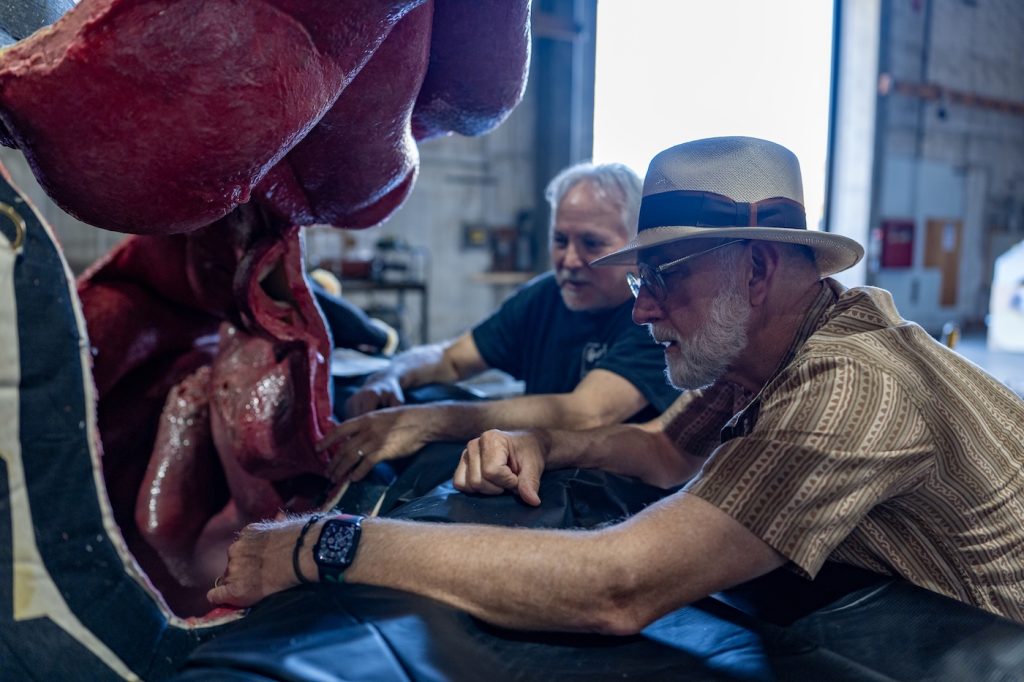
After extensive experiments in whale construction, “the head worked pretty much as ordered,” Avery recalled. “The interior stomachs, however, really did have a life of their own.” Fortunately, Whalefall’s cast and crew met their challenges with equanimity, unlikely to be matched among audiences of the deliciously terrifying film.
Note: This interview has been edited for length and clarity.
You first worked with director Brian Duffield on No One Will Save You. How did you begin collaborating with him?
He is friends with Dan Trachtenberg, who I worked with on 10 Cloverfield Lane. Brian really loved the way that movie was designed. There’s no dialogue in No One Will Save You, so the production design becomes very important for creating the backstory. Brian wanted somebody who could figure out the backstory and bring it to life in front of the camera. It was a wonderful challenge, and it was great working with Brian and with Aaron Morton, the DP, who I worked with on The Rings of Power, as well.
How did you get involved with Whalefall?
Brian started talking about it at the end of No One Will Save You and later called to ask, “Do you want to try to figure this out?” I got to read the script, cried, and thought it was a fascinating project. We put together a “whale room.” Our job was to answer the question, “Is it even possible to do this?” We did a ton of research and brainstormed possibilities. It was important for everyone to keep it realistic because it’s such an extreme experience, and you want the audience to believe it.
Did anything in your professional background prepare you for this distinctive challenge?
My process is always research-based. Even in a fantastical world, there have to be elements that an audience can identify with. For The Rings of Power, we riffed off Peter Jackson’s designs but also figured out what’s representative of our ancient world and would feel like a time 3000 years earlier than the Peter Jackson movies. With every project, I feel like I’m getting a master’s degree in some odd topic. This time, it was whales!
Why was it important to film on location in California?
The story is set in Monterey. You can always make one place look like someplace else with trickery and a bit of hand-waving. We could have made Wellington, New Zealand, look like Monterey, but this project has a very strong sense of reality. Being in California gave the film that real sense of an honest place.
Since Monterey Bay is such a crucial setting, what was it like to be there?
It was fantastic! We scouted North Monastery Beach to begin with. We hadn’t really known at that point that Daniel had been there. We thought, “This looks just like the book says. This is wild!” Then, we took a whale-watching trip to see the coastline. A diver, Underwater Pat, streams his dives from Monastery Beach. He told us all kinds of specific information and gave us photographs of the dive that Jay would have made. We were able to do some diving in that water and then reproduce what was in the water on our stage in a tank.
I was curious about the sets you built. Could you talk about how you created the underwater cliff?
Once we had solved how we were going to do the whale, my biggest worry was that underwater cliff. Representing that kind of topography and all the life on a stage tank was complicated. We did a bunch of testing. We used silicone to create sea cucumbers, anemones, and starfish. We figured out ways to dye mosses to make them look like algae. We scoured the world for different types of underwater plants that we could reuse. Our tank was only 65 feet wide and about 25 feet deep, so we figured out a way to design multiple pieces of the cliff that could fit in the tank and that we could shoot in different directions. It was all a puzzle! Happily, the camera divers and stunt divers, who were very familiar with California waters, were stunned the first time they went into the tank. They said it looked exactly like the waters and the life around Catalina Island in Monterey Bay.
Could you tell us about the whale sets, starting with the head?
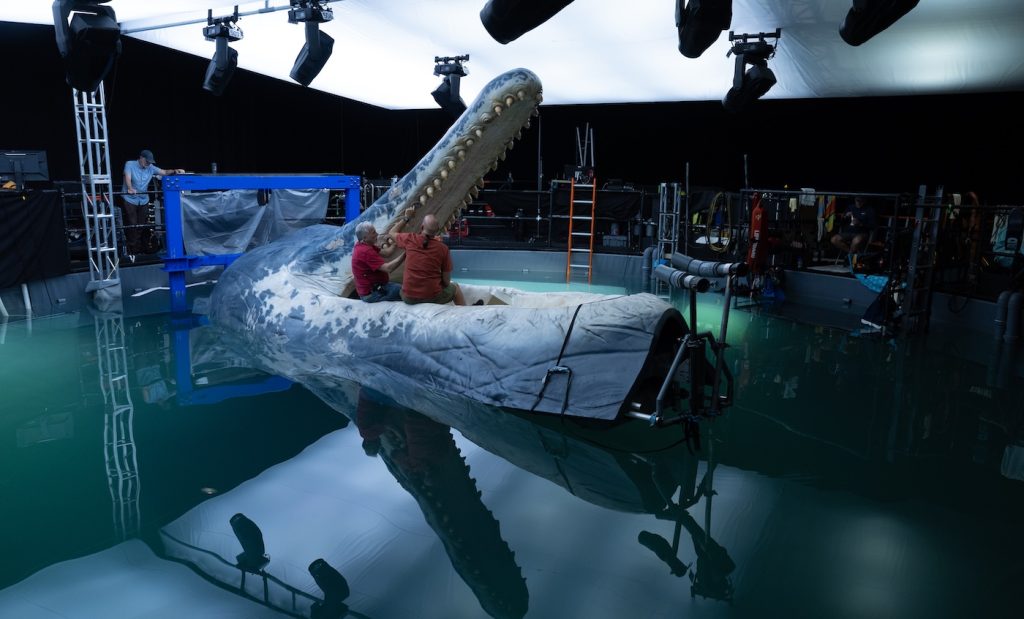
We went through a lot of research, mostly talking with one particular expert, Dr. Joy S. Reidenberg. Sperm whales have unique physiognomy because they evolved to eat giant squid. Their throat differs from other whales because the larynx shifts to the side, creating a larger opening. We searched online for endoscopic footage and imagery. Nobody has stuck a camera down the throat of a live sperm whale, but scientists have with orcas and dolphins. Dr. Reidenberg had dissected dwarf sperm whales that had beached themselves. I had 6 a.m Zoom calls with her where she would flip through pictures so we could see how the jaw was built and how the mouth formed around the back of the jaw. Sperm whales don’t chew their food. The teeth are for display. The tongue doesn’t move like our tongue. It’s basically a piston that moves up and down, creating suction. After I learned all of this, the trick was to reproduce it. We worked out a digital model of the head. We did a big full-scale foam sculpture and tested it. A stunt guy close to Austin’s size crawled around in it. Once we figured out the right size, we made all of that out of fiberglass and put it on a steel frame. The mouth was articulated. The teeth had to be hard rubber so that they wouldn’t hurt Austin but would still be strong enough for him to pull on. Then, we built the six-foot-long tongue. To operate it underwater, we had to figure out an air-bladder system so we could pump it.
How did the second stomach differ from the first stomach?
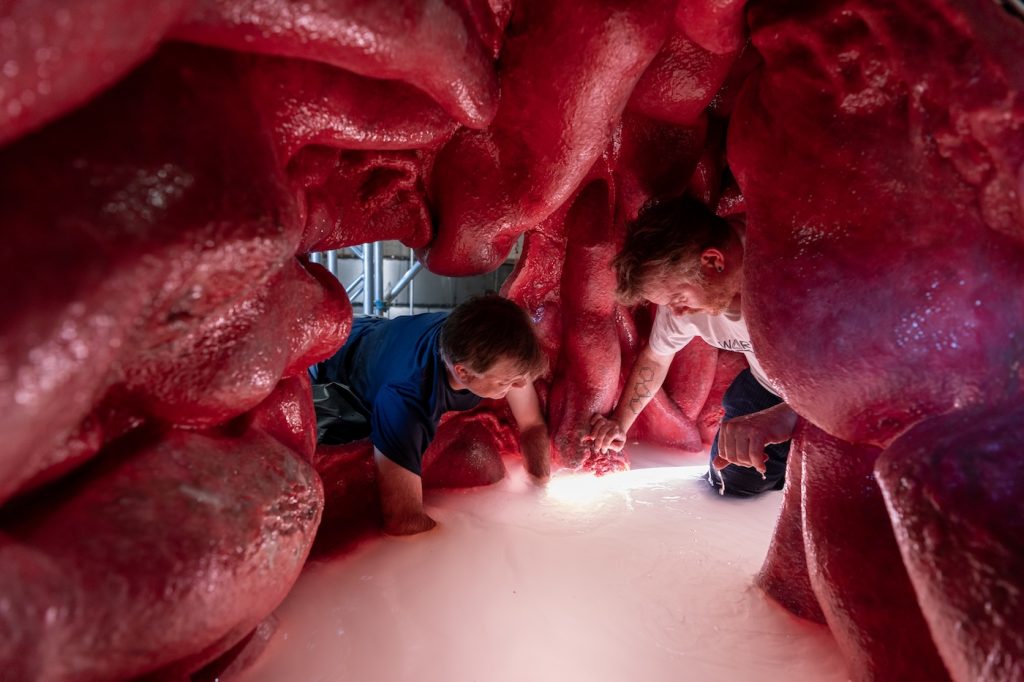
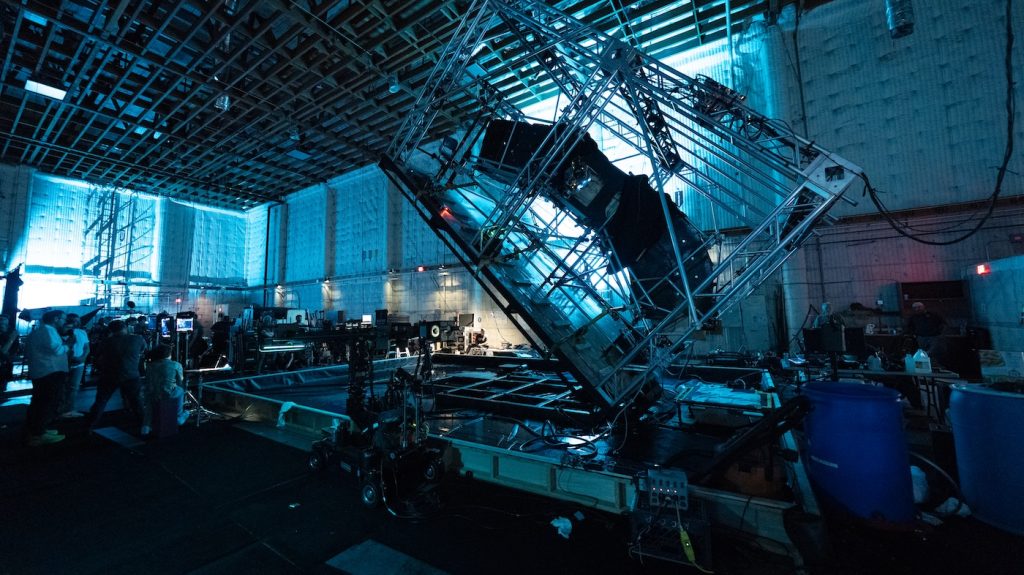
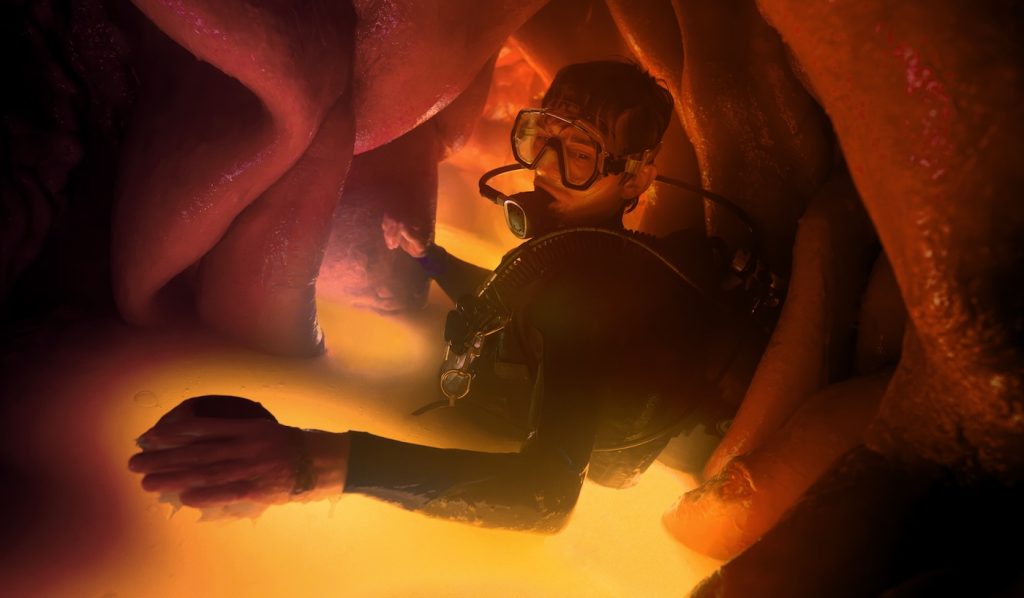
Mechanically, they were very similar. They were both made from antibacterial bedding foam and painted with many layers of translucent silicone. Stomach one is the chewing stomach. We built four matching ones for different functions and put them on different rigs. We had two gimbal sizes: a teeter-totter and a stationary one. The second stomach is the acidic stomach, where digestion starts to happen. In stomach one, the liquid that Jay maneuvers through is mostly just water with biological breakdown elements. In stomach two, it is digested goo. We had to figure out how thick and dense we could make that. We used methylcellulose and oatmeal to give it the viscosity and crunchiness that we wanted. Because we needed the fluids to do the right motion as the whale dived, Stomach Two was on a very big teeter-totter rig. It was amazing to watch from the outside because Stomach Two went from being level to being tilted almost 60 degrees. That was one of the hardest things to figure out. Because there were no straight lines, we had to use the water level to tell viewers if the whale was diving or rising.
Did you learn anything from this film that you will carry forward in your career as a production designer?
I don’t ever need to say the word sphincter again! What I loved about this project was that everybody felt the same passion, from the studio down to the PAs. Trying to figure out how to make this world real, how to make it functional, how to make it safe, so that we never hurt Austin, yet always holding on to the emotional heart of the father-son story was really hard! But nobody ever lost their cool. I hope I can always be part of engendering the kind of collaboration and camaraderie that we had on this project.
Whalefall is in theaters now.
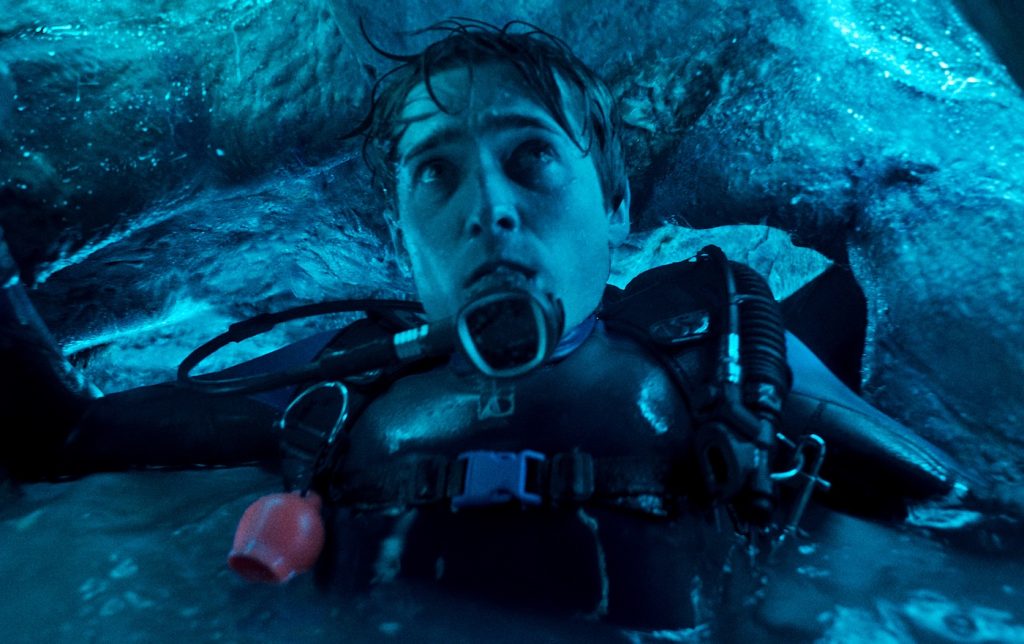
Featured image: Austin Abrams as Jay Gardiner in 20th Century Studios’ WHALEFALL. Photo by Jennifer Clasen. © 2026 20th Century Studios. All Rights Reserved.