Busan 2026: How “Everybody’s Oma” Filmmaker Jason van Genderen Turned Family Stories Into a Global Movement
Jason van Genderen has a story to share, and it proves how a seemingly small, distinctly domestic idea can lead to inspired filmmaking that reaches a global audience. It’s also a story about familial love, specifically respect and adoration for our elders, and the requisite empathy they deserve. He brought this story to the Busan International Film Festival after it inspired millions.
It starts during the pandemic, after the filmmaker’s mother, who had developed Alzheimer’s, had begun to miss the trips to the shops that gave structure to her day. It ends with Van Genderen capturing his family’s work to help her regain what she’d lost, and, in turn, showing millions of people around the world how to navigate their own struggles and find joy.
“There was nothing in her daily life that would make sense anymore, so she was really spiraling,” the filmmaker explains. “Then my oldest son, who was 14 at the time, said, ‘Why don’t we bring part of the outside world inside?’ We decided to try to reignite her love of shopping, so we ordered groceries and set up a store inside the house. Then my son jumped on the phone and started filming.”
Eventually, more than 100 million people watched the van Genderen family on social media, and the filmmaker further developed the initial concept into the feature documentary Everybody’s Oma (2022).
“Before we knew it, we were on The Late Late Show with James Corden and Good Morning America and all these big shows,” he says. “And it went from being a series of little viral videos into a feature documentary.”
Today, though, the multi-award-winning Australian filmmaker is doing more than sharing this tale; Van Genderen is using it to motivate the 24 budding filmmakers gathered for this year’s 20th edition of the Chanel X Busan International Film Festival Asian Film Academy to take action.
Titled iPhone to Features, his talk was part of the MPA-BAFA Film Workshop: Bridge to Hollywood Initiative, and through it Van Genderen mapped out his journey in cinema, particularly his groundbreaking work making smartphone films, to inform and inspire this next generation.
Later in the day, academy members had a platform to put what they learned into practice in a pitch competition, where a panel featuring Van Genderen, Stephen Jenner, the MPA’s vice-president of communications for Asia-Pacific, and Kimball Thurston, Chief Technical Officer at Wētā FX, judged the pitches.
Jenner, as host of the workshop, explained that the day was designed to “share knowledge” and, through that, encourage emerging filmmaking talent to “bring your energy and your ideas and your stories to the industry.”
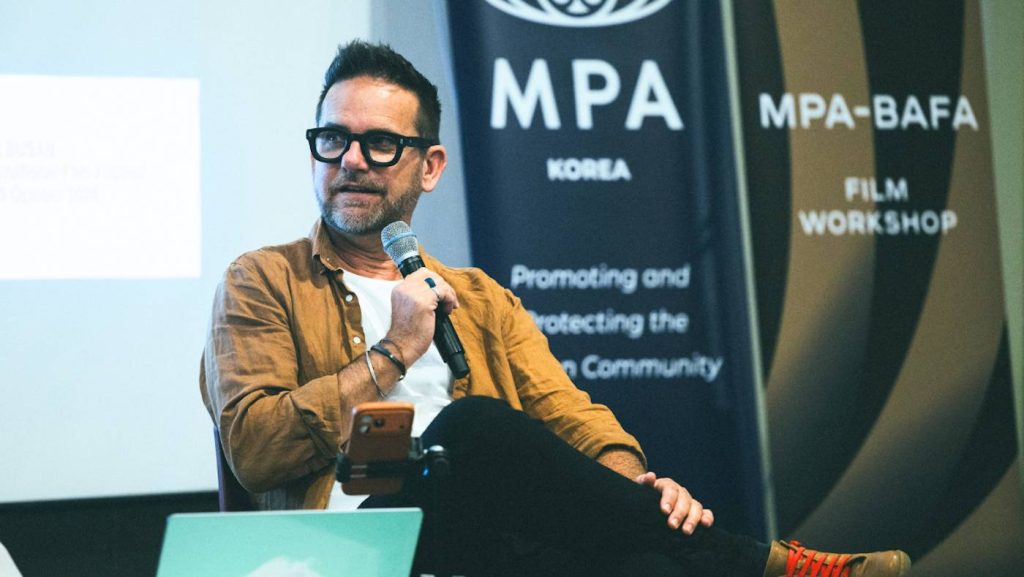
So Van Genderen began the conversation by going back to 2008, when he first started carving out his career in film and looking for opportunities. And then he looked at his phone, a Nokia N95.
“I looked at it, and I thought, ‘I wonder if one day people will actually make serious films on these tiny, tiny cameras’,” he recalled. “For me, it was definitely the novelty of the new. I could see that there was potential for this to really democratize access for storytellers to cameras.”
The enormity of what Van Genderen would then do, with a movie made for around $57, didn’t really hit home until Mankind Is No Island started winning awards.
“At the time it did not make sense to my colleagues that I’d been playing with this media,” he said. “Most of them were saying, ‘You won’t get into a film festival with something like that, it’s not going to work, he’s lost his mind, he’s given up, he’s leaving the film industry,’ all that stuff. But I think in there somewhere was still that curiosity of, you know, well, I don’t know…people are open and receptive.”
At the time, films shot entirely on phones were a novelty, but Van Genderen’s short changed a lot of minds, especially when it played outdoors at New York’s Battery Park and went on to win Best Film and People’s Choice at TropFest NY. The film features words and faces that together question global empathy.
“The film came on in the park, and I held my breath. I have never experienced anything quite so amazing,” said Van Genderen. “Just in the middle of Manhattan, and to hear that space and quiet as people were sort of really absorbed in the message.”
Building on the publicity the film received, Van Genderen continued to make documentary shorts and established the Pocket Film Academy. He also continued working with smartphone makers and explored what their technology could offer not only aspiring but established filmmakers.
Beholder (2019) is another short that earned acclaim at the 2019 Moment Invitational Film Festival in New York and reached a global audience. Using an anamorphic lens on an iPhone and working over one weekend, Van Genderen pieces together the story of his father, a sculptor, while exploring the art he left behind and his legacy.
“I think the lesson that we can all learn from in my dad’s journey is to be completely unapologetic in what you create and what you do and to do it with all your heart every day because you never know when that privilege is going to get taken away from you,” he said. “Make your story count and leave a legacy for future generations to understand what you brought to this world.”
As a message to the academy, Van Genderen urged the filmmakers to consider universality.
“I think that’s a really important thing to remember: have your viewpoint, have your idea and your concept you want to express, but really spend time thinking about how does this travel, how does this land with other people,” he said.
Later in the day, Van Genderen helped decide the pitch competition winners after sitting, listening, and discussing the young filmmakers’ ideas.
First prize, which includes a trip to Los Angeles for the LA Film Immersion Course as well as the American Film Market, went to Korea’s Jang Sohyun and her pitch for Now What, a film she says is a “very philosophical” tale of teen love.
“I’m excited, but I am nervous, too,” she said. “This was actually my first time pitching, and now I will go to LA and meet people who have been doing it for so long. But I am really looking forward to being in this industry in the future. I feel I have been drawn into the cinematic experience because there are feelings or emotions that we can feel only through cinema, and I really cherish that.”
Meanwhile, the President’s Special Recognition Prize went to China’s Yuan Yuan and her pitch for Heading South, the story of a Mongolian teenager who dreams of becoming a K-pop star. She will now head down to the Asia Pacific Screen Awards in Brisbane, Australia.
Like Jang before her, the recognition, as much as the workshop before it, left Yuan excited about what lies ahead.
“This project is very personal, and I think the judges could feel that,” she said. “I like personal films, but I want to also make this one funny because it is about teenagers. Being part of this program has shown me all the reasons I want to be a filmmaker.”
For more interviews with filmmakers and producers taking big swings in Asia, check out these interviews:
Busan 2026: Wētā FX CTO Kimball Thurston on AI’s Biggest Promise: Less Busywork, More Creativity
From Busan to the World: Hollywood and Korea Celebrate the Power of Global Storytelling
Local Stories, Global Audiences: Jon Wax’s Vision for Disney+ in Asia
Featured image: “Everybody’s Oma.” Courtesy Bonsai Films.