How VFX Wizard John Knoll & Sound Master David Acord Made “The Mandalorian and Grogu” Bigger Than Ever
Director Jon Favreau’s Star Wars: The Mandalorian and Grogu is now streaming on Disney+. The first Star Wars film since The Rise of Skywalker (2019) extends the beloved The Mandalorian TV series and gives audiences at home the IMAX treatment. Now available in IMAX Enhanced Edition, viewers can experience the same aspect ratio and dynamic sound mix of the IMAX theatrical release. Just be sure to adjust your motion smoothing settings.
The bigger question? How did filmmakers lead us here in the first place? We asked production visual effects supervisor John Knoll and sound designer/supervising sound editor David Acord. “We wanted to make this a cinematic experience, but Jon [Favreau] also felt that he didn’t want this to be fundamentally different from the show people fell in love with,” Knoll tells The Credits of the story set in a time between Return of the Jedi (1983) and The Force Awakens (2015).
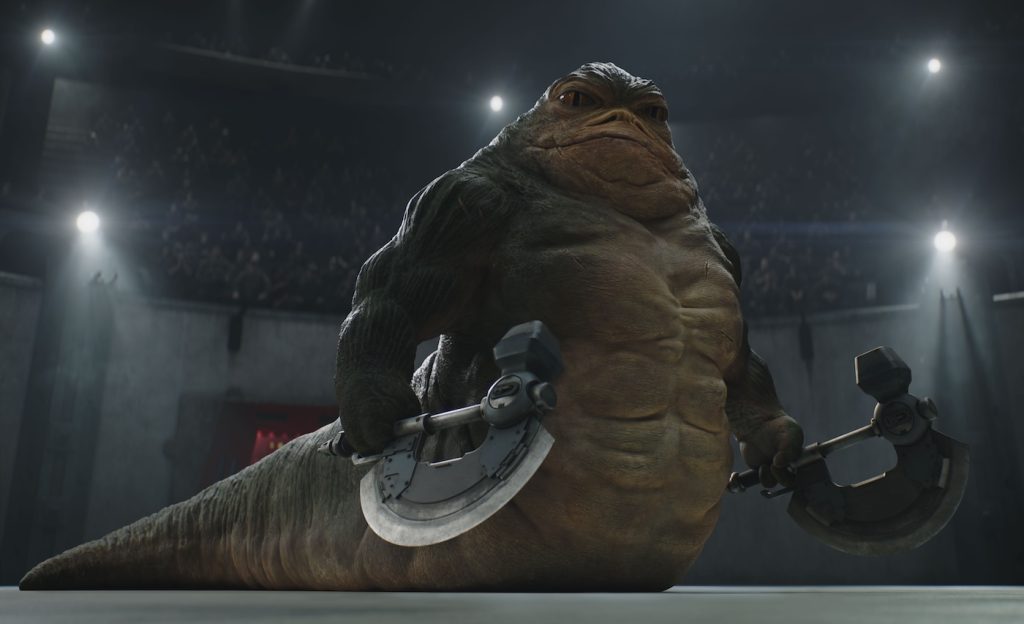
Designing for the big screen allowed production to go beyond the visual scope of the TV series—like filming for the aforementioned IMAX—but also to create complex CG characters, including Rotta (voiced by Jeremy Allen White), who is the son of Jabba the Hutt and becomes a key figure in the storyline.
Even with large format in mind, production leaned into visual staples of early Star Wars films like shooting on anamorphic lenses, puppetry to bring creatures to life, miniatures, and motion control techniques. But they also embraced retooled virtual production technology first seen on Season 1 of The Mandalorian. No matter the method, Knoll says basic filmmaking underpins it all. “Making sure you’re designing things with pleasing compositions that’ll cut together and tell stories visually well applies to any technique that you use.”
That mantra extended to the sound design, which was mixed in Dolby Atmos for its theatrical release but then remixed for home viewing. “We know people are watching more on home systems, laptops, tablets, and cellphones, so we do a whole separate mix we call a near field pass,” mentions Acord. Post sound will deliver home theater versions for Atmos, 5.1, and stereo, with each version posing challenges to what sounds should lead the way. “We have to be really careful about how we manage the soundscape and not overcrowd the mix, so there’s a lot of experimentation to decide who’s telling the story better in that moment,” Acord adds.
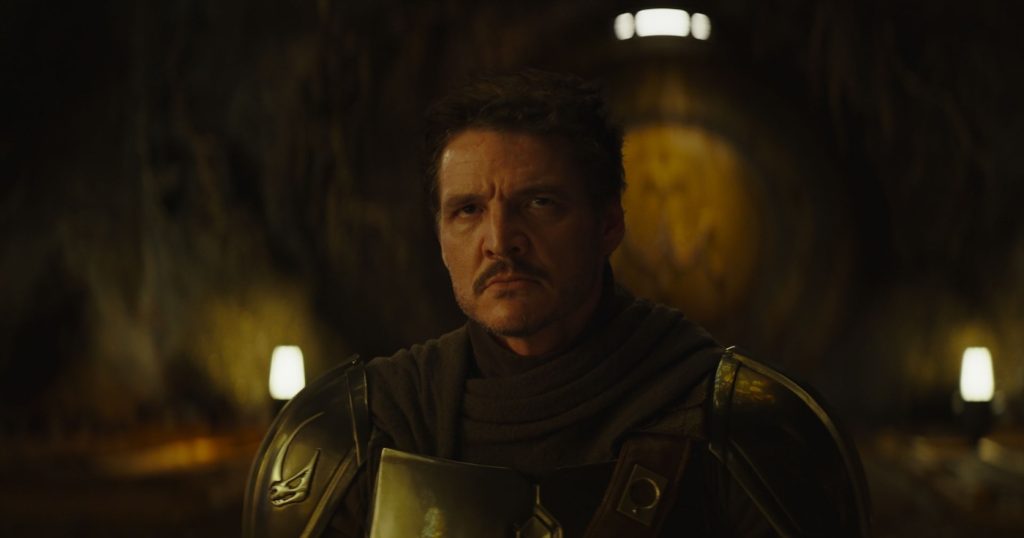
Predominantly shot in Southern California with a studio base at MBS Media Campus, the story takes Din Djarin (Pedro Pascal) and Grogu to the outer reaches of the galaxy to save new friends and each other. Below, Knoll and Acord unpack the major set pieces the bounty hunter and his Baby Yoda sidekick encounter.
A Walk Among the Mountains
The film opens with an intense pursuit on a snowy planet where Din Djarin and Grogu are in a battle with Imperial forces, culminating in the destruction of AT-AT Walkers and the “removal” of the local warlord.
“It started with production paintings from the art department that had this sort of beautiful jagged peak, snowy mountain-scape with evergreen trees,” notes Knoll. “Then Andrew Jones, our production designer, started looking for real-world locations, and because we were talking about sending a plate unit out to shoot things, we selected Mount Waddington in North Vancouver.” The team conceptualized the sequence to figure out what they would need to shoot.
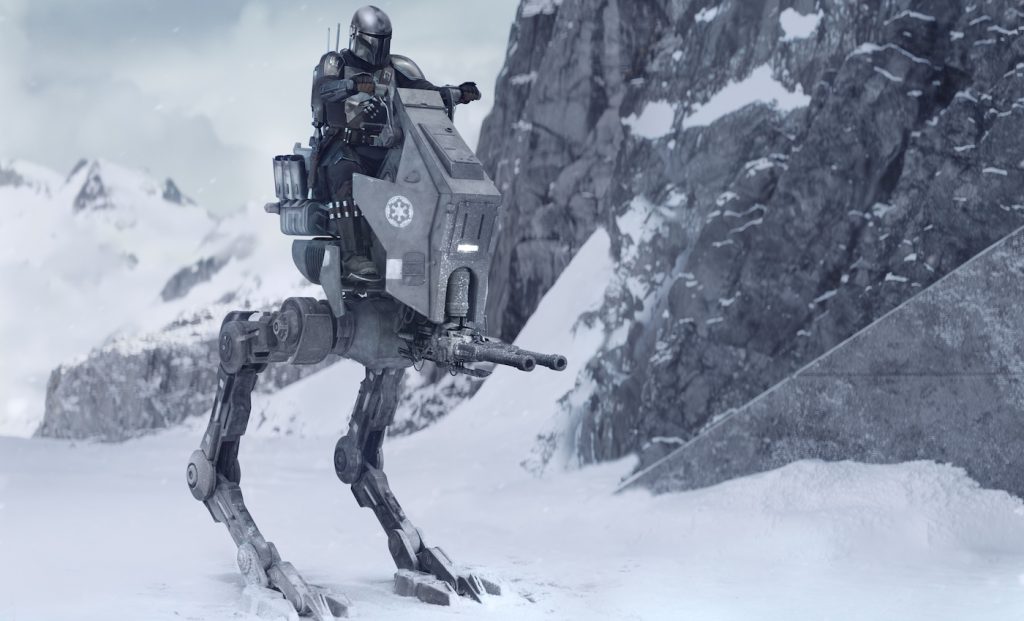
“We realized we weren’t going to get all the shots designed and approved in time before the end of principal photography. So we figured this could be a pickup shoot that we do at some other point. Then we got talking about what would be the most useful thing to help us set the look and design of the shots,” says Knoll. “We decided on a photo survey of the location, so my co-VFX supervisor Justin Van der Lek went up with a local helicopter crew and shot 50,000 stills over the course of three days in different areas.” The photography became the stepping stone in creating the sequence.
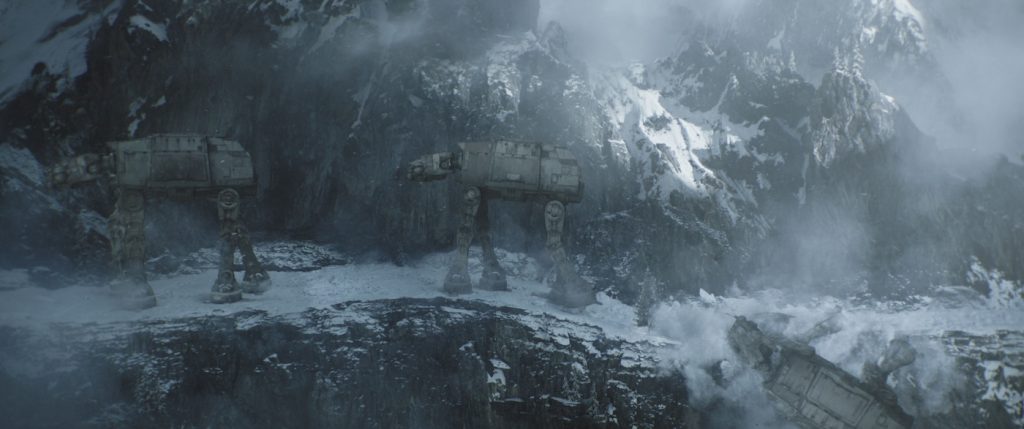
“We did photogrammetry solves on them so that we had three-dimensional assets. Essentially we scanned a bunch of areas at various different sizes and scales and then used those to start designing the environments,” Knoll explains. The team then modified the photos, creating the pathway for the Walkers alongside the mountain and designing the environment to look and feel like something out of the Star Wars universe. The effort proved to be worth it. “As we were working through the design, we were pretty happy with how the CG environments were looking,” suggests Knoll. “We ended up never going back to do a live-action shoot. It was Justin’s photo survey that was sufficient.”
A Dejarik Death Match
When Mando tracks down Rotta, he discovers he’s become a contract gladiator in the pits of Shakari. With one last fight to gain his freedom from the evil Janu, Rotta (and Mando) enter a final fight against 8 terrifying monsters.
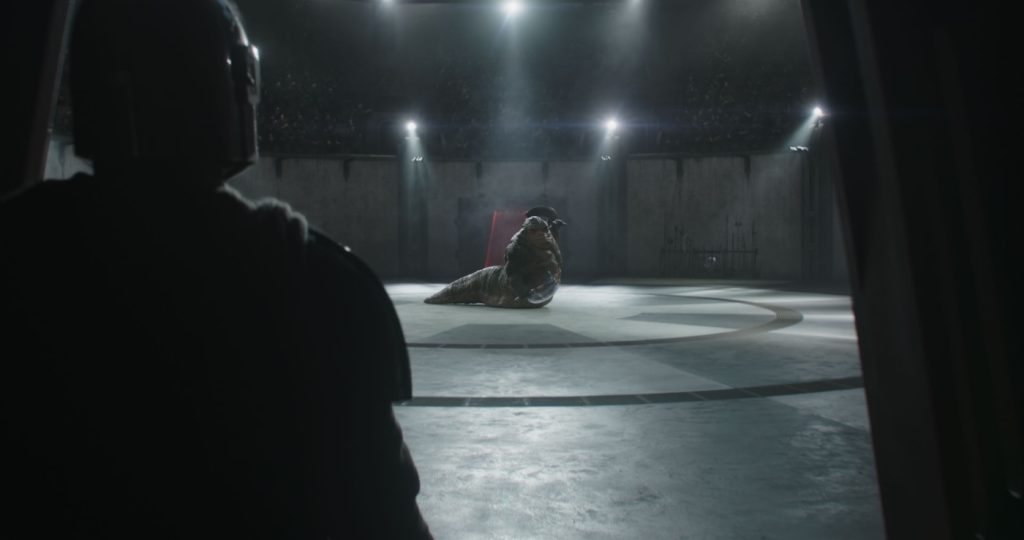
“Jon didn’t want to have an arena so big that you didn’t believe it. If it’s too gigantic, it stretches credibility,” says Knoll. To pin the proper scale, production relied on practically built foam core models and VR scouting tools to determine the seats, crowd, the fighting pit shape, and arena size. Production then built an arena section for the live-action shoot modeled after the Dejarik holochess board from Star Wars: IV: A New Hope. The Easter Egg didn’t stop there, as those same monsters created by stop-motion animator legend Phil Tippett for the game between C-3PO, R2-D2, and Chewbacca were reimagined for the arena fight.
“In terms of sound design, doing creature vocals is a big deal. It’s painstaking,” notes Acord. It’s all to taste. I guess every sound design is to taste, but you can go round and round on what a particular mythical creature is going to sound like because there is no right or wrong answer. It became a mind meld with the director as far as getting in tune with what they’re after.”
Favreau provided a clear path in how each creature should sound, but the looming challenge was making sure each one could be heard among the roaring crowd, effects, and score. “The idea was that at any moment, regardless of who was on screen, you can kind of pinpoint the sound for each one so there’s no real confusion,” notes Acord. For the final mix, rerecording mixers Bonnie Wild and Christopher Boyes had to weave sonically in and out of the action depending on perspective or plot point.
Rotta’s sound effects received extra attention. “Foley does a thing that’s called a cloth pass, which is when a character is on screen, you match his movements like he’s wearing leather. It’s like a base tone of the movement, but it’s not up all the time. You bring it in as you need it. It’s the same with Rotta’s skin. It’s kind of rough. So the direction I gave the Foley department was almost toad-like, not frog, not too leathery, but sort of amphibian-type skin. And then he’s got these sort of heavy moves which are basically couch cushions that are manipulated, like Naugahyde couch cushions that are kind of pitched down. That kind of gives it the vibe of when he moves for those big swishes and big heavy punches,” explains Acord.
For Rotta’s voice, sound added another trick. “His voice is Jeremy Allen White, which is a really cool casting choice because it’s so outside the box as far as what you would expect him to sound like,” says Acord. “Bonnie had this idea, because normally with the Hutts, there’s sort of like a low component under the performed component of their voices, sort of like a dual-band type thing. So she had me re-perform all of Jeremy’s dialogue in my voice, which is lower, but then pitched it down even lower. So that’s my voice under Jeremy Allen White’s voice. And it’s heavily reverbed, so you wouldn’t know it was me underneath. It’s there like a base coat, and it also serves as a bit of an Easter egg because I voiced Rotta in Clone Wars.”
A Chase through a Neon Lit City
After the electrified fence that keeps the monsters at bay short-circuits, they smash through the arena wall, wreaking havoc on the rain-soaked, cyberpunk streets of Shakari. Realizing he was set up by Janu, Rotta attempts to flee from Mando in a high-stakes chase propelled by jetpacks, speeders, and an adorable flying stroller.
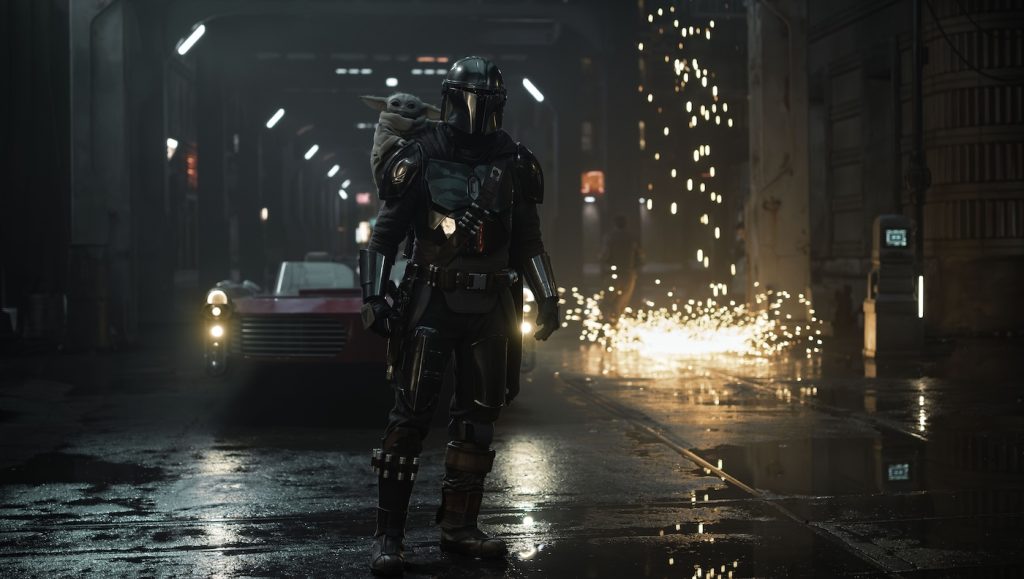
“Again, it started from concept paintings from the art department,” says Knoll. “We were pretty conscious of past visits to Coruscant in The Mandalorian season three, and when Obi-Wan goes in the prequels [The Phantom Menace, Attack of the Clones, Revenge of the Sith], so we were trying to make it visually distinct from that.”
To do that, one aspect of Shakari’s exterior color palette was limiting street signage to yellows, reds, and greens, while drawing reference from the Windy City. “It doesn’t take a lot of imagination to figure out that Shakari is supposed to be Chicago,” notes Knoll. “So that was sort of the inspiration, and there were a bunch of design decisions about the shape and size of the buildings that come out of that.” For sound, The French Connection became the reference point, a busy place filled with cars, horns, and people.
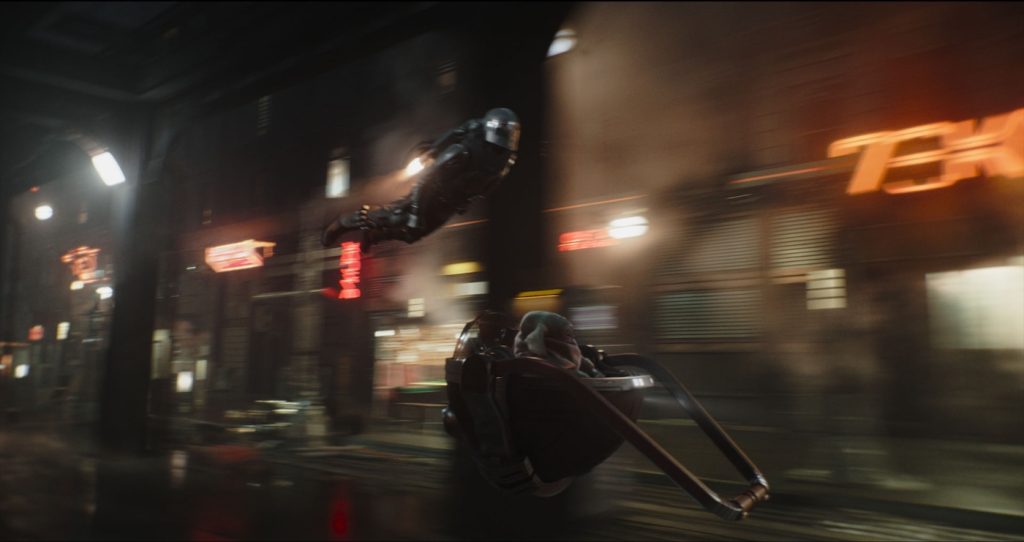
But the neon city wasn’t a big splash of visual effects. Physical sets were built at SCS Warehouse in downtown Los Angeles, home to other high-profile shoots including Inception and Birds of Prey, grounding the action in the effects. “The street was supposed to go on for miles in either direction, and we thought about putting up blue screens, but instead, we put up big LED screens on both ends, motion tracking cameras, and then generated the correct perspective to extend the streets,” explains Knoll. The virtual production use marked a departure from its usual production setup.
“After having done three seasons of The Mandalorian, The Book of Boba Fett, and Skeleton Crew, it’s sort of becoming harder and harder to fool people about volume sets and where the split line is. There’s a natural tendency because the volume is circular in shape; you see a lot of circular sets. We wanted to break that up and keep people guessing where the split line is.” [The split line is the area where the LED wall meets the physical set]. With the Shakari chase, the vanishing points of the LED wall lined up seamlessly with the practical sets, providing natural reflections from the neon signs bouncing off the wet streets.
Saving Friendly Faces
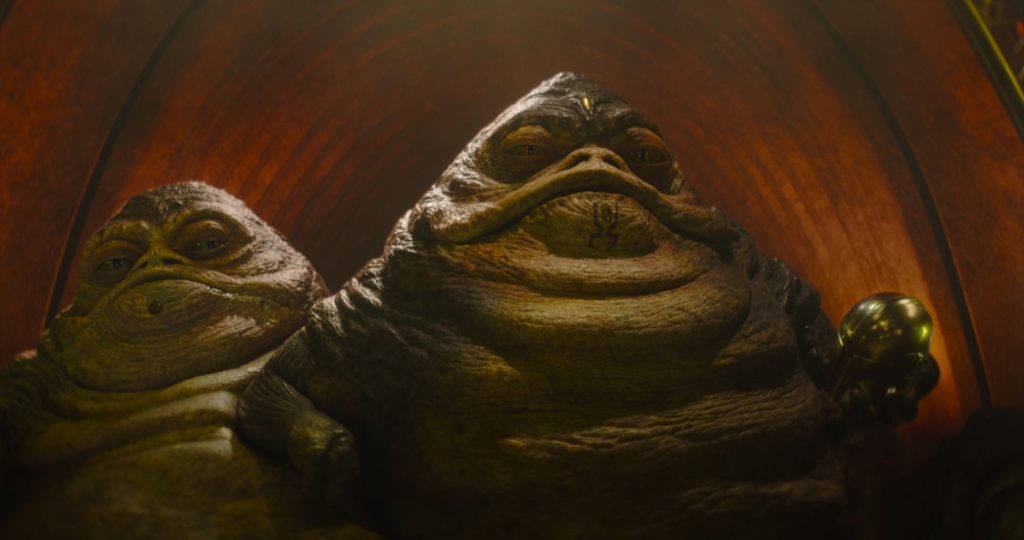
Mando and Grogu are captured by bounty hunter Embo and brought to Nal Hutta to face the wrath of the Hutt Twins for letting Rotta go free. Ripped from his helmet, Mando is dropped into a watery pit and attacked by nasty creatures. Our hero is hurt. Grogu to the rescue! And then revenge!
“A lot of the art had what I thought was a really beautiful-looking sort of yellow, green, foggy gloom to it, kind of an alien feel that I really liked,” says Knoll of the planet Nal Hutta. “I’m always keen to make things feel more exotic and not too earthbound. It shouldn’t look like we went to some place on Earth to shoot it, even though you get a lot of realism out of doing that when Star Wars has gone to Tunisia, Iceland, Jordan or wherever…so the first thought was to completely embrace what I was seeing in the artwork.”
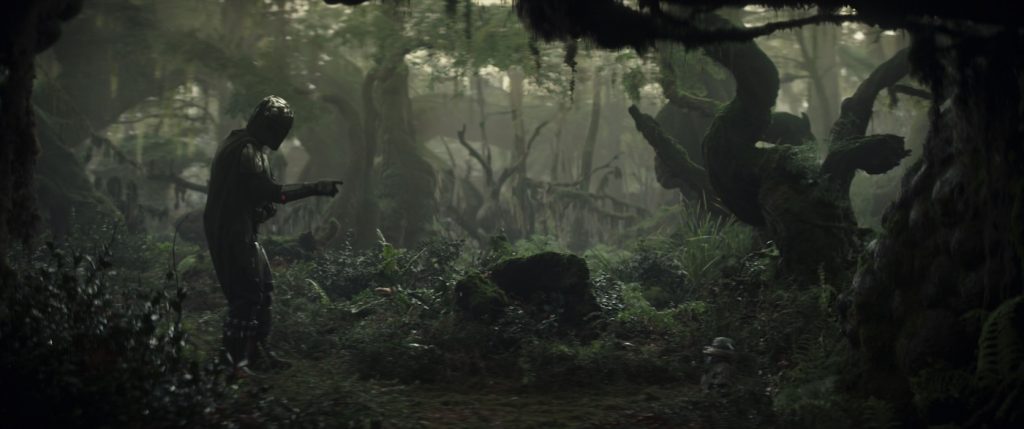
The team created a lush rainforest-like environment filled with mossy green textures, wildly overgrown plants, and exotic trees with buttress roots. Areas further away from the Hutt Twin’s stronghold are punctuated with open air and sunlight. For instance, scenes with Gatori, the alien fisherman who hides Grogu from the bounty hunter chasing him, appear brighter and sunnier. Then as you inch deeper towards the fortress, it becomes gloomier, denser, and darker.
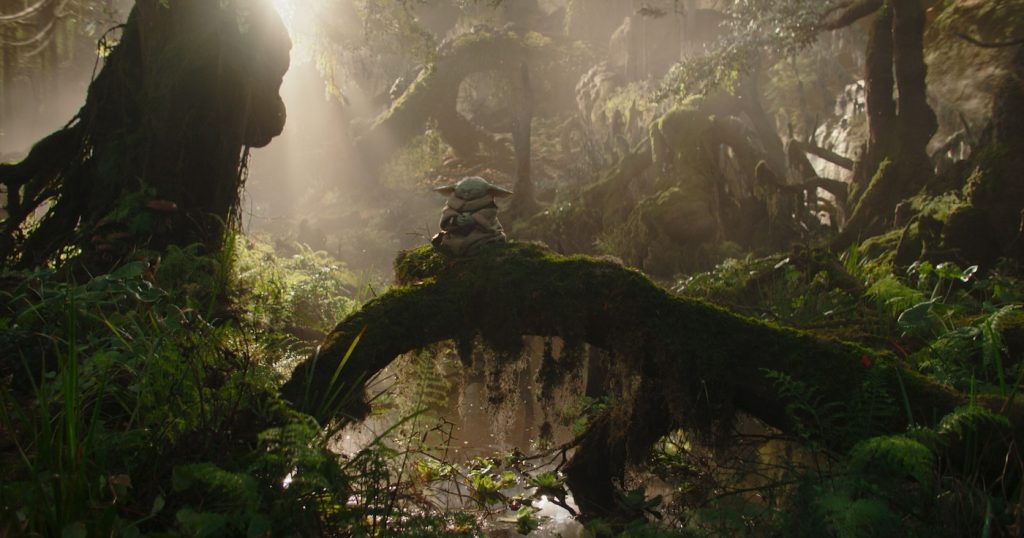
For the soundscape, Acord says, “This is a jungle, and it’s an unforgiving place, and we want to hear the insect buzzes; we want to hear weird, off-screen animals like birds, maybe monkeys. What is that in the background? And try to make it as unique a place as possible. We haven’t really been on Nal Hutta very much in the Star Wars world, so it was fun to play in that sandbox.”
For the showdown between Din Djarin and a venomous Dragonsnake in the pit, the team built a partial set and animatronic pieces of the snake to capture the live action before augmenting it with visual effects. The team had to navigate scale, water rendering, fight choreography, and a massive underwater root system that, at one point, grabs hold of Mando. Part of their approach blended production plates with CG animation and environments.
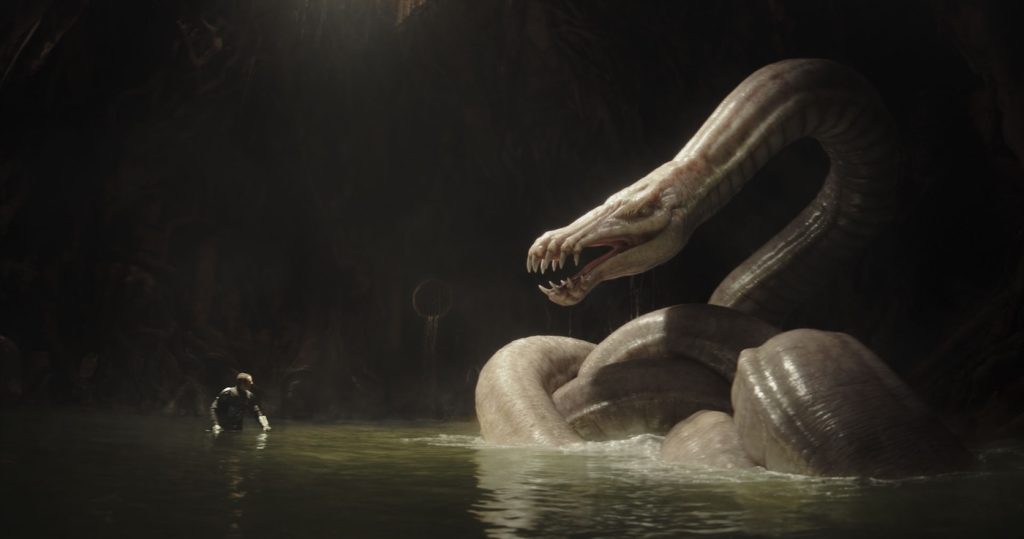
For sound, tuning the water became the challenge. “Anytime you’ve got water in a scene, whether it’s moving water, that’s a tough thing because the sound of moving water is mostly noise. So you’re battling that a little bit along with this giant roaring, hissing snake, notes Acord. “There’s a potential for a big cacophonous sound, and Chris Boyes really worked very hard to dial it in and make it have dynamics and make it sound interesting without being painful. It still sounds powerful. That’s a really fun sequence that we did.”
Star Wars: The Mandalorian and Grogu is available to watch on Disney+.
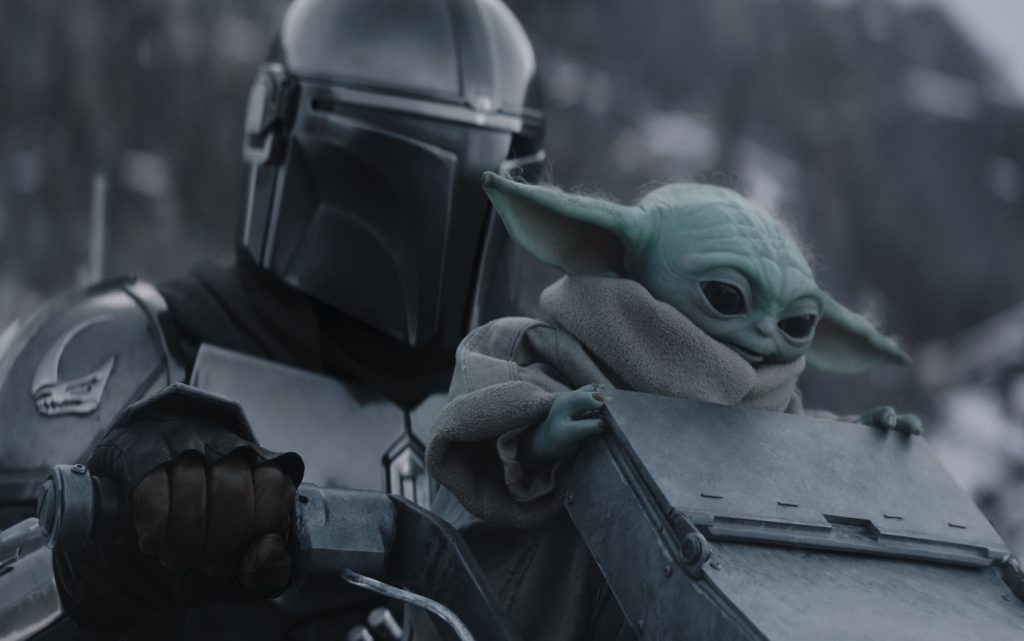
Featured image: Grogu and Din Djarin / The Mandalorian (Pedro Pascal) in Lucasfilm’s THE MANDALORIAN AND GROGU. Photo courtesy of Lucasfilm. © 2026 Lucasfilm Ltd™. All Rights Reserved.