Bringing Motunui to Life: The Cultural Experts Who Guided Dwayne Johnson and Catherine Laga’aia’s Live-Action “Moana”
Moana returned to answer the ocean’s call in Disney’s new live-action version of the animated smash hit this past weekend. Directed by Thomas Kail (Hamilton), fans will recognize the vibrant adventure of courage, self-discovery, and identity of the original movie as Dwayne Johnson reprises his role as the charismatic demigod Maui, luscious locks and all, while newcomer Catherine Laga’aia takes over the title character role from voice actor Auli’i Cravalho, who stays on as an executive producer. Together, they set sail on a quest that pushes Moana beyond the familiar shores of Motunui to save her people.
Production for Moana took place just under four months around Oahu, Hawaii, and in studios in Atlanta, Georgia, with over 200 actors from the Pacific taking part. The task for filmmakers was translating a story rich in regional culture, values, and traditions into practical terms, a feat that required experts and local artisans to work hand in hand with department heads to get it right. Guiding that challenge was a Cultural Trust led by native Hawaiian Kalikolehua Hurley, whose team worked closely with the production team on dialect, language, choreography, music, and culture.
Below, Samoan linguist Dr. Grant Muāgututiʻa, Pacific dance, music, and choreography expert Tiana Nonosina Liufau, and Te Vaka frontman and composer Opetaia Foaʻi discuss the care that went into the live-action adaptation and the significance of seeing Native Hawaiians represented on screen.
Following the smash animated film, the latest Moana is a live-action epic featuring Native Hawaiians, bringing a lot of cultural nuance that animation can’t match. What’s the significance of this shift to live action?
Tiana Nonosina Liufau: To our core, we are storytellers, and so, no story is too soon to be reimagined or told for the first time. And also, just a little cultural note, we are dealing with real people. Our cast alone—they’re all Samoan, representing Tonga, Aotearoa, and communities all over the Pacific. And then the heart of Motunui, I would like to say, is Samoa, which is the heart of Polynesia. Then Dwayne and Catherine are also of Samoan descent, so it hits differently. I think we have people who are like, oh, it’s too soon. What they need to do soon is go to the movie theater to see it; it’ll answer a lot of questions. When you see our faces, you see our expressions, our nuances, and the pride and joy, I think it’ll speak for itself.
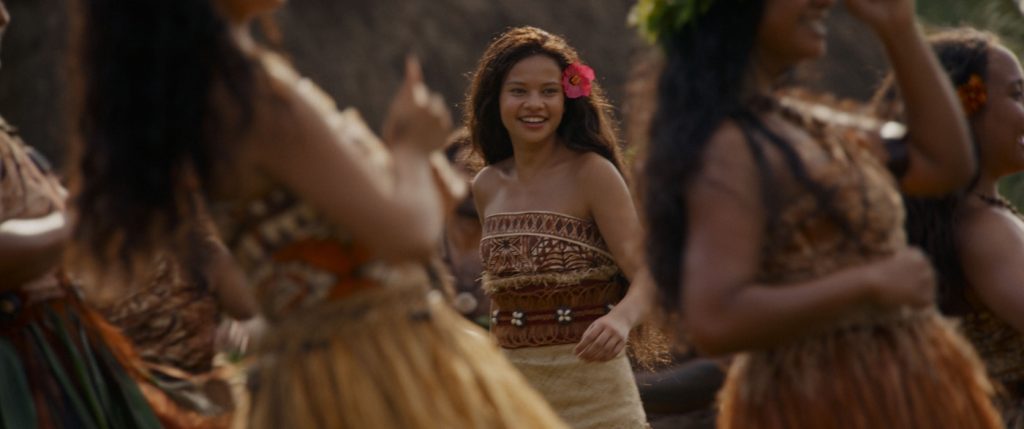
Very well said. Let me ask you, Tiana, in terms of bringing the mana, the spiritual energy, to the choreography, did you want to infuse certain Polynesian elements into the characters played by Dwayne and Catherine?
Tiana Nonosina Liufau: Well, the ocean definitely has the mana, and I think with DJ and Catherine, it’s innate. It’s in their blood. And whether they know the dance or not, the dance knows them. And so it’s just reintroducing them to the shapes and putting it to beautiful music, in which behind all of it is a Pacific person, a Pacific Polynesian heritage. So it was just bringing that out of them, encouraging them, introducing vocabulary for it, and then putting it to a rhythm. Once they’re comfortable with that, they bring their own mana. The mana was there; it’s just been waiting for them to express it in that way.
One of those expressive moments is in the new song “Along the Way,” written by Lin-Manuel Miranda. The song is performed by Catherine Lagaʻaia alongside the original Moana voice actress, Auliʻi Cravalho, and Dwayne Johnson. Can you share how the idea came about?
Opetaia Foaʻi: Well, it was nice to welcome Lin back in. It was lost in the last movie. And Lin had the great idea to make it a duet between Auliʻi and Catherine, so we went with that. Then I did the version that was in a Pacific language. We worked on that for a couple of weeks.
Since there’s this type of duet going on, did you have any conversations about the instrumentation going back and forth as well?
Opetaia Foaʻi: If it were totally up to me, it would be just log drums, but how it turned out is good.
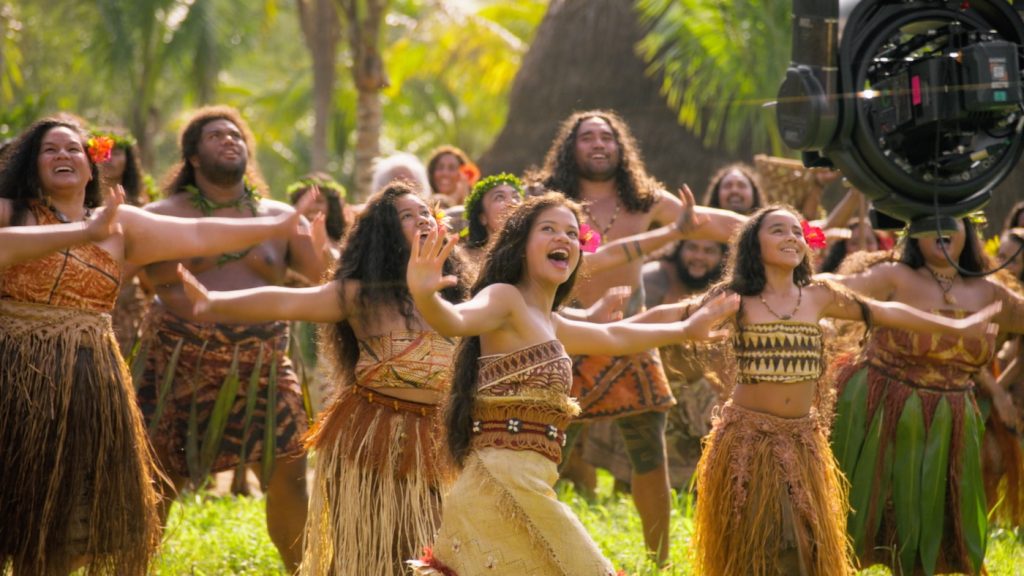
One of the longer sequences is the song “Where You Are,” which introduces us to the village of Motunui. The scale and nuance are more pronounced than in the animated film. How did you approach pulling off the immersive feeling?
Tiana Nonosina Liufau: I couldn’t do it alone, so I had my partner, Kayla Faʻamaligi, and a team to help with efficiency and communication with the villagers. What I love about this, and I think it’s more important than just choreography, is that in this scene, you’re going to see daily things in the village, like whether it’s weaving the baskets, or it’s the fishermen, the people that dedicate their lives to planting the trees that become the elements for making our tapa. There are a lot of elements in there that are so typical of daily life in the village. You get a glimpse of that, and it’s where those activities inspire the choreography.
How so?
Tiana Nonosina Liufau: The choreography isn’t just a bunch of movements; it stems from a lot of practicality. Things we do as a village that are practical, and it’s very social. The joy was there, whether it was the kids running around, there were always elders present, and there were always certain things. The way that she serves the elders. The way our houses are positioned and who can and who cannot be in them. It’s knowing your role, and not just the dance, and not just the formation or lineup. It’s knowing your role as a Polynesian.
With animation, the approach to recording dialogue differs from that on a live set. How did you want to approach working with the cast?
Dr. Grant Muāgututiʻa: It was amazing working with an all-Polynesian cast that comes with a background of knowing. They might not be fluent in the language, but they’ve heard it before, they know what it’s supposed to sound like. And then just bringing those lyrics to life, lyrics that Opetaia has written, kind of coaching them on the Samoan way of pronouncing things. I was really happy to have seen the receptiveness, of course, from the actors, but also from the film crew, who were open to the different takes we needed to do, the different angles, and all that stuff with the language, especially for new scenes that weren’t in the animation as well.
Did that responsiveness continue into the dance and other areas as well?
Dr. Grant Muāgututiʻa: Yes, not only the language, but also, like Tiana was saying, how the dance reflects the social structure and culture. And so all those daily activities, making sure that care and attention went into how people are sitting, how people are talking, how they’re preparing food, how they’re weaving, so that when our people watch the film, they know that it’s done in the right way, and it’s done correctly, and it resonates with them.
Did the team want to approach Polynesian culture with broad strokes or something more specific?
Dr. Grant Muāgututiʻa: We definitely wanted to weave in as much representation from across the Pacific as we could. I think the sort of base was Samoan. It feels very heavily Samoan, especially reflective of Dwayne Johnson and Catherine Laga’aia’s connections. But at the same time, we’re weaving in nods to Tonga, Hawaii, Aotearoa, and many other places. And of course, Tokelau and Tuvalu in the language. We were trying to be as inclusive and representative as possible.
For audiences inspired by Moana and looking to explore Polynesian culture more deeply, are there any films, books, or other resources you would recommend?
Dr. Grant Muāgututiʻa: For me, in relation to the film, growing up on Te Vaka and listening to all that music, the lyrics, and the stories really helped me learn Tokelauan and Tuvaluan as a Samoan. So I think starting there as a window through the music and then musicians, legends like Opetaia, who really provide the depth of the storytelling and weave in elements of the culture, is a really good place to start.
Disney’s live-action version of Moana starring Catherine Laga’aia and Dwayne Johnson is in theaters now.
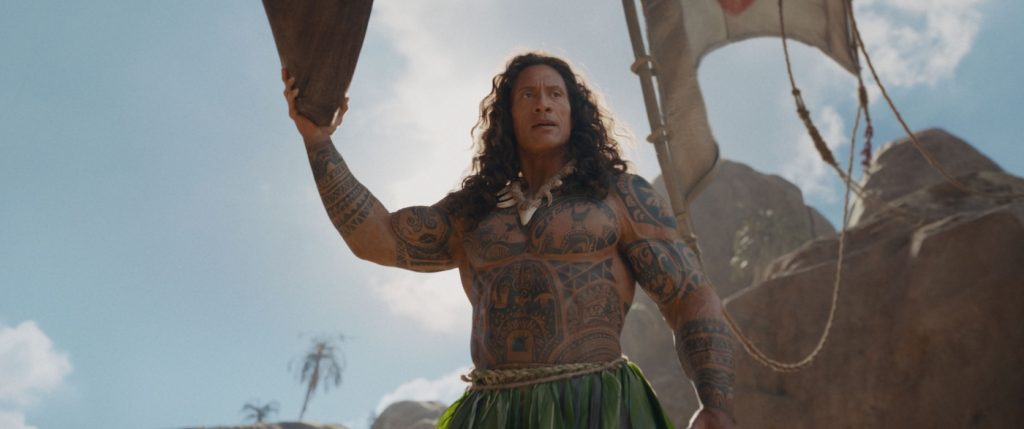
Featured image: Catherine Laga’aia as Moana in Disney’s live-action MOANA. Photo courtesy of Disney. © 2026 Disney Enterprises, Inc. All Rights Reserved.