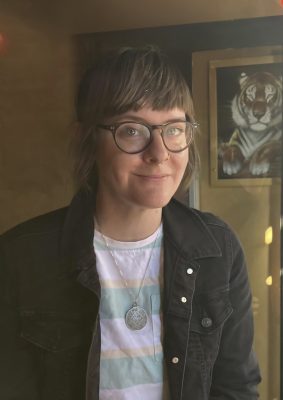
“The Pitt” EP & Writer Simran Baidwan on Building TV’s Most Immersive Medical Drama
Few television series have captured audiences quite like The Pitt. Combining relentless tension, innovative filmmaking, and deeply human storytelling, the medical drama has become one of television’s most celebrated recent successes. Critics have praised its authenticity, healthcare workers have embraced its realism, and viewers have connected with its nuanced portrayal of life inside a busy emergency department.
For Emmy-winning executive producer and writer Simran Baidwan, the show’s success is about more than ratings and accolades. According to Baidwan, at its heart, The Pitt is a series about people, community, and the connections that bind us together, even in our most difficult moments. Speaking about her experience helping shape the acclaimed drama, Baidwan reflected on the collaborative spirit that fuels the series, the unique production challenges behind its immersive storytelling, and what audiences can expect when the show returns for its third season.
Ironically, Baidwan never intended to return to the world of medical dramas. “My background has a lot of medical shows in it,” she said with a laugh. “I have zero medical knowledge. The closest I’ve ever come, or will ever come, to being a doctor is writing for these medical shows. Much to my parents’ chagrin, none of their children turned out to be doctors.”
After intentionally pursuing projects outside the genre, including Manifest, Ordinary Joe, and the comedy Clean Slate, she was approached by producer John Wells’ team about a new project pitched simply as “a medical drama.” Initially hesitant, Baidwan agreed to meet with executive producers R. Scott Gemmill and Noah Wyle, and their meeting quickly changed her mind. “We talked less about what the medical show was going to be and more about our personal histories and talking about the state of the world and things that we felt were missing in modern medical dramas and what our wish list would contain,” she recalled. “After that meeting, I walked away thinking, ‘If these guys can even accomplish 50% of what they’re pitching, I want in.'”
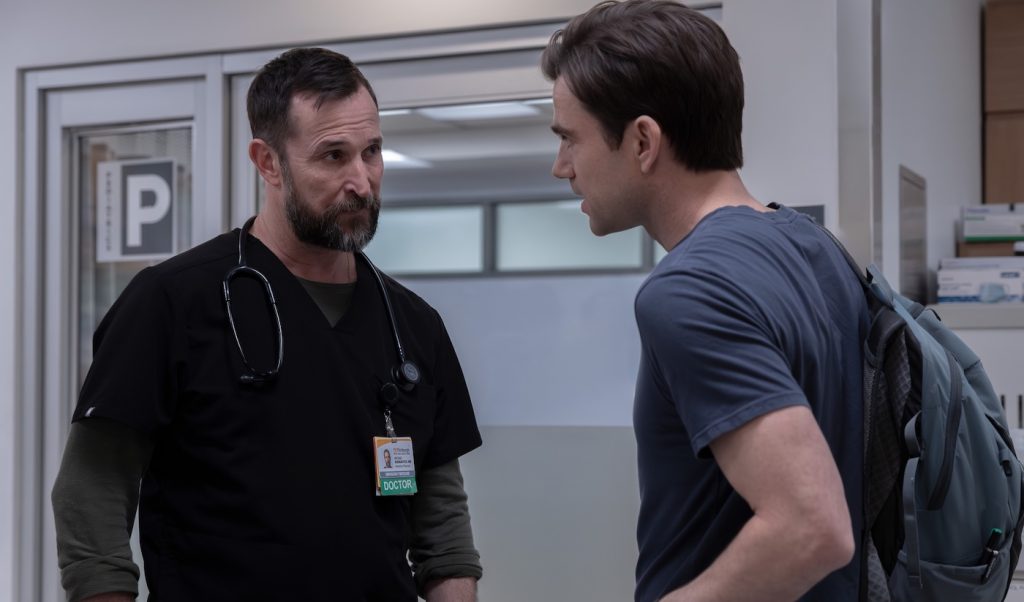
The conversation set the tone for what would become one of The Pitt‘s defining characteristics: collaboration. According to Baidwan, the creative culture established by Gemmill, Wells, and Wyle has been instrumental in shaping the series. “They have created a really wonderful and warm and collaborative environment that really allows you to feel safe when you’re pitching stories, safe when you maybe disagree with something or are trying to put a finer point on something or carve out more nuances,” she said.
The team’s rare approach to openness throughout the creative process encourages writers to explore ideas freely, even unconventional ones. “We have a lot of creative liberty to pitch some things that might be totally cuckoo bananas,” she said. “But from there might be some seed that could feed somebody else to grow a different story or pitch on it.”
The show’s writers’ room reflects a broad range of perspectives. More than half of the writers are women, and many come from diverse cultural backgrounds. “So many of us are children of immigrants from Ghana, Taiwan, China, Trinidad. I’m from India,” Baidwan explained. “It’s so nice to have people who have different cultural and socioeconomic backgrounds who can infuse a little something different into all of the storytelling,” she explained. “Yes, my name might be on a couple of episodes solo here or there, but really all of our names and our fingerprints are on every single episode.”
The result is a series that feels remarkably cohesive despite being built by a large creative team. “It’s one of the things I love about TV, probably the most,” she said. “It is a team sport. Collaboration is king.”
The collaborative philosophy that shapes The Pitt’s creative process is also essential to the show’s signature realism. From the moment viewers enter The Pitt’s emergency department, the world feels lived-in and authentic. The camera moves fluidly through hallways and treatment rooms, following doctors and nurses as they navigate a relentless stream of crises. The immersive quality of the show is no accident. Baidwan explained that realism begins long before cameras start rolling.
“We’re characters first,” she said. “Everything is through the POV and the lens of our principal characters and our healthcare workers, but there’s so much in the writing that really chronicles the choreography of what’s going on when you actually get to set.”
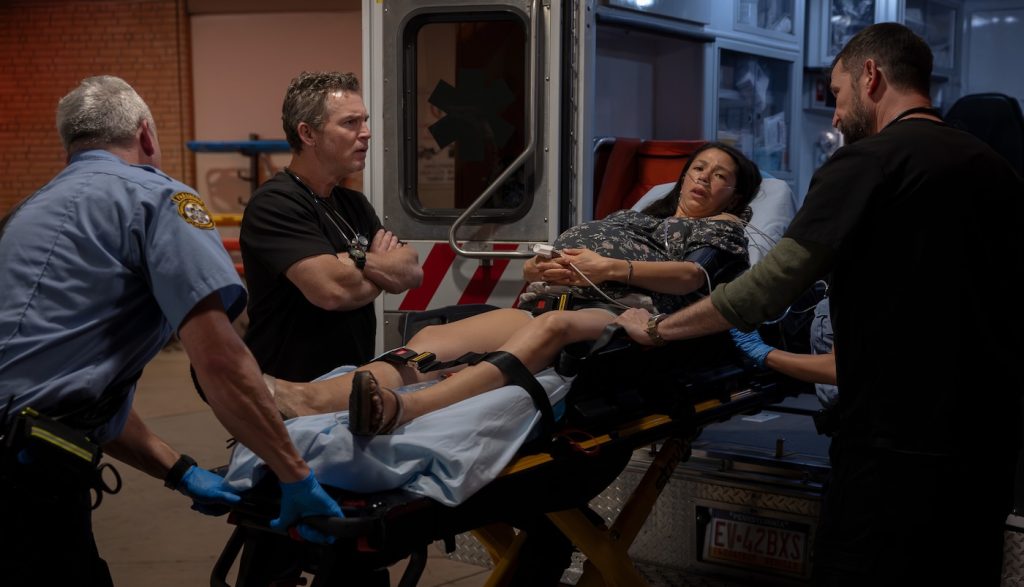
Every scene requires careful consideration, not only emotionally but physically. “You have to be really thoughtful and intentional, not only about the content of the scenes, but where they’re taking place. Then in the midst of that, what is the connective tissue between the stories, both physically and emotionally?”
To achieve this level of continuity, the creative team worked closely with production designer Nina Ruscio and physician-writer Dr. Joe Sachs long before the first scripts were completed. Before a single episode was written, Ruscio designed a realistic emergency department floor plan that became the foundation for the entire production. “We wanted it to look like a real emergency department,” Baidwan said. “We wanted to look at where the stations would be and where the hubs would be.” The layout would become a storytelling tool as well as a logistical aid. “All of us have these laminated floor plans that we take home with us,” she said. “Either we’re using little Lego figures or Post-it notes to navigate and plan out how we’re moving through the episodes.”
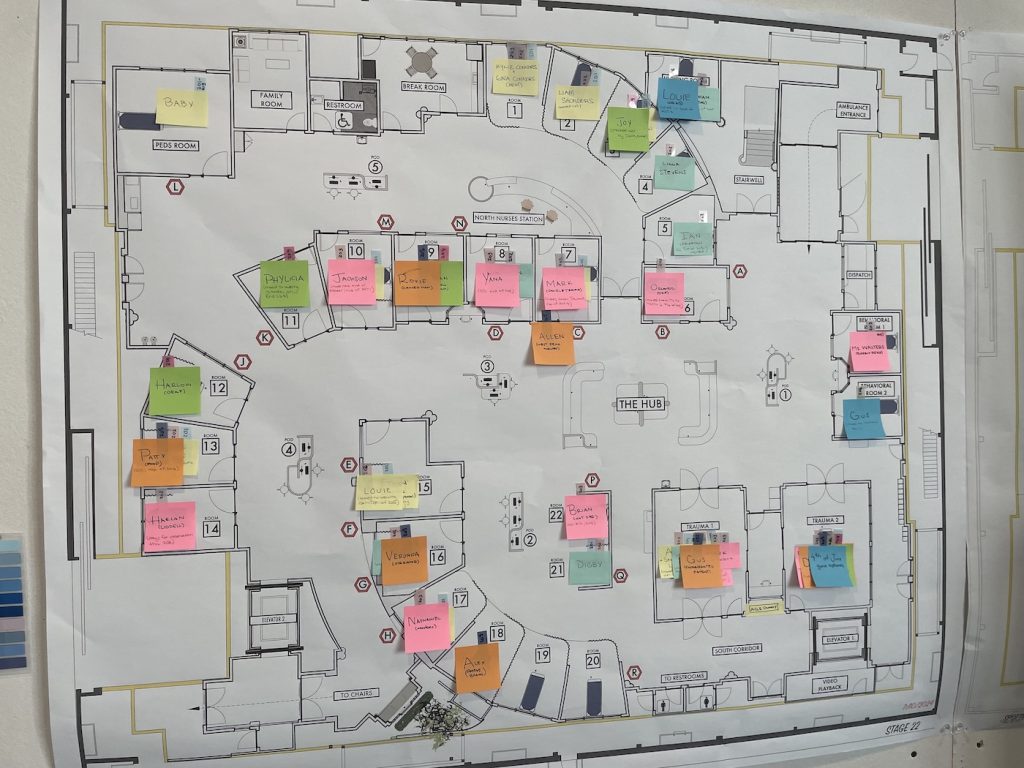
The physical geography of the emergency department influences every creative decision. “If Robbie leaves out of Central Nine, is he going to go out the back door or the front door? Is that going to connect to the North Hallway? Is that going to be where the lounge is?” she explained. “That also informs how we write and what we’re going to do.”
The show’s ambitious structure presents its own unique challenges. Unlike most television dramas, The Pitt unfolds in near real time, with each season chronicling a single shift. “We have what some people may say is a challenge that we have to cover 15 hours in one day,” Baidwan said. But she believes that the compressed timeline creates opportunities for more nuanced storytelling. “We don’t have the luxury or liberty of saying, ‘I got in a fight with you, but I’ll see you two days later, or a week later, a month later.'” Instead, characters must confront the immediate consequences of their actions. “When a character makes a mistake or has an argument, they still have to live with it because it’s very fresh, it’s raw, it just happened an hour ago or two hours ago,” Baidwan explained. “We are very conscientious about making sure that the audience knows what things aren’t resolved,” she said. “Things aren’t always tied up with a nice, neat bow.”
Maintaining that kind of realism requires an extraordinary amount of preparation. “We’re basically shooting live theater,” Baidwan said. Unlike many television productions that shoot scenes out of sequence for efficiency, The Pitt largely films in chronological order. “We shoot it the way you’re going to see it,” she explained. “I think it helps the actors, and it helps with the flow and the rhythm of the series.”
Writers remain heavily involved throughout production, attending prep meetings, collaborating with department heads, and working directly with directors. “In every prep meeting, there are writers, not just executive producers,” Baidwan said. “We walk through the sets and go beat by beat and see what’s going on, so that we can work out any potential pitfalls or roadblocks that come along the way.”
This kind of meticulous preparation allows the production to adapt when inevitable challenges arise. And challenges invariably arise. “Every episode presents different opportunities and challenges,” she said. Sometimes those challenges are creative. Other times, they are logistical. During production, actor Isa Briones, who plays Dr. Santos, underwent an emergency appendectomy, forcing the writers to adjust storylines and staging. “We had to pivot, restructuring some scenes, rewriting some stuff,” Baidwan said. But instead of hiding the situation, the team incorporated it into the character’s experience. “When she came back, she was still a little sore. We’re like, ‘You know what? We’re going to lean into this. Santos is having a really tough day.”
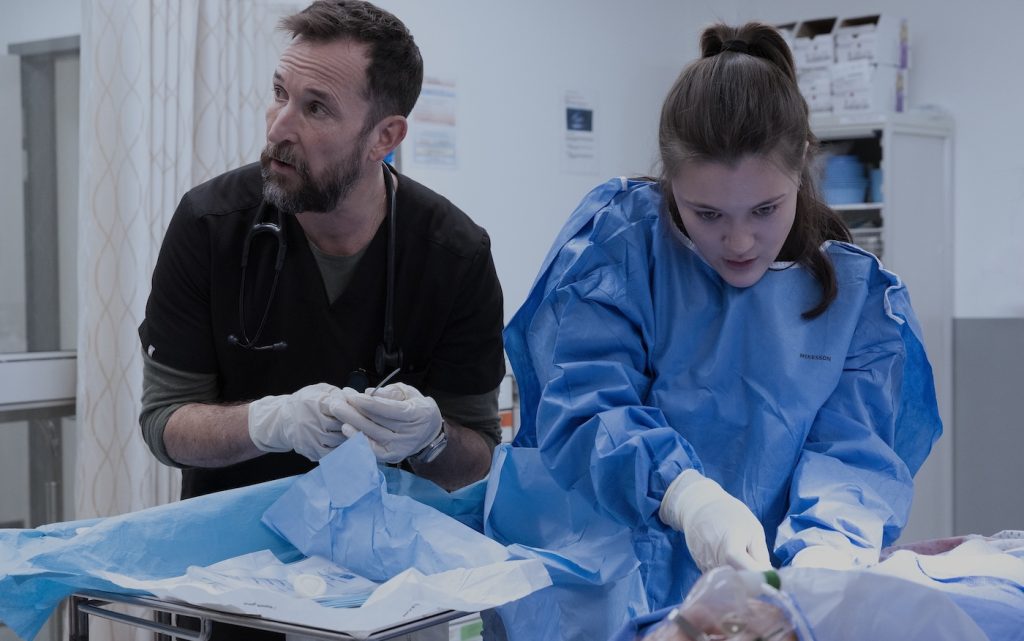
The production also faced significant disruptions during the Los Angeles wildfires. “It just became a humanitarian crisis,” Baidwan said. “We paused to take care of our own and make sure everybody was in a safe space and felt comfortable coming back to work.” Even under disastrous circumstances, the team’s collaborative culture helped them navigate the uncertainty. “Because we’re so prepared, and everybody’s in sync, when we do have to pivot, there’s no freaking out,” she said. “Everybody’s very calm and cool and collected.”
The realism extends beyond storytelling and production design into the show’s memorable practical effects. One particularly gruesome injury from the first season involving a severed fingertip left many viewers squirming. According to Baidwan, the sequence was just as shocking behind the scenes. “Myriam Arougheti is our phenomenal head of makeup and special effects, and she’s a genius,” she said. “I know it’s plastic, I know it’s silicone or whatever, and I’m sitting there on set looking at it, and we were like, ‘This is disgusting. What is happening?”
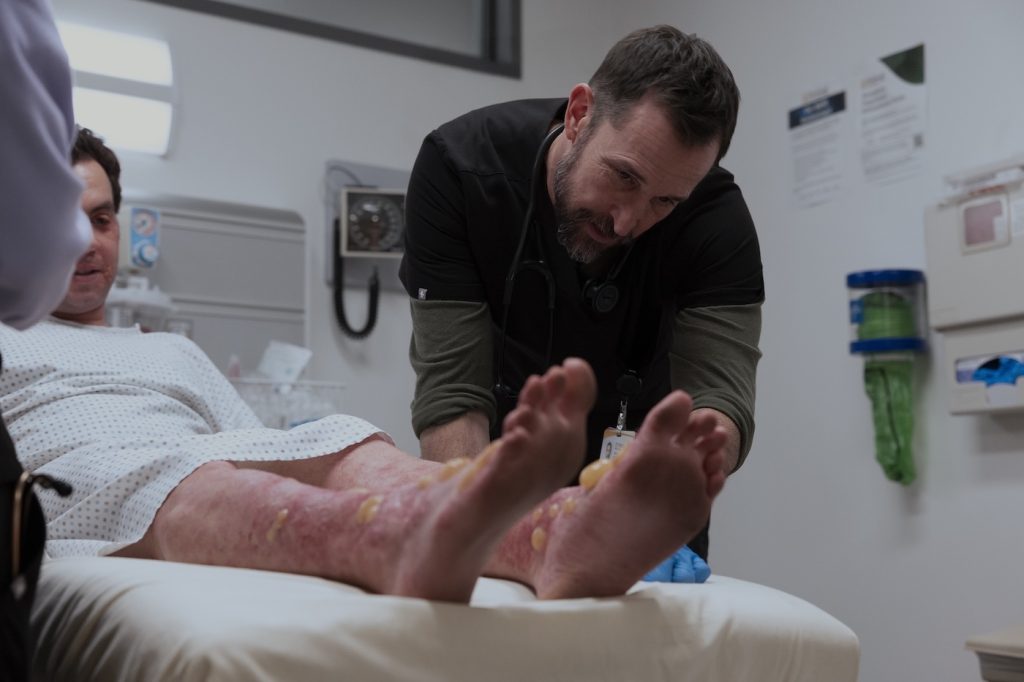
The team’s commitment to authenticity permeates every department. “If you come to our set, it looks like you’ve just walked into the doors of an emergency department,” she said. “There is nothing telling you otherwise…All of our props are real; there are real gauze pads, somebody could probably really do surgery in there, who knows?” The realism is so convincing that Baidwan jokingly offered a practical solution for the apocalypse. “If the apocalypse comes, just head on over to Warner Brothers Stage 22. We got you.”
Among the many storylines explored throughout the series, one stands out as particularly meaningful to Baidwan. She was passionate about introducing a story involving a death doula, offering a perspective on mortality that audiences rarely see portrayed on television. “What if you’re dying?” she remembered asking. “And what does that mean? How do we show that in a thoughtful, loving, beautiful kind of way, that death does not necessarily have to be completely scary and really terrible?”
Research for the storyline revealed how many healthcare workers sought new ways to support patients and families during and after the COVID-19 pandemic. “In talking to them, I realized that there were so many nurses who, during Covid, because they saw so many patients dying alone, saying goodbye to their loved ones on iPads, were wanting to find a compassionate way to care for patients that extended beyond just what the nursing arena did, and a lot of them went into becoming death doulas and really being there for people and their families and being an extension of caregiving in a totally different realm.”
For Baidwan, stories like that exemplify what The Pitt does best: finding humanity amid crisis. And as audiences look ahead to the show’s third season, Baidwan offered a few hints about what’s to come. “We start shooting next Tuesday, and it will take place in the fall,” she revealed. “We’re going to be jumping ahead about four months, so it’ll be November.”
The time jump will allow viewers to see how the characters have evolved during the intervening months. “We’re going to find out some really fun things about each of our characters with respect to what’s going on,” she said. “We dig deeply in our writers’ room about what happened to them in those four or five months off.” One question, at least, remains firmly on fans’ minds. What happened to Robbie? “Robbie’s going to be back,” Baidwan confirmed, “but we’re going to find out if he went on the trip or not, and what transpired in that time off.”
Beyond future storylines, Baidwan hopes viewers ultimately take away something larger from the series. “I hope that it restores people’s faith in humanity,” she said. “That it gives people hope that we can still have faith in our communities and our neighbors, workers, and our country to do the right thing.” In an era often defined by division, The Pitt reminds audiences of what connects them. “Even though we may look and feel and seem so different in so many ways,” Baidwan reflected, “when you really look at people, at their core, we’re actually more common than we are different.”
That belief in human connection may be the show’s most powerful prescription of all.
Watch The Pitt, streaming on HBO Max.
Featured image: Noah Wyle, Ayesha Harris, Alexandra Metz. Photograph by Warrick Page/HBO Max