Production Designer Doug Chiang on his “Star Wars” Blueprint: How Real-World History Shapes “The Mandalorian & Grogu”
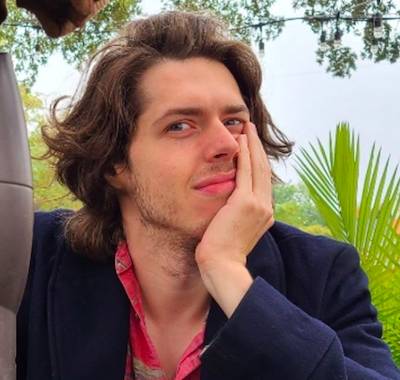
Doug Chiang is the Senior Vice President and Executive Design Director at Lucasfilm. The Academy Award-winner began his career at Industrial Light & Magic in the early ‘90s, working as a creative director. Since then, he’s played many roles in the Star Wars sandbox – including serving as the head of the art department on the prequels, working on designs for games and theme parks, and, under the Disney umbrella, being a major force behind the series’ aesthetic.
Chiang is the production designer for live-action Star Wars shows on Disney+, not to mention his outstanding work recreating the past with Rogue One: A Star Wars Story. Most recently, he deployed his talents on director Jon Favreau’s The Mandalorian & Grogu – an epic space western true to the series’ spirit while expanding it to create a proper, stand-alone cinematic experience. When the Mandalorian (Pedro Pascal) and Grogu search for Jabba the Hutt’s son, Rotta the Hutt (Jeremy Allen White), in exchange for information about the whereabouts of imperial scum, Chiang brings audiences to new and familiar corners of the Star Wars universe.
Chiang takes us on his journey to a galaxy far, far away and explains that, as wild as the world-building is, much of the work remains rooted in Earth.
You’ve been a part of Star Wars for around 30 years now, starting with The Phantom Menace. Both under George Lucas and Disney’s watch, what have you wanted to stay consistent?
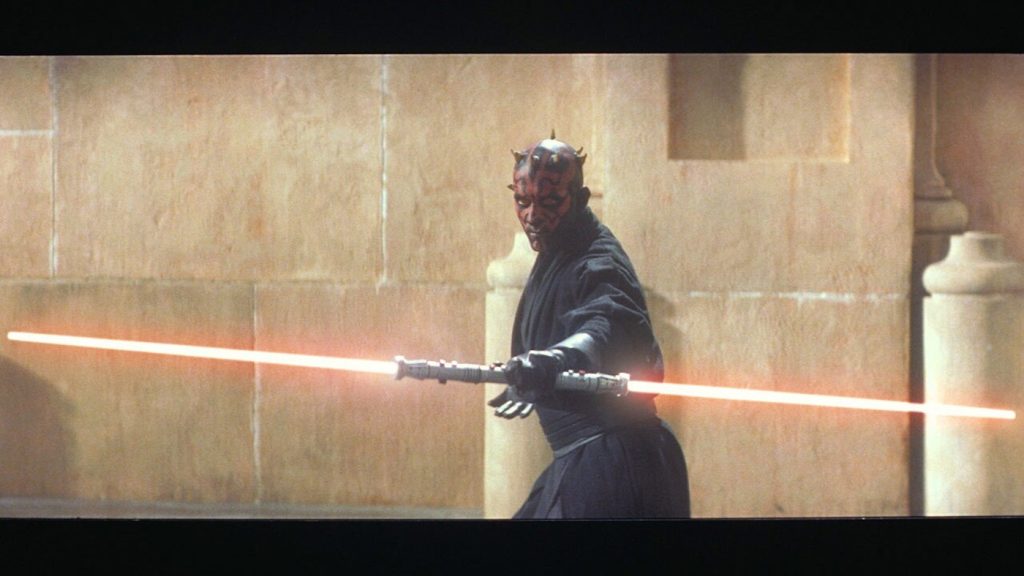
I’ve always tried to stay true to George’s vision. As a fan prior to working with him in 1995, I realized a lot of my assumptions about what makes Star Wars were wrong. Granted, a lot of it was me designing and thinking about my fan version of Star Wars. George had a bigger, broader view of what Star Wars is. It was an important phase of my education, and that’s what allowed us to push the boundaries of designs for the prequels. The prequel aesthetic is very different from the original trilogy aesthetic, and that was on purpose. George wanted to create a design history of the universe to anchor all future designs.
Do you continue to use that anchor?
I’ve been building on that. A lot of the requests he had of me during that first year surprised me. Okay, is this really Star Wars? Can it fit into Star Wars? Now, in hindsight, it absolutely is. It actually gives us a terrific framework moving forward for the sequel films, and now for what we’re doing with The Mandalorian and Grogu in the New Republic era. It is mirroring that design timeline in our history. That was critical because George never thought of Star Wars as science fiction or space opera. He always thought of it as a historical film, like a documentary.
Whether in the past, on the prequels, or production designing for The Mandalorian & Grogu, what’s the balance between reality and fantasy you want to strike?
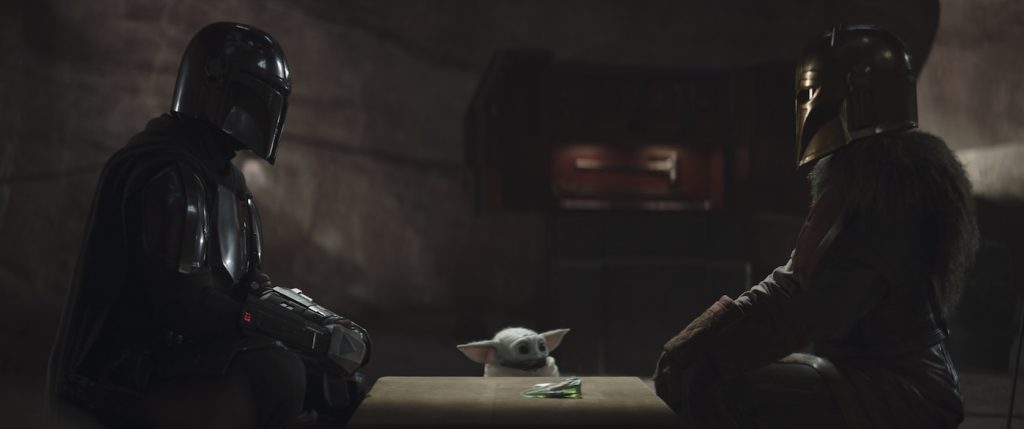
One of the biggest lessons is to never design in a vacuum. Always lean into history, into research. You ground Star Wars design in something that we’re familiar with, even though it’s very exotic. And so, that design philosophy is one I will adhere to moving forward. I try to help guide other filmmakers now to work within this universe because the Star Wars aesthetic is very specific. In the broadest sense, it’s 80% in our reality, but that 20% that makes it Star Wars is unique. You almost have to understand how far to push that 20%.
Which chapters in history did you look at for The Mandalorian and Grogu? What was grounding Star Wars this time?
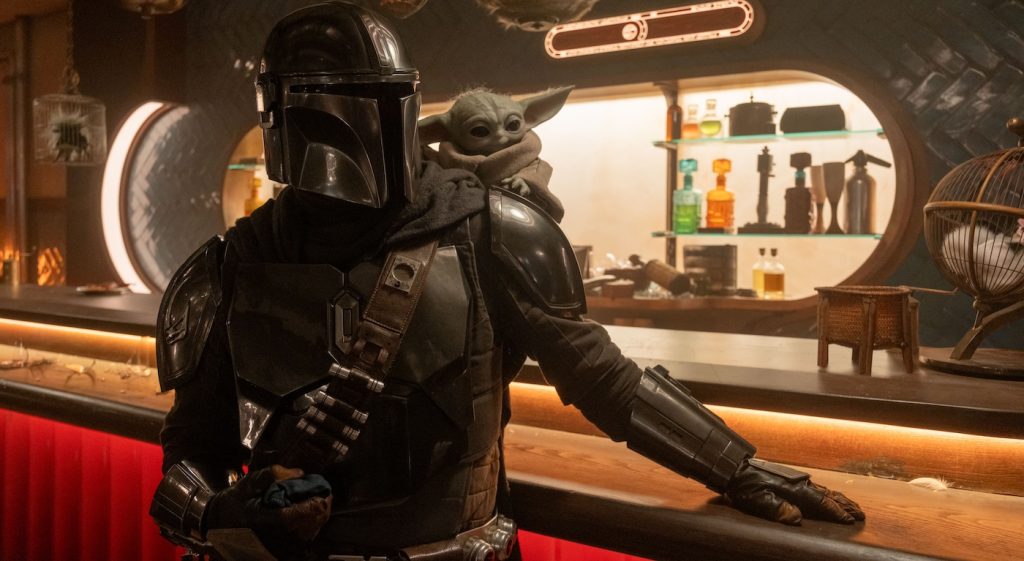
For the moon of Shakari, we discovered a bunch of 1920s photographs of Chicago, old Chicago. Those were terrific because the lighting quality was different. It wasn’t like bright neon or Coruscant; it wasn’t Blade Runner, but it had a distinct tonality. It was almost two color palettes – warm yellow and orange with a cool sky. It was a color palette that spoke to Jon Favreau, who said, “Let’s stick to that simple color palette and apply the same rules to the architecture.”
How did you and the team accomplish that?
We were taking old 1920s Chicago and then amplifying it, adding that 20% to make it more exotic. In essence, it’s keeping the L train but twisting it so the trains hover. They’re slightly different in aesthetics, almost more streamlined-era. Shakari feels familiar, but something in your brain also triggers the feeling that, okay, this is not quite Earth, this is something different. When you can do that, it propels the story forward without taking the audience back and having them question whether this is a real environment?
You want the environment to help suspend disbelief.
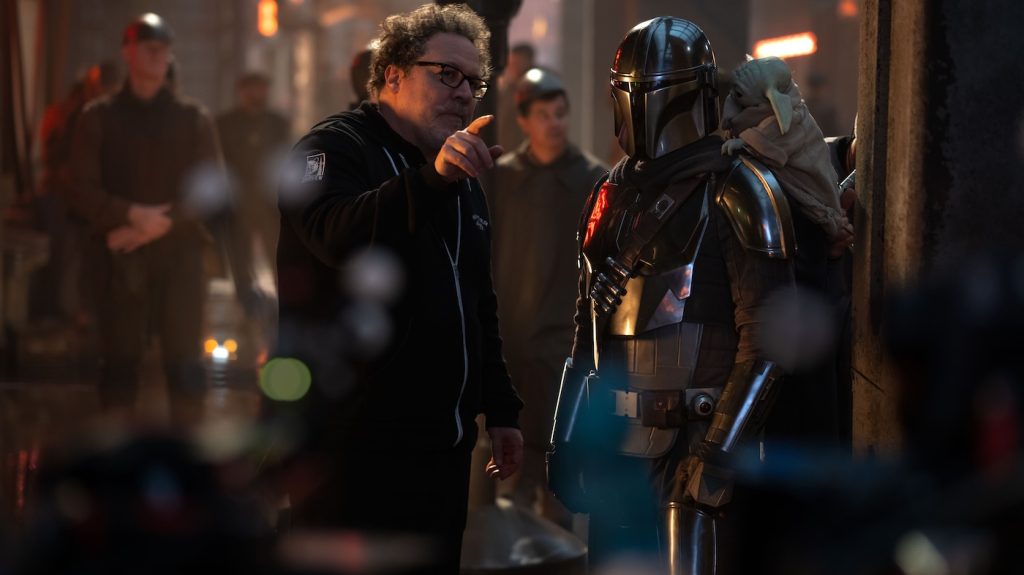
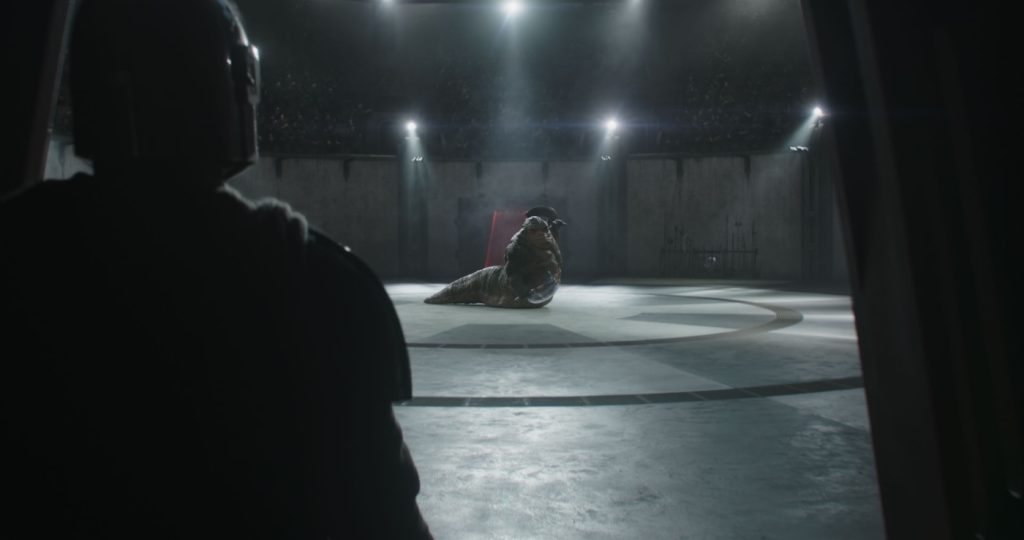
Even though we’re designing everything from scratch because everything has to be fabricated, George wanted the audience to forget about the designs—never call attention to the designs. And then, after the fact, if you ask an audience member, “What was that specific design?” They wouldn’t be able to identify it, but they would say that it just felt real. The Shakari Arena is another good example. What should a gladiatorial arena look like? Obviously, we did our research into Rome, but let’s stick to Chicago, Wrigley Field, and the 1920s. It was the right shape.
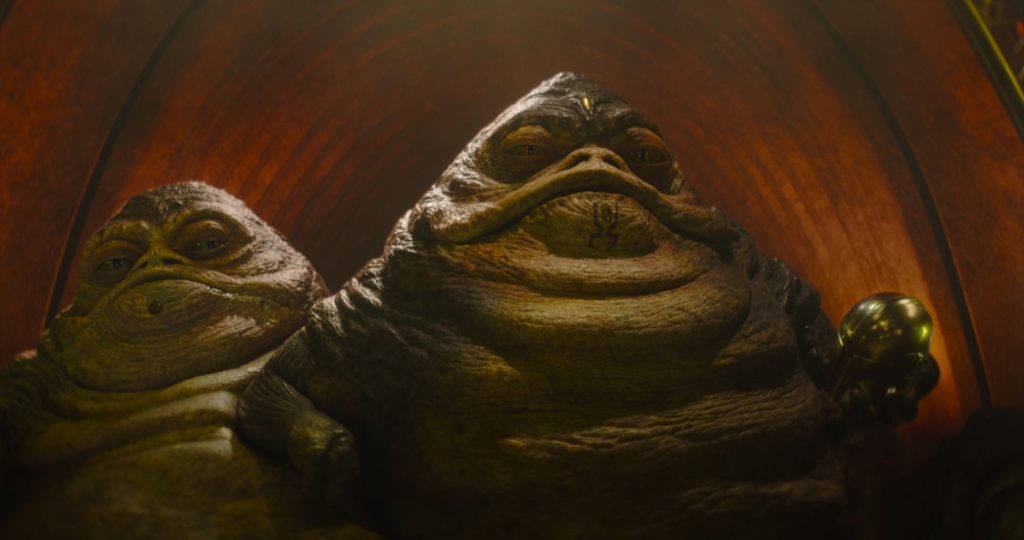
The most alien location in The Mandalorian and Grogu is the home of the Hutt Twins. How do you want to strike the balance between reality and sci-fi on Nal Hutta?
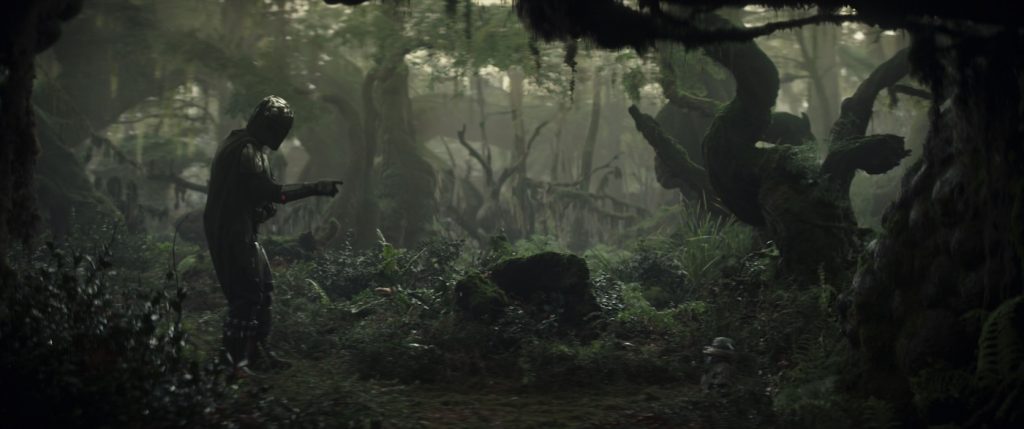
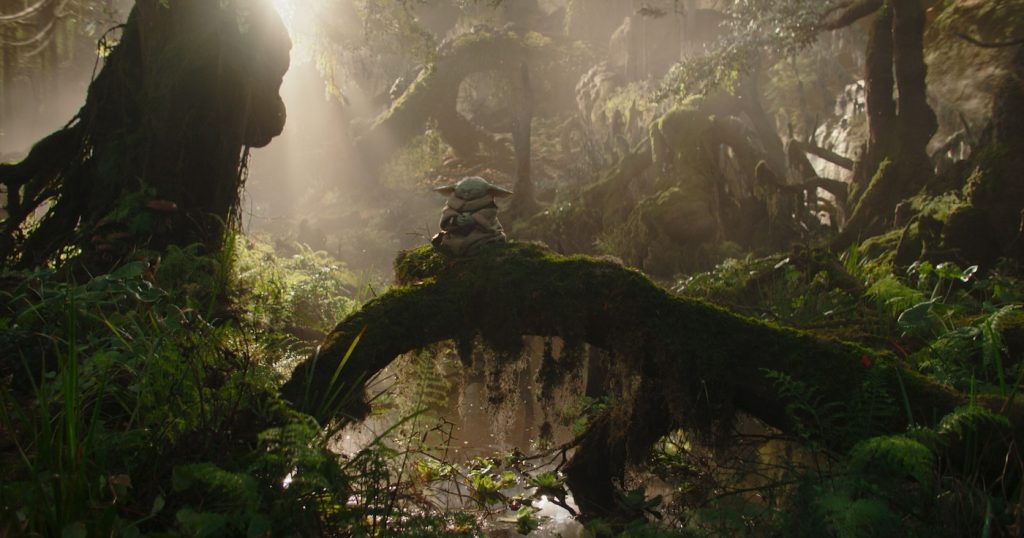
Some of it was already established in The Clone Wars animation, and we kind of used that as the foundation, but how do you bring those fantastic designs into a reality that we can relate to? We applied the same formula. We literally used Earth biomes, swamps, and adding that 20% was increasing the scale. Those mushroom spores you would find in a Louisiana swamp, but we exaggerated the scale. What I love about Star Wars design is that you don’t have to tweak the world that much to make it special.
Did you use the same philosophy for building the Hutts’ palace?
I used the same philosophy, where perhaps they grew this giant mushroom shape, then went in and carved out and built technological infrastructure into it. You see it as a good mix. One of the fun Easter eggs for me was that if you look at the palace on Nal Hutta, it mirrors Jabba’s palace on Tatooine. It’s one giant form – a tower, and a small one. I wanted to lean into that, maybe a bit of an instinctual, emotional connection.
Digital filmmaking and effects today wouldn’t be where they are without the work of ILM and George Lucas. When you started working on the prequels, did you ever imagine the technology leading to what we see in modern blockbusters and Star Wars?
I see a lot of parallels. George was such a visionary in terms of filmmaking and technology. History has proven him right in many ways, both in the aesthetics of Star Wars design and in its technology. What I enjoy now is that many technologies have matured enough that we can pick and choose the best method for what we want to put on the screen. We have everything. We have traditional miniature photography for models. We have stop-motion, puppetry, and obviously, CG. These were all things that weren’t available to George, but he had expected those developments to help his filmmaking process. Now we have access to all those tools. It’s a matter of being responsible and picking and choosing the best one for the job.
Star Wars: The Mandalorian and Grogu is in theaters now.
Featured image: (L-R) The Mandalorian (Pedro Pascal) and Grogu in Lucasfilm’s THE MANDALORIAN AND GROGU. Photo by Francois Duhamel. © 2026 Lucasfilm Ltd™. All Rights Reserved.