“Spider-Noir” Colorist Pankaj Bajpai on Crafting Two Worlds—From Lush Color to Gritty 1930s Monochrome
“Originally our focus was black-and-white and we were committed to making a period piece that had the spirit of that time and era,” senior colorist Pankaj Bajpai tells The Credits about MGM+ and Prime Video’s Spider-Noir, a live-action drama inspired by the comic “Spider-Man Noir,” set in 1930s New York which tells the story of struggling private investigator Ben Reilly (marvelously portrayed by Nicolas Cage). The eight-episode series offers audiences two distinct viewing experiences: “Authentic Black & White” and “True-Hue Full Color.”
It was up to Picture Shop’s Bajpai, whose credits include Ang Lee’s Crouching Tiger, Hidden Dragon, Netflix’s Bridgerton, and HBO’s The Penguin, along with a team that included supporting colorist Rene Karp and Rajiv Bedi and color assistants Solvi Arnason and Melissa Moreno, to help solve those demands.
Asked about how the visual language evolved into two formats, Bajpai explains that it came down to creative decisions. “Phil Lord and Chris Miller were working on Project Hail Mary, and if you’ve seen the film, you know it’s incredibly vibrant and colorful. And so, they were coming into this project with that sensibility.” Lord and Miller (Spider-Man: Into the Spider-Verse) served as executive producers alongside co-showrunners and executive producers Oren Uziel (The Lost City) and Steve Lightfoot (The Punisher). Cage has also said he was an advocate of dual formats as he didn’t want to “turn off” younger viewers who may not be familiar with monochrome.
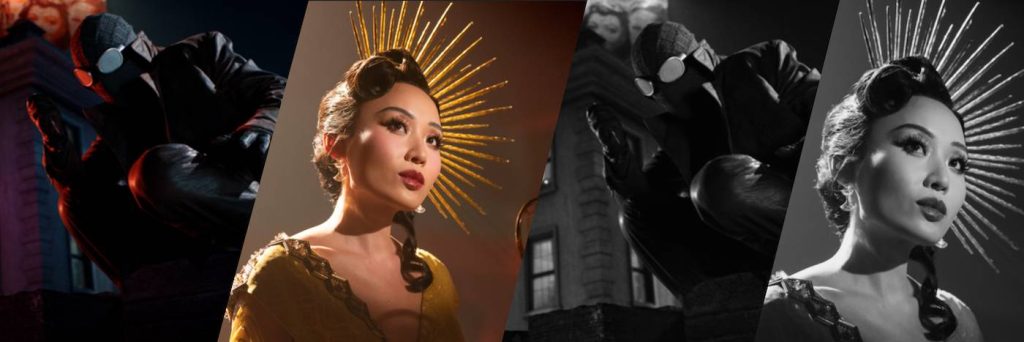
The big question was how to pull it off.
Initial prep for the production design, costumes, sets, and lighting leaned towards black-and-white noir over color – a rare approach for modern productions, as they’ll more often than not shoot in color and then post-process monochrome. See: Godzilla Minus One / Minus Color (2024), The Batman – Noir (2022), and Snyder’s Justice League – Justice is Grey (2021). When the decision came down to introduce color, it meant that department heads, including production designer Warren Alan Young, costume designer Trayce Gigi Field, and DP Darran Tiernan, had to manage workflows to support both formats, as production would capture digital footage for simultaneous processing in both formats.
For the monochromatic version, the colorist was inspired by films of the era. “Nick [Cage] wanted to take Humphrey Bogart and mash him into the Spider-Verse and come up with something new, something challenging. So from a photography standpoint, we watched a lot of movies from that period, like Kubrick’s The Killing and The Lady from Shanghai,” says Bajpai. “For me, creating black and white is still a color process. So the exciting part was how to filter these vibrant colors into analog photography? I ended up creating a process digitally where we took these color images and put them through my knowledge of black and white photography.”
Bajpai worked closely with image scientists on the project to mathematically generate data profiles for different black-and-white film prints – almost like LUTs – including Kodak TRI-X black-and-white film stock. “We were shooting on the Sony Venice 2, and it doesn’t quite translate to black-and-white TRI-X, but also, we weren’t trying to emulate TRI-X but create our own hyper-chromatic, cross-process blend,” he says. “So we took the footage through our black and white analog photography concepts, turning it into our own black and white interpretation.”
For its fifth episode, Bajpai created an additional black-and-white look for a flashback sequence depicting Ben Reilly’s origin as The Spider during the final days of World War I. “We were in a certain period of time, so I went into our basket of goodies, and we have what’s called the ENR process,” he says. The highly controlled print technique was invented by Technicolor chemist Ernesto Novelli Rimo and produces richer blacks, increased contrast, and desaturated colors because light is held back by the silver retained in the film print. The results are significantly different when compared to skip bleach, which generally skips the chemical bleach stage entirely. “Our version was not 100% ENR, but I created my own interpretation, our own blend of silver retention ENR techniques,” Bajpai says.
For the color version, Bajpai admits it was “an enormous amount of work” to make it come together. “When Oren, Darran, and I started talking about a color version, we said it had to be of the same intensity as our black and white. And it also had to be something that distinguishes itself from regular, straightforward color.” While the color version is vivid – especially in sequences featuring Cat Hardy’s (Li Jun Li’s) penthouse residence – it wasn’t as simple as turning up the “saturation to 11,” Bajpai says.
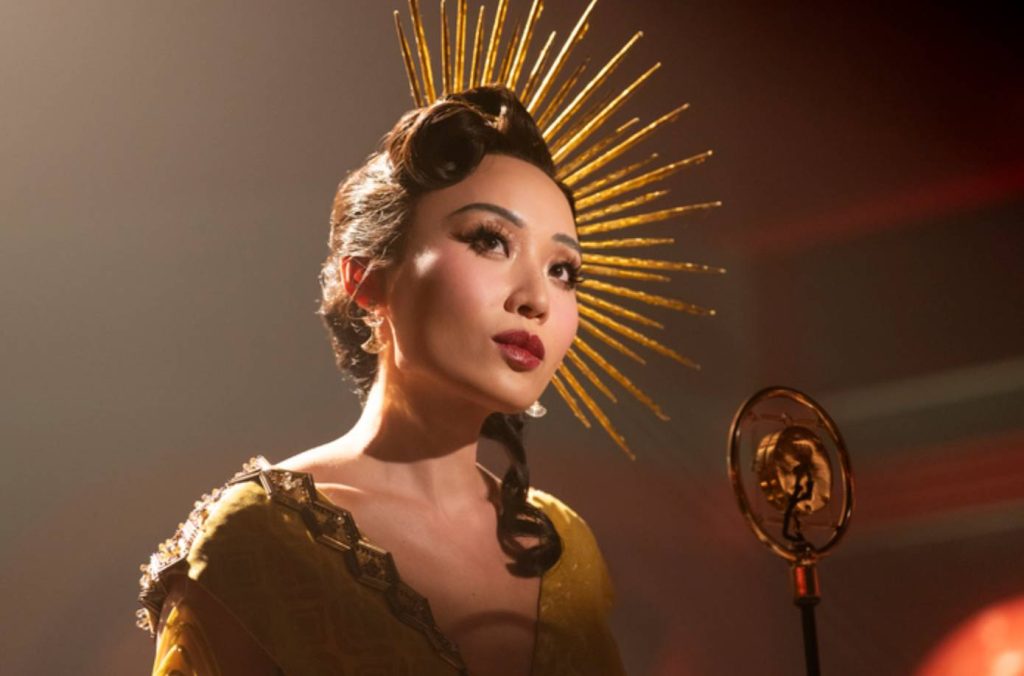
“We were able to utilize the richness of all these color values that were produced on set, and my job was to design the color representation of their work. When you’re watching in color, you want it to have that experience of color, the vibrancy, the joy, and the charm of watching something that’s very comic book-like. And then when you watch in black and white, you’re now looking into the 1930s, but the texture and the emotional response had to be somewhat in the same world. That was the most challenging part of making these two versions.”
Technical approach aside, emotion ultimately guided decisions. “It had to speak to you emotionally. Great actors and their performances needed to come through. So when the producers and everyone at Amazon and Sony were watching, they weren’t really concerned about the process I was bringing to the table. They just wanted to feel that it was working. That the acting, the environment, the way the story was being told was working at the emotional level.”
Spider-Noir is now streaming on MGM+ and Prime Video.
Spider-Noir
Credit: Courtesy of Prime
Copyright: © Amazon Content Services LLC