
Designing Agnes’s Gilead: Martha Sparrow on Crafting Chase Infiniti’s World in “The Testaments”
Out now from Hulu, The Testaments sees Margaret Atwood’s Gilead renewed. Crumbling toward the end of The Handmaid’s Tale, a few years onward, this totalitarian world appears wealthy and assured, now home to a generation that has never known anything beyond its communal violence and physical beauty. Played by Chase Infiniti, Agnes—the daughter of the season’s most powerful commander—narrates this society’s stringent hierarchies and elaborate marriage rituals. With a fertility crisis affecting both Gilead and the outside world, pairing off in Gilead is more critical than ever, and season 1 of The Testaments is essentially a coming-of-age story, as Agnes and her schoolmates age out of Aunt Lydia’s school to be matched to commanders of their own.
But there’s a wrinkle among the teas and dances and transitions from plum to green dresses—the subversive Mayday group is still active, with a mole planted in the form of Daisy (Lucy Halliday), once the daughter of a pair of Toronto vintage shop owners and now a Pearl Girl, or Gilead convert. Elegant homes and a clean, plastic-free environment do nothing to shake Daisy’s horror at Gilead’s internal tyranny, and as much as she’d like to leave, she wants to destroy it more. Shooting at Cinespace Studios and locations in and around Toronto (the vintage store we see on screen is a real Toronto shop called Mrs. Huizenga), The Testaments production designer Martha Sparrow color-coordinated with the show’s costume department and carried over a symmetrical aesthetic from The Handmaid’s Tale to create an idyllic setting that stands in shocking contrast to the way the denizens of this world actually live.
We got to speak with Sparrow about incorporating Gilead’s plastic-free ethos into her design and creating a version of Virginia horse country outside Toronto.
Gilead is a plastic-free world. What did that mean for you in terms of production design?
In Gilead, they’re experiencing a fertility crisis. One of the possible causes, they think, is environmental toxins. And so they’ve made an effort throughout society to live a much more natural lifestyle. One of those things is cutting out plastic. When we’re designing our sets, we have to be very careful about the materials that our furniture and props are made from. We veer towards natural cottons in the curtains. Anything that’s packaged is done so naturally, wrapped in paper. We’re always exploring materials and making sure that we pay attention to that aspect of the Gilead world.
How did you make Agnes’s house a focal point for the surprising beauty in this corner of Gilead?
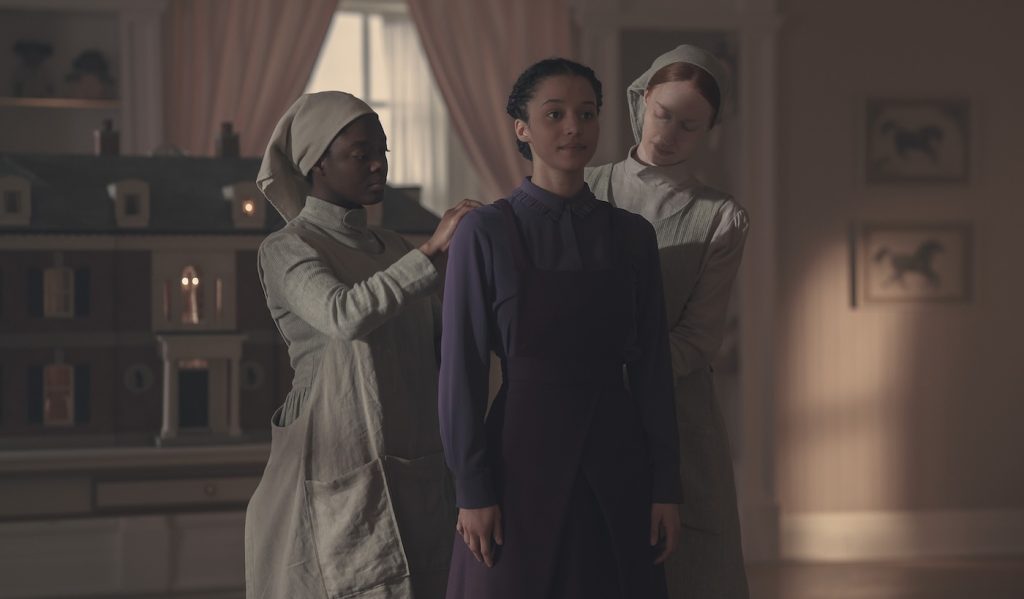
The Mackenzie house belongs to one of the rich commanders. He’s got a very powerful position. He’s living in the vicinity but outside of Washington, and so we wanted to give him a kind of country estate. I was researching equestrian estates in Virginia and Maryland, and the kind of aesthetic that we thought this man might aspire towards—and also, with this house, a level of luxury, a level of status. But we’re also thinking about the visual language that The Handmaid’s Tale initially set up. There’s a lot of symmetry in the way we shoot on The Handmaid’s Tale, especially for the wide shots. And in Testaments, although we’ve developed a different aesthetic for Agnes’s point of view, we wanted to continue with the symmetrical wide-shot approach. The location for the exterior of the Mackenzie house has this beautiful Georgian-inspired facade, where everything is very symmetrical, and it plays nicely into that. And it has a circular driveway, which also plays nicely for all of the action of cars coming in and out. It provided us a lot, visually, to work with.
And that house is actually in Canada?
That was in an area called Caledon, which is north of Toronto, and it’s an area where there are a lot of horse estates.
For the Mackenzie interiors, did you coordinate with the costume department regarding color schemes?
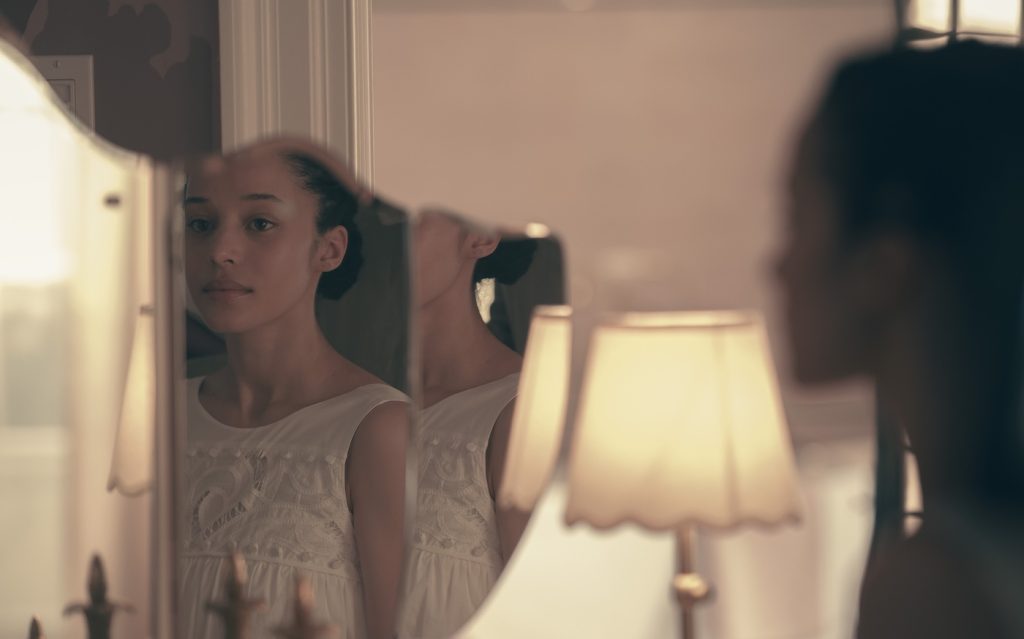
Absolutely. Each role in society has a uniform of a different color. And now that we’re getting into the world of the girls, we’re adding in on top of what we saw in The Handmaid’s Tale, which is the teal of the wives and the red of the handmaids. We’re also adding in the plum of the teenage girls and then the pinks of the younger girls. It starts to get very colorful, so there’s a lot of consideration about how the backgrounds and rooms should envelop those colors without getting too overwhelming. But in Agnes’s bedroom, we really leaned into the plum color and the pink. We tried many different versions of the color scheme for the murals we designed in that room, and we camera-tested all of them with the different costume colors. We tried different plum shades for the costume as well, until we found what we thought would be the nicest combination. One of the biggest considerations was what happens to those colors in different lighting scenarios, because we’re trying to plan for day and night.
And how do you use residential space to convey the story? For example, Agnes’s friend Penny’s house, where she lives with her commander husband, is distinct from Agnes’s home.
The idea there was to have the girls go in and see this life that their friend Penny has adopted, and for them to think forward to their future in a very optimistic way. The way that Judd was portrayed, too, is that he’s kind of cool. He’s a little bit younger. He’s permitting them to have this little party together. And so it’s this idea that in the beginning of the series, they’re really looking forward to what they’re about to step into. They can imagine being the head of a household and having a hot young husband, and they’re very excited about it. So that house, it wanted to be nice, but definitely not as lavish as Agnes’s parents’.
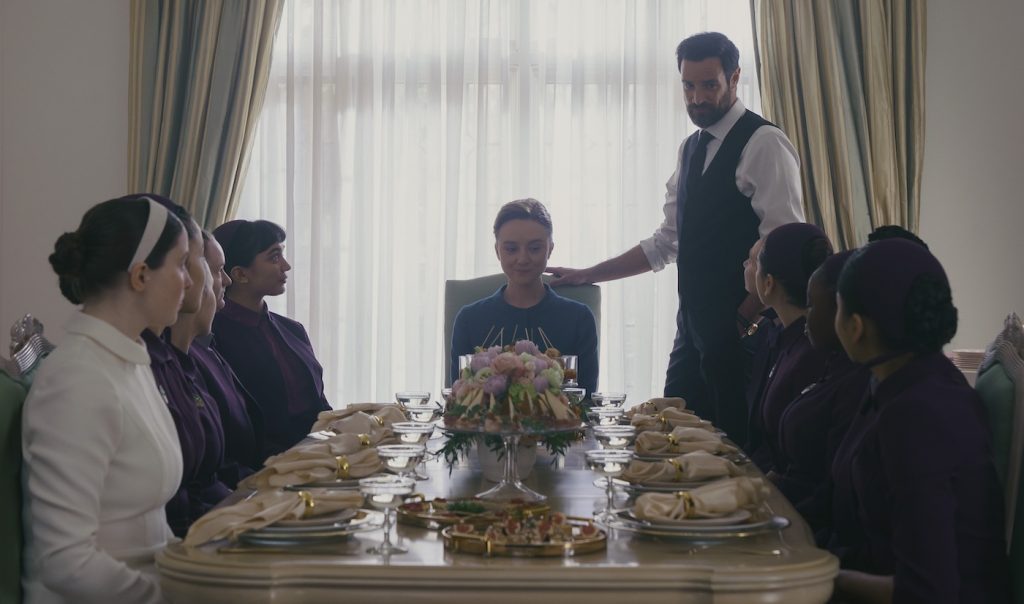
LUCY HALLIDAY, ISOLDE ARDIES, ROWAN BLANCHARD, ELLEN OLIVIA, CHARLIE CARRICK
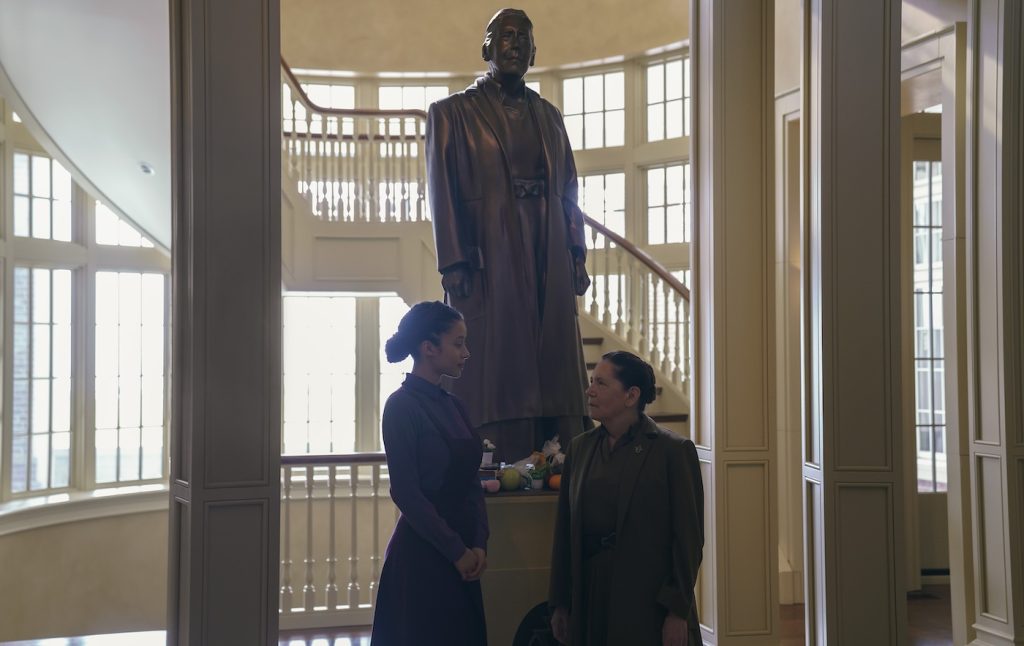
What was the approach to the grandeur of Aunt Lydia’s school?
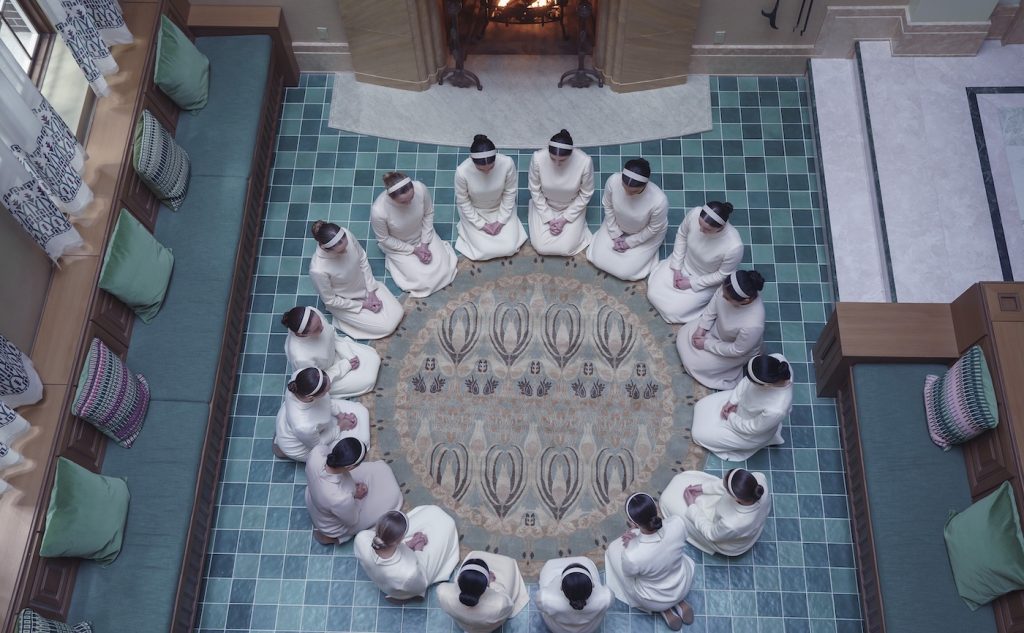
There were a few desires for the school. One of the directives was to make sure the girls in the school felt like little girls and felt quite small. In the design of the sets that we built, we did kind of over-scale the space. But where we began with the process of designing the school was to look for a location to play for the exterior. We knew we wanted it to feel like an enclosed compound where they would be safe, and we could have this gated entrance. And then we wanted it to have a wealthy appeal, like a very grand property, because these are supposed to be the most powerful of the daughters of Gilead. We found this amazing estate just outside of Toronto, to the west of the city, on the water. It’s actually a huge private residence. It’s one of the most expensive houses in Canada. And the owner, his mother was a big Margaret Atwood fan, and so they were excited to be part of the show.
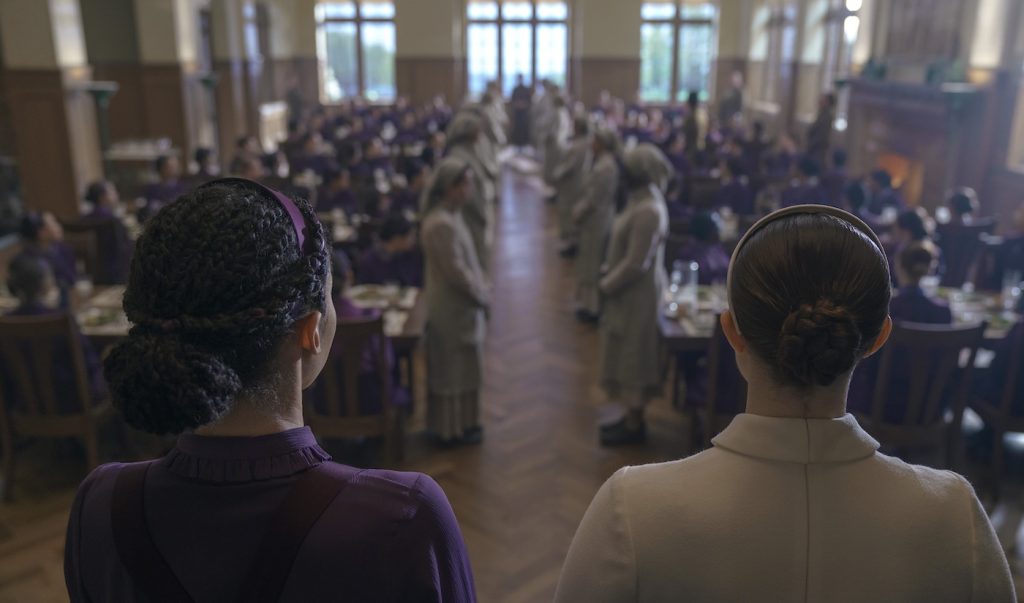
Were there interiors from the school that had to be built?
We built the dining hall on stage, and we used elements from the location to tie into that build. If you’re looking at the back of the estate, which plays as the back of the school, the windows match in the dining hall. From there, I had certain aesthetic things in mind, based on some research and this idea of a more beautiful school and a place that had a very aspirational quality to it.
How do you do research for a show like The Testaments?
It’s all visual research. I have a master’s in architecture, and I always look at history. I’m always pulling from different historical sources. It’s really thinking about the character of the space and the people who created it, and what their aspirations might be. But when I’m thinking about those aspirations as to what they might have built, I’m thinking about who else in history might have had a similar mindset. It’s a very visual thing: collecting images, examining them, and pulling them apart. A lot of it’s about materiality, marbles and textures, which I know the camera will like. Combining that with the colors, it’s sort of like making a cake, mixing things together—definitely not a precise science.
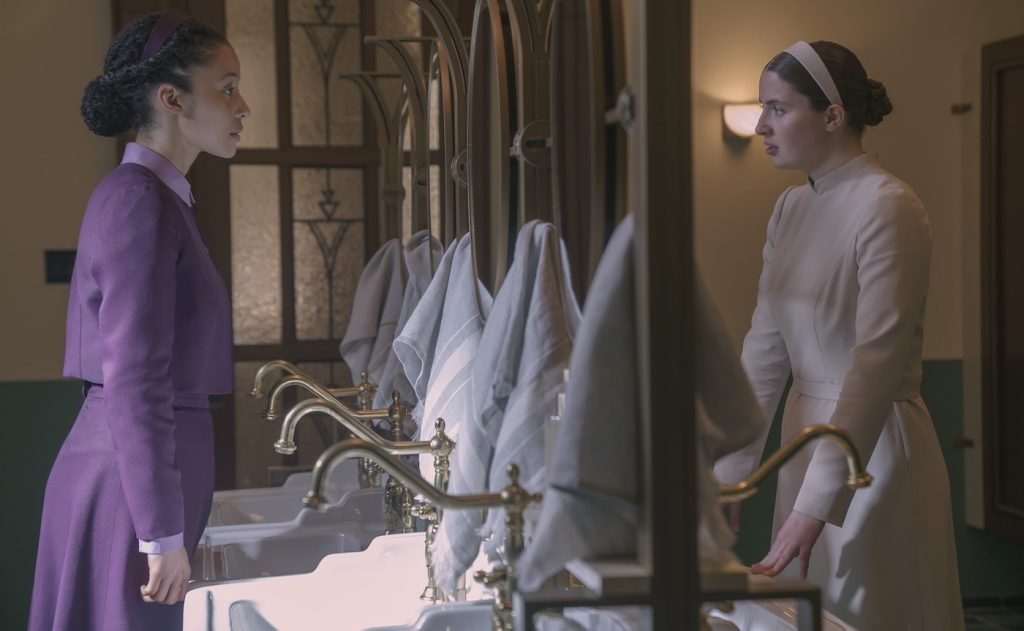
I was reminded of Shaker spaces a few times, though in a more luxurious form.
Some of that comes from this idea of returning to a more natural way of building. Some of our furniture was made by Mennonite builders. We’re looking to return to this craft aesthetic. Some of it also has to do with this idea of religious purity. It’s pulling out what the visual signifiers have been in the past, but then also thinking that they still have modern technology. How do we incorporate that into this world in a way that it’s not strictly a period piece? We’re not going back to a Victorian or a Shaker era. They use electric cars, for example, so the vehicles look a little more modern than you might expect for the show’s aesthetic.
Featured image: THE TESTAMENTS – “Precious Flowers” – In the halls of Aunt Lydia’s premarital preparatory academy, the finest in Gilead, Agnes is assigned to mentor a new Pearl Girl, and a fragile alliance begins. (Disney/Russ Martin) CHASE INFINITI.