Production Designer Grace Yun on Power, Class, and Conflict in “Beef” Season 2
The second season in the Netflix anthology series Beef, created by Lee Sung Jin, is set among the genteel confines of the Monte Vista Point Country Club, in Montecito, California. Run by Josh (Oscar Isaac) and decorated by his wife, Lindsay (Carey Mulligan), the club appears to be a chintz-filled idyll with two consummate professionals at the helm. But the couple’s marriage is all but over, and when two young club employees, Austin (Charles Melton) and Ashley (Cailee Spaeny), catch and film them in a vicious argument, both couples’ lives come apart. Accelerating their demise is the arrival of the club’s new owner from Korea, Chairwoman Park (Youn Yuh-jung), a shrewd businesswoman likewise grappling with a growing set of intractable problems.
Beef was shot on locations and soundstages in and around Los Angeles, with production designer Grace Yun (Beef’s first season, Past Lives, Hereditary), working with a dozen local vendors to bring the posh club and three aesthetically distinct home environments to life. Because they’ve never fully moved in and their marriage is perpetually on the rocks, Lindsay and Josh live with drywall, an overabundance of colorful decor, and separate quarters in the same home. Young and under-earning, Austin and Ashley’s simple home environment reflects their youth and meager salaries. Opposite both couples is Chairwoman Park, who resides in serene, colorless luxury that’s as frill-free as her demeanor.
Yun spoke with us about designing these spaces to contrast with one another, shooting in both Los Angeles and Korea, and building a country club from the ground up.
What was the starting point for designing the world of the Monte Vista Club?
Country clubs, in general, are spaces I have not personally experienced, except through films and TV shows, mostly from the ’80s and ’90s. I got a rare chance to go on this field trip with Sunny [Lee Sung Jin], a trip he organized with the cast and the creative heads of departments to tour country clubs. It was really eye-opening—the theme of eternal summer, the gardens being perpetually manicured, and having all the members’ needs catered to. And then there was the narrative character slant from Lindsay’s perspective that needed to be applied, along with her influences and taste. The next layer was Chairwoman Park’s adverse reaction to that type of decor style, and to make sure it felt quite distinct from her own personal style and the feeling and motifs that we used for all the Korean sets.

The club is fully Lindsay’s vision before Chairwoman Park takes over. How did you make it hers?
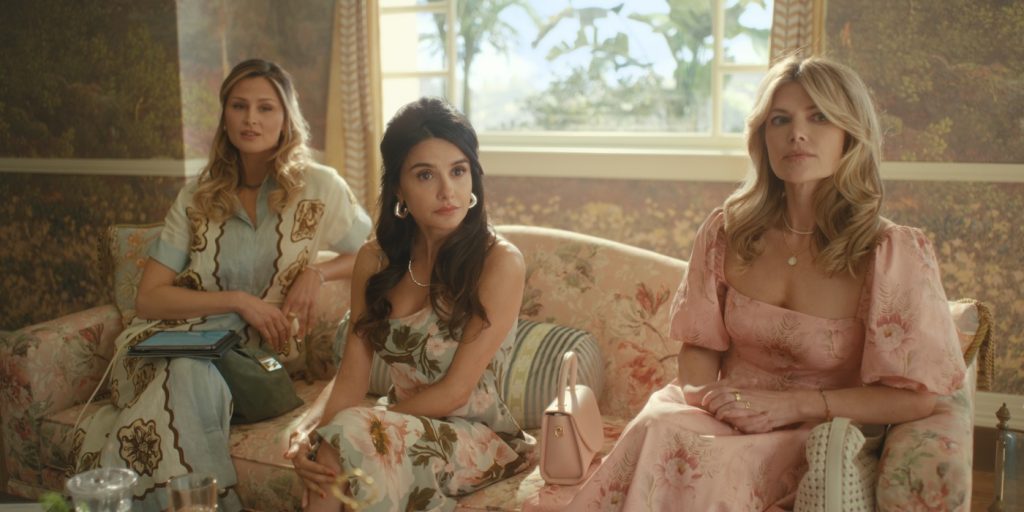
The banquet hall was on a stage. I borrowed certain motifs that I saw at some of the amalgam of locations that we were choosing for the exterior, such as the arched windows, the white stucco, the whitewash walls, some of the grander features of high ceilings, and a fireplace. And then for the decor elements, I looked into classical furniture shapes that you might see in a club. We have those tufted club sofas, but they’re in a lighter caramel color. All of Lindsay’s patterns and fabrics lean toward floral and plaids, within a summer pastel palette. I got to do some fun traditional window treatments. It was an endeavor to bring it all together, but quite a lot of fun.
How did you play Lindsay’s lived-in design perspective off Chairwoman Park’s elegance?
I really zeroed in on Chairwoman Park saying, “It feels colonial,” and Lindsay’s character being like, “Oh, thank you,” as if that’s a compliment. And for Chairwoman Park, it’s not. There’s a bit of this East-meets-West kind of clash that’s going on. What Lindsay feels comfortable with, what she grew up with, borrows from these more Western, established interior design eras. A nod to a bit of neoclassical, but also a California aesthetic, along with British cottage chic. Chairwoman Park is way more into a minimalist, limited-palette aesthetic, something that feels quite clean, orderly, and icy.
How did you create the three primary home environments?
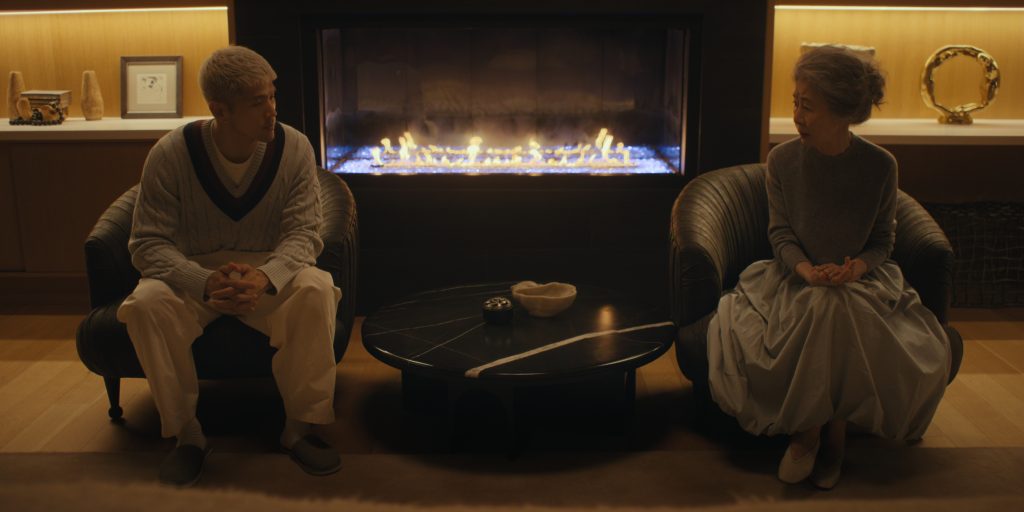
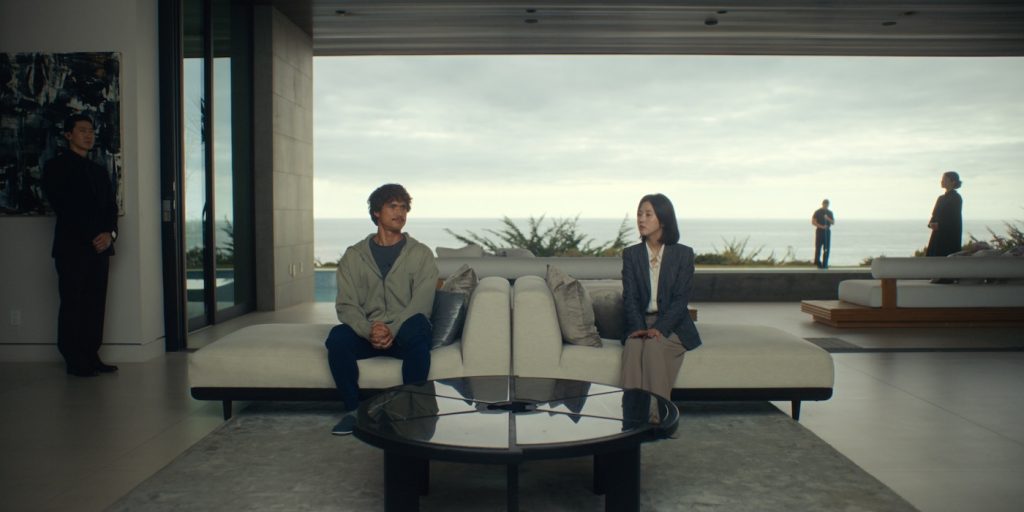
Chairwoman Park was at this really gorgeous location in Malibu. We wanted something that was close to the water, but felt like it could not be too far a drive from the club itself. She needed to have something luxurious and convenient, and also within her style. So there are lots of blacks and grays, and like you said, not a lived-in feel. Very minimalist, clean, ordered, curated-feeling with a great, gorgeous vista of the ocean.
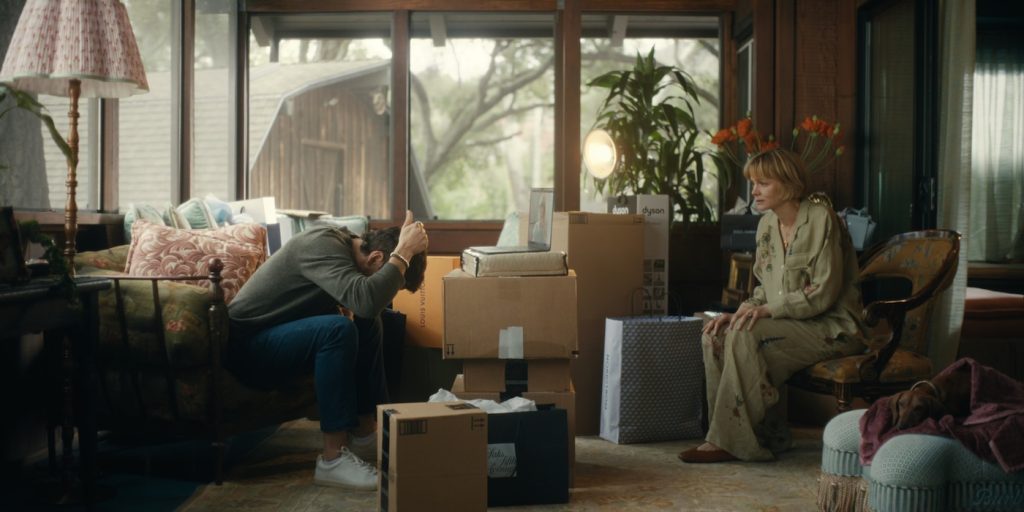
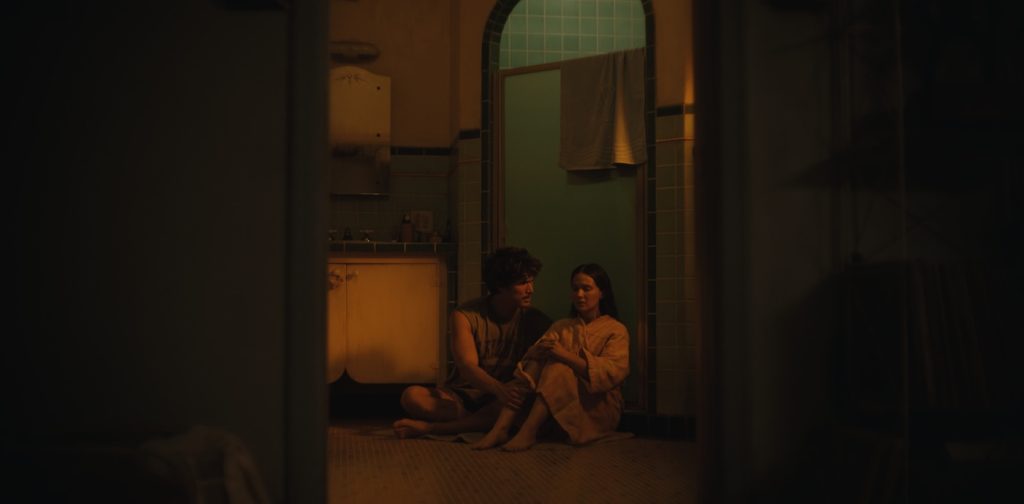
And then for Lindsay and Josh’s home, that was on location. Pretty much every surface in that house we covered, painted, or redid. We also brought in the work-in-progress textures. Even the drywall color was made a custom color, just so that it would fit in more seamlessly with Josh and Lindsay’s deeper, more autumnal palette. And then Ashley and Austin’s exterior was on location, and the interior was on a stage built.
How did you handle separating Josh and Lindsay within their home?
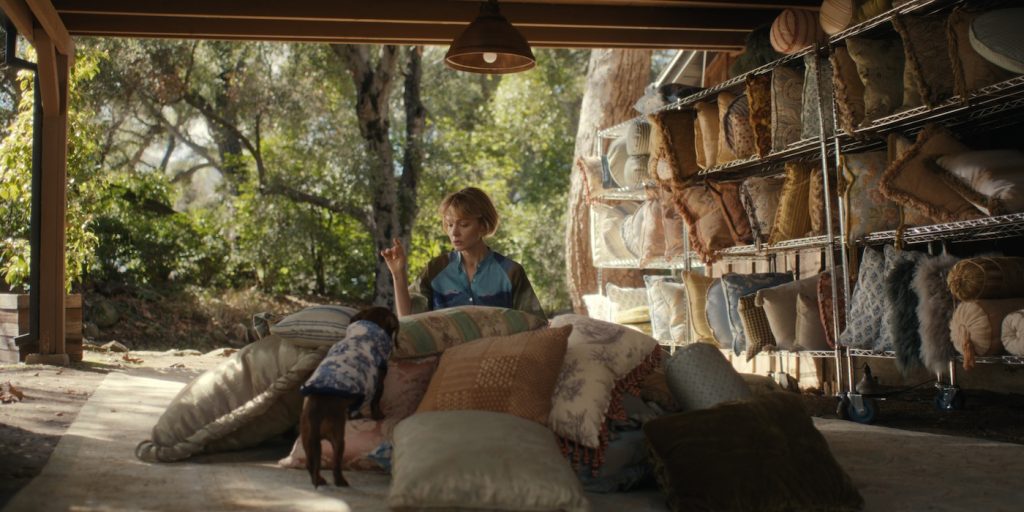
From the beginning, Sunny had talked about and scripted that Josh had a separate space from Lindsay. We really talked about how Lindsay’s penchant for collecting things and being occupied in this decorator persona overtook their main space. They’re kind of drowning in objects and fabrics. My set decorator and I took the approach that she was using it as a coping mechanism. All of her pillows are some sort of tactile comfort therapy for the emotional stagnation that she feels in her relationship with Josh.
It was important that Josh’s space felt all his own, filled with his hobbies and things he loves, the memorabilia, his music station, his clothes, and leftover objects he hasn’t unpacked yet because they’re in this unfinished state. He clearly sleeps there, makes his coffee there, winds down, and has a drink there. There’s a bar. It’s this makeshift, almost studio apartment for him, where he can be himself and be out of Lindsay’s way.
Did you work with any local vendors in California to bring the different environments to life?
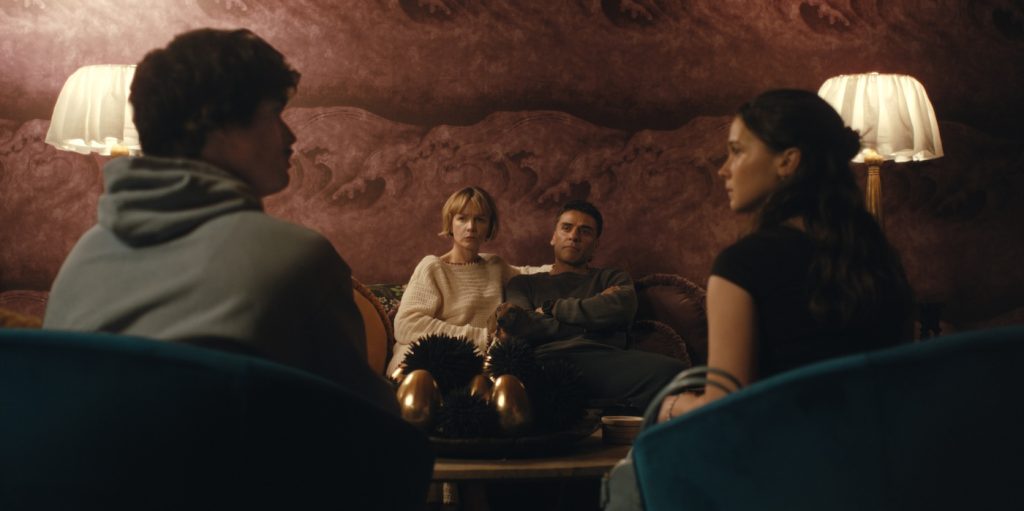
For sure. For instance, we worked with Walnut Wallpaper on the wave wallpaper that is in Josh and Lindsay’s house. They had this beautiful pattern already, and I wanted to manipulate the color and the scale of it. Our graphic designer did mock-ups and tweaks and worked with Walnut, and that was quite seamless. The textile fabric on the custom sofa directly underneath the wallpaper is from Walnut as well.
When we get to Trochos in Korea, the characters enter a very different world.
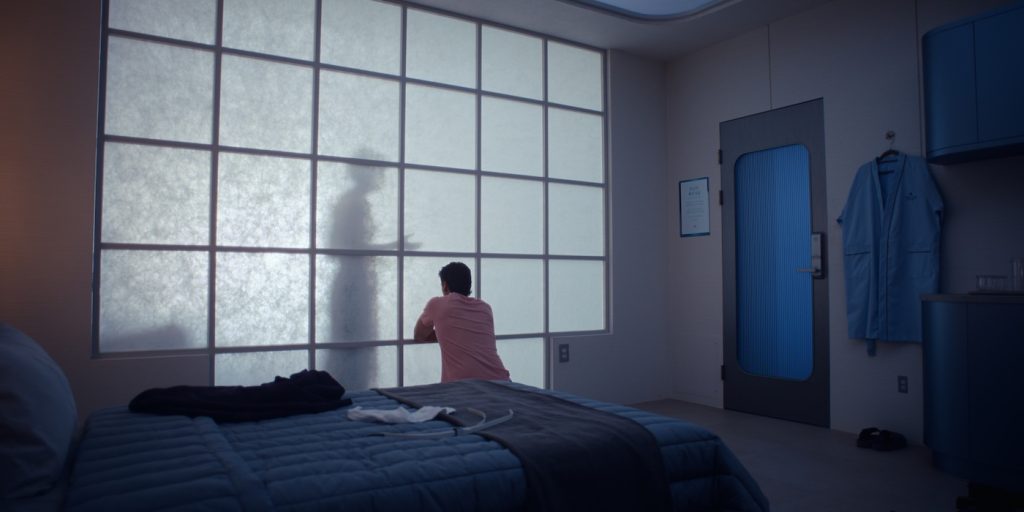
It was one of the more heightened moments, [between] all the action and the really beautifully, emotionally connected moments that happen there. When Sunny was describing how the characters would be trapped, [while] finally being vulnerable and opening up with each other, we discussed this divider wall that had a translucency, so that their vision of each other would be obscured, but we can still feel the silhouettes. What that’s trying to convey is that they’re connecting more on a deeper level rather than just seeing the facade of who they are to each other. It was important to test those materials and to work with James Laxton, our cinematographer, to make sure the lighting conditions were able to pull that type of silhouette off.
And then that segues into action.
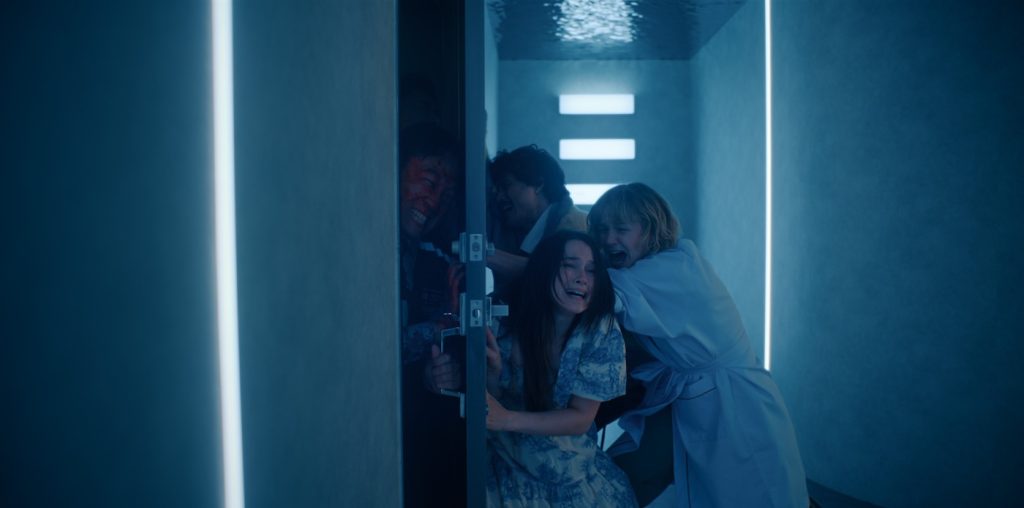
For the action sequence, I came up with this theory that maybe it’s just one large operating room, and there are these individual stations where Dr. Park can visit each patient. But the patient is already under, so they’re not quite aware that there are multiple surgeries happening all at once. There’s a secrecy there, a darkness there. We wanted it to feel moody and also distinct from the textures and the strong color palette that we see in LA. Everything in the Korea sequences was built using materials from that region. I wanted to make sure we’re pulling those textures from Korean companies or Japanese companies.
How was shooting in Korea?
It was my second time working in Korea on a project, and this time around, it was just so dreamy. We were initially only going to shoot in Korea for a short time, on location. It was decided late in the process that we would build. That build was simultaneously designed, sourced, and erected in two weeks. It was quite a feat. I just want to give a lot of credit and recognition to the Korean crew and my Korean art department that pulled it off. There were a lot of late nights. I’m so happy we ended up building it because Jake [Schreier, the director] and Sunny really utilized that space to its full, maximum advantage.
Beef season 2 is streaming on Netflix.
Featured image: Beef. (L to R) Charles Melton as Austin Davis, Cailee Spaeny as Ashley Miller, Carey Mulligan as Lindsay Crane-Martin, Oscar Isaac as Josh Martin in episode 202 of Beef. Cr. Courtesy of Netflix © 2026