From Page to Orbit: Screenwriter Drew Goddard on Adapting “Project Hail Mary” for the Big Screen
As much as critics love the film adaptation of Andy Weir’s bestselling high-stakes science fiction thriller Project Hail Mary, early screenings have shown audiences are loving it even more. The crowd pleaser has garnered a nearly unheard-of 95% audience score on Rotten Tomatoes. That’s great news for theaters around the country—Project Hail Mary delivered on its promise this past weekend, opening to an A+ year-best $80.5 million domestically, the best-ever opening for Amazon MGM Studios.
Ryan Gosling stars as the film’s lead character, Ryland Grace, a doctor of molecular biology and a middle school teacher who wakes up in space with no memory. In time, he gets flashes of his past and slowly recalls his mission, which is to solve why a mysterious substance is killing suns across the galaxy and threatening life on Earth. He thinks he has to decipher the solution alone until he discovers an alien with the same task. Can Grace and the alien he names ‘Rocky’ save their worlds by working together?
Andy Weir sent his manuscript of Project Hail Mary to Ryan Gosling even before the book was published, asking him to act as producer for the film adaptation. Gosling said yes, and immediately brought on Academy Award-winning directing team Phil Lord and Christopher Miller (Spider-Man: Into the Spider-Verse, The Lego Movie). They so wanted screenwriter Drew Goddard, Academy Award-nominated for The Martian, also adapted from a Weir novel, that they waited until he was available to begin production. The Credits spoke to Goddard about bringing this newest Weir success to the screen while maintaining the humor, pathos, and heart that made the book such a global fan favorite.
In Project Hail Mary, Grace’s character arc plays out backwards, and in both the book and the film, we learn things at the same time Grace does. Can you say what you can about how that affected how you wrote and developed the film’s emotional arcs?
The book follows the same structure as the movie, with our main character, Grace, waking up on a spaceship and having little memory of how he got there. We’re telling the story both in the past and the present. He’s trying to figure out what he’s supposed to do on that spaceship, and his memories are slowly coming back to him over time. At a certain point in the book, about two-thirds of the way through, he remembers what happened. I remember when I read it, the hair stood up on the back of my neck, and I thought, “Oh, I have to do this movie.” I loved it. I also knew it was the sort of thing that had to be protected, because I’ve done this enough now as a screenwriter to know the interesting things tend to get squeezed out if you’re not careful, because they’re different, and this was different. The first conversation I had with Andy, Chris, and Phil was that we have to protect that at all costs, because that is one of the 10 things that make this story thrilling and unique. We really built around those big moments, and that was the biggest of them.
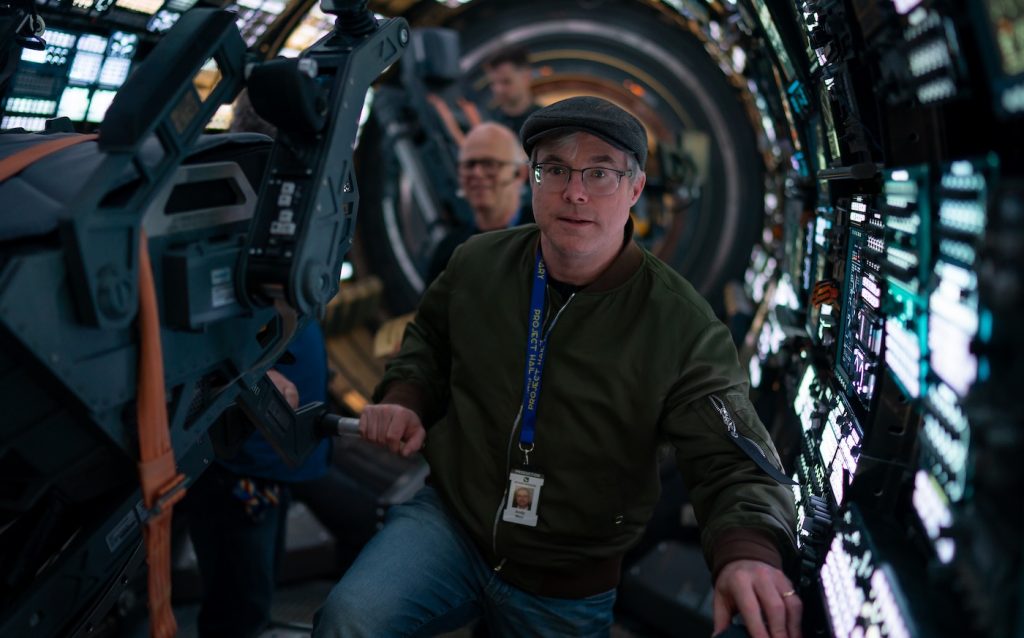
Photo credit: Jonathan Olley © 2026 Amazon Content Services LLC. All Rights Reserved.
It’s about the past and present informing each other, and, by extension, the audience.
Right. One of the things I loved about this story is that it appears that we’re just doing a standard flashback structure, but slowly but surely, it becomes clear these aren’t just flashbacks. It’s a conversation between the past and the present that speaks to a larger truth about the meaning of life. What does life mean without interaction with the other? What does it mean to look outward rather than inward? These are all big themes that become part of the conversation between past and present in the film.
Another beauty of the film is that it realistically portrays the teacher as a superhero, someone who might save the world.
This movie adaptation is just filled with the joy of teaching. I mentioned that the big reveals were the first things to make the hair on the back of my neck stand up. The other thing that made my heart swell when I read the book was that Grace is a school teacher. He’s not that square-jawed hero. My mom has been teaching school for 50 years, and I think we should all jump at any chance to celebrate teachers. I was so excited to tell a story of a teacher saving the world, flying around on spaceships, and interacting with aliens, and it’s so perfect for the big themes of this movie. What I love about teachers is that they all love learning. You can’t be a great teacher if you don’t love your students, right? That suggests that, as a teacher, you’re already reaching out to others. That’s what’s happening in this movie. It’s about communication and teaching, but the roles of student and teacher often switch back and forth. That’s part of the joy of this. We’re all teachers and students, should we choose to be.
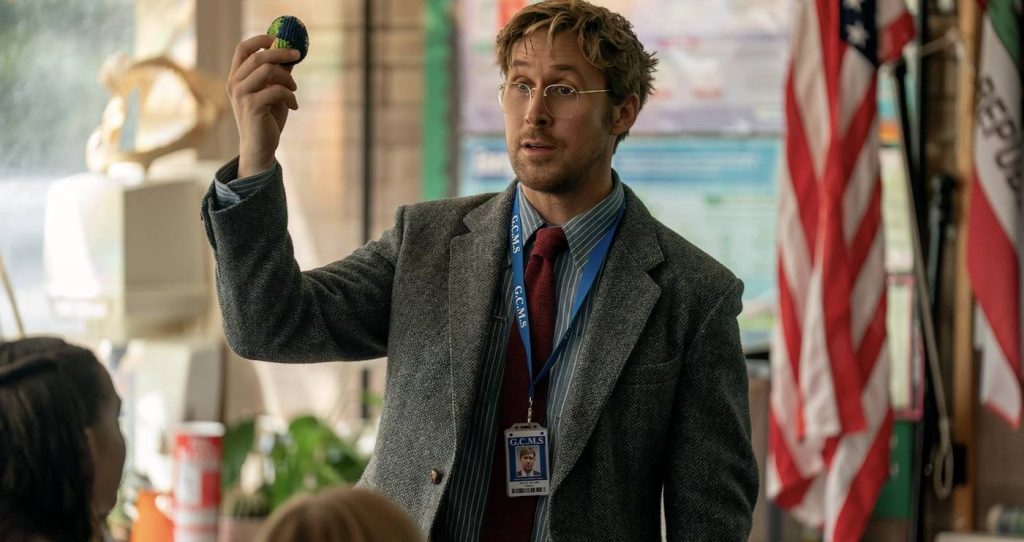
Photo credit: Jonathan Olley © 2025 Amazon Content Services LLC. All Rights Reserved.
These characters aren’t going to get where they need to go without being open and curious with each other.
They’re not going to survive unless they figure out how to empathize and see the world from the other’s point of view. They have to learn about each other to survive in this movie. I would take it even further: it’s not just that they have to teach, but that good teachers have to learn. Good teachers have to love teaching, and they have to love learning. That love becomes the emotional soul of the movie.
Rocky’s character is described by Grace as a dog-sized spider made of rocks. What were the challenges of having a sympathetic protagonist with those characteristics?
Every day I was grateful that I had Chris and Phil. Even when I first read the book, Chris and Phil were already attached, so I knew I’d be working with them. I’ve known them for two decades, and I don’t know anybody else who could have pulled off Rocky. He’s a spider-rock crab that can’t exist in our atmosphere. That alone makes it challenging. He doesn’t have a face, and speaks in whale songs, but I knew Chris and Phil could pull it off, because they have this background in the animation world, and there’s nothing they can’t do. Their brains don’t accept the constraints that our brains would. I’m thinking about what the story might look like when we’re standing on set, whereas they treat the set the way they treat their animation, which is, “if we can dream it, we can make it. Let’s just figure it out.” That’s thrilling to be around. They treated Rocky like this three-dimensional character, not thinking about a green screen. The CGI version exists to do things a puppet can’t do, but the design of the puppet, the puppet itself, and the puppeteers are just exquisite. It really was this magical work that I still don’t know how they pulled off.
How did you develop the relationship between Grace and Rocky? It’s so central to the story.
The most important part was not to make it easy. We had to start with the basics. How do you describe counting or sharing math with a character that doesn’t have eyes? The very challenges to that are going to be the point, which is that communication and empathy are not always easy; they become more satisfying through the struggle. That was key to us.
Project Hail Mary got incredible reviews, which energized audiences, but why do you think people should see this film, and see it in theaters?
Well, it’s about one person and one alien from opposite ends of the galaxy coming together to find common ground. It’s bristling with empathy, compassion, care, and kindness. It speaks to a lot of things that make us human and that are worth celebrating right now. All of us involved in making this love movie theaters, but it falls on us as filmmakers to give you a reason to go see Project Hail Mary on the big screen. We tried to make it as thrilling as possible, but also as emotional an experience as you can have, because your time is valuable and we want you to have a wonderful time in the theater. Our goal was to make you feel what readers of the book felt. We’re going to make you laugh, and we’re going to break your heart. We’re going to celebrate some of the lovely qualities that bring us together, like empathy, like compassion, and give you a good time at the theater.
Project Hail Mary is now in theaters nationwide.