How Simon Franglen Brought Punk Energy and Mongolian Instruments to “Avatar: Fire and Ash”
The audible experience of an Avatar film is as ambitious as the groundbreaking visuals. With both familiar and otherworldly cues, composer Simon Franglen develops textured cues and themes that draw audiences into the story. Together with the sound effects, Franglen, his orchestra, and collaborators deliver another transportive score in James Cameron’s Avatar: Fire and Ash.
As vast as the world of Pandora is, the experience for Franglen scoring these mammoth spectacles is counterintuitively intimate. “There is a thing that Jim [Cameron] and I called the sh** art boundary—which is everything up to 99% is shit, and then there is art,” Franglen told The Credits. “And that’s the requirement for writing music for this. I have to hit 100%. The great thing about it is that I literally only have two people to please. First, I have to please myself—I will not play something for Jim until I’m happy. He wants it when it’s right. Once I’m happy, then I play it for Jim.”
The composer wrote over 2,000 pages of music to hit that 100% for the latest epic, which sees Jake Sully (Sam Worthington), Neytiri (Zoe Saldana), and the Metkayina clan facing off against a new threat — the Mangkwan Clan, the ash people led by Varang (a terrific Oona Chaplin). To make them a ferocious force, Franglen tapped into his love of punk rock and conjured a vast yet personal score that moves viewers in subtle, emotionally resonant ways.
Franglen takes us inside his process for scoring the third film in Cameron’s sui generis franchise.
When you scored Avatar: The Way of Water, you said you planted seeds for what we’d hear in Avatar: Fire and Ash. How did they grow?
For instance, an echo of the war theme — what we call the Eywa theme — which is now not just an echo you hear in the background. There’s a point where Kiri (Sigourney Weaver) in Way of Water says, “Yes, I could feel it.” And we said, “What does Eywa sound like? It sounds mighty.”
In Avatar: Fire and Asht, that becomes a central thing, which is that you actually hear a chant, “Ma Eywa,” which becomes a distant part of this. I wanted the idea of this being something that is the sound — that there is almost Eywa’s ringtone, shall we say — and that is there, and that becomes an evolution. We have discovered a binding between Kiri and Eywa. We just start to see it, and then in Fire and Ash, it’s an important part of that story.
As Kiri grows, how does her theme grow along with her?
This one is a much more sophisticated thing I use with a solo violin, played beautifully by Alyssa Park. Initially, we hear it early in the film: a longer, more sophisticated Kiri theme that evolves into a more orchestral one. Kiri has an arc, and the theme needs to flow. There’s a point where she jumps in the water, for instance, that involves Kiri’s theme in its full orchestral majesty. Those are the sorts of evolutions that I thought about when I was doing two that come into three. There are easter eggs I have planted in two that won’t pay off till five.
Neytiri’s arc asks a crucial thematic question: Will she, like Varang (Oona Chaplin), turn her grief into fire and ash? Given her new arc, how’d her theme evolve?
The last track on the album is called “The Future in the Past,” sung by Zoe Saldaña. It was in the film, but it was discarded at some point because there is only so much time. It was her singing. When I wrote it in, I found a file I wrote in April or May of 2018. I always loved this theme, based around a melody and a lyric that I’d written for Zoe to sing in 2018, which is actually a memory of what’s going on in the family about the future and the past and so on. I wanted that theme to be the film’s core. Even though it isn’t in the movie, there’s an exquisite performance that Zoe does. What you hear is a single live one-take. I used it because I needed to expand the language to cover everything the family’s going through, since we’re dealing with loss.
How’d you develop a new theme for the Ash people, Mangkwan Clan?
I had been to Inner Mongolia in 2014, and I’d come across this instrument called the morin khuur. Two strings that could be played with a real visceral bite. I wanted something that was almost punk. Now, when I was a kid, punk was my music.
Punk music influenced Avatar: Fire and Ash’s score?
Yeah. When “New Rose” by The Damned came out, and when I heard the band Neurosis, that transformed my life. I used to go around and see The Damned all the time. I am not someone who went to The 100 Club to see the Sex Pistols play, but I did see The Clash. I did see The Stranglers. And there is an energy to that.
And you wanted that energy for the Mangkwan Clan?
The Ash are chaos agents wanting to tear the world down. I needed an instrument that was definitely the Ash. I took a hybrid of the morin khuur and a bit of electric cello, going through a fuzz box. We also tested some things with violas, played with two bows, incredibly aggressively. I’m very proud of this texture because I think you know immediately that it’s not quite orchestral, it’s not quite guitar, but it’s different. It has a bite.
How’d you expand on it from there?
There’s a bass thing that starts the opening of that cue, “The Mangkwan Attack,” with this big slide. I went back to my old day job of building synthesizers for other people and built this enormous synthesizer patch, which is the gnarliest bass thing I could possibly come up with. Then I went to my fabulous orchestra and said to Jacob and Mike, the leaders of my cellos and basses, “I want you to play this molto martelé on cellos and basses. Any attempt at training has to disappear out the window.” We went and ground away like crazy to get the texture I wanted for it.
Once you got that sound, you moved on to Varang’s theme. What was the key to unlocking her sound?
Oona asked, “Did you really call her theme ‘A Girl Falling in Love with a Gun’?” And I said, “No, actually the true title is ‘I’m Just a Girl Standing in Front of a Gun Saying Love Me.’” There is a scene when she first sees the gun, and I said, “This is about a girl, this is about the wrong understanding of the power of the gun, that the gun gives her something that she’s never had before.” Suddenly, there is this symbol of power in front of her. For me, that was it. She’s obviously a seductress, and there is an element of that that I wanted to have. I wanted to have that sense of snake-charming, almost.
Like when Miles Quaritch (Stephen Lang) enters her home, goes on a big drug trip, and hears her backstory. How’d you want the cue to express an altered state?
You want that sense of his perception. So the music at that point is meant to be his perception, not that of, “Well, I’m not playing score; I’m playing how he feels.” He’s looking around, and there are things going on that get amplified and stretched. I was time-dilating echoes so they went boom, boom, boom, boom with pitch. They pitch-shift down, and then the thing completely changes.
There is so much story to tell in that sequence. How’d you want to pace it?
Over six minutes, Varang tells her story. This is probably the cue I’m most proud of. We go from this enormously weird orchestral thing to just the flutes playing her theme, and she starts telling the story of the Ash and so on. You can hear the morin khuur in the background, a rhythm like that gradually builds up, and you think you know where you’re going to go until it turns again, hard left.
You switch between her theme and Quartich there, too, right?
There’s a perception shift. Now we move to Quaritch’s theme. We’ve gone from this visceral Ash motif to the military man, to him now telling a story about what power changes. And then there is the point where she says, “I see you.” And he goes, “Damn right, you do.” And there’s a kick drum, and the kick drum is somewhat loud. Everything you think you know about the music of Avatar changes at that point, because suddenly there’s this almost acid bass that I’ve built, and then this enormously loud kick that’s just in your face.
And then you keep going. How’d you want that combining of those two themes to pay off?
I gradually do this thing where the Ash motifs start to build again, but on the full orchestra. Underneath it is Quaritch’s theme. Quaritch is being played on the brass and so on. And then the strings play more of her theme. Gradually, this thing builds and builds. Still, at this time, there is this hard, biting, single drum right in the face. And then it explodes. It is a journey across six minutes. It took a while to get it, but when I got it, it was so satisfying.
Avatar: Fire and Ash is in theaters now.
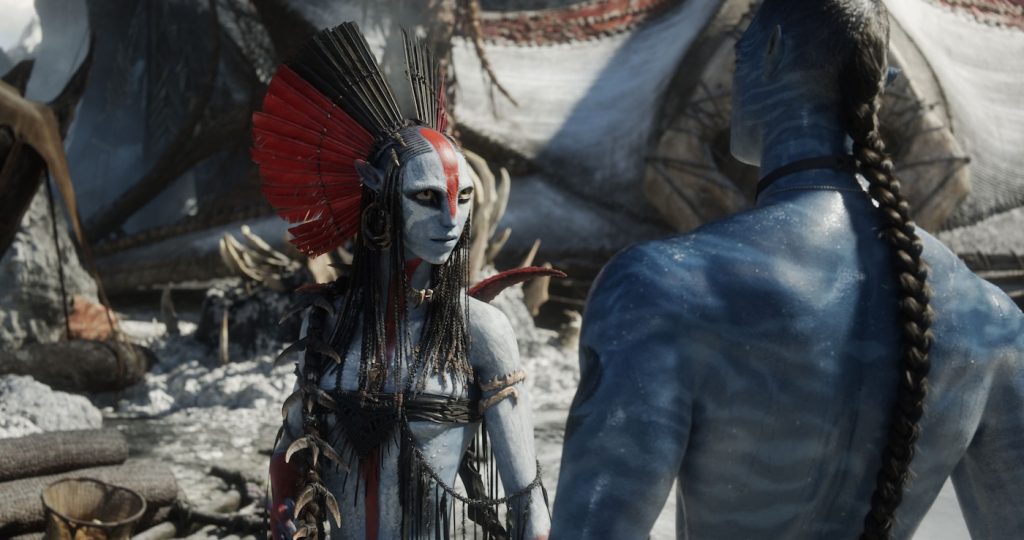
Featured image: Varang (Oona Chaplin) in 20th Century Studios’ AVATAR: FIRE AND ASH. Photo courtesy of 20th Century Studios. © 2025 20th Century Studios. All Rights Reserved.