“Wicked: For Good” Choreographer Christopher Scott on Conjuring Magical Moves With Cynthia Erivo & Ariana Grande
Christopher Scott was in theater camp when Wicked first rocked the Broadway world. As an aspiring artist, Scott was swept away by the show. Around 20 years later, the circle was complete when Scott became the choreographer for the Jon M. Chu-helmed film adaptation.
Wicked: For Good also completes a long-haul assignment for Scott, who spent 13 months developing the original, grand-scale musical numbers for the two-parter. Although Wicked: For Good is the darker chapter of the two, it’s not without its foot-tapping dance numbers – including the show-stopping tunes “Thank Goodness/I Couldn’t Be Happier” and “Wonderful.”
They are two of the many musical numbers that sing character-driven set pieces, similar to Scott’s rich work on In the Heights. When the choreographer spoke with The Credits, there was no sadness about his farewell to Wicked, only gratitude for his time spent in Oz with Glinda (Ariana Grande), Elphaba (Cynthia Erivo), and the rest of this magical cast and crew.
Wicked: For Good’s introduction to Glinda, her and her crew dancing, plays as old-school Hollywood. What were your inspirations for her intro?
I’m very inspired by Bob Fosse. I’m a tap dancer, so the Nicholas Brothers inspired me, so there’s a lot of rhythm in there. I always try to remember my roots as a tap dancer and my musicality, because there are beats that you want to hit, but then there are also the sounds in between the music that not everybody hears. Our job can make people hear the music in a very specific way.
Glinda and the dancers all seemingly become one in that dance number. How do you and an ensemble of dancers pull off that sense of oneness?
A lot of repetition. It is a huge testament to how incredible dancers are. My process is not the easiest. I change things a lot. I feel something and I’m like, “Wait, let’s try this.” Those dancers have to stay with me. And then I’m like, “Okay, can we try it again?” And then you want to see it as the choreographer to know if it’s going to be good. I would sometimes be like, “Oh, there’s no way that they’re going to hit this right now. I just showed them what I’m thinking and I forgot immediately. I wouldn’t be able to hit those damn steps.” They do it, and they kill it.
How much does conflict drive your choreography? For example, in “Wonderful,” there’s a push and pull between the Wizard (Jeff Goldblum), Glinda, and Elphaba.
It’s all driven by the conflict because that’s what this movie was about. It was really interesting to get inside that number, to really think: Who is the Wizard? He really is this façade, but how much of this does he actually believe? How much does he love what he does? This number was built on the idea that his character holds this belief about what people consider “wonderful.” So when we were doing this dance, every little piece of the puzzle was all being driven by that. I’m so grateful to have worked with Jeff and see him find honesty in a performance like that.
What makes for an honest, authentic dance number?
Those are the moments that make us believe that they happened, because people think musicals aren’t real. They think nobody sings and dances through life. That’s not true. People do. I’ve been to places where you’re feeling romantic, and somebody grabs somebody on the street and starts to dance with them because they hear a little music. That’s a real moment. Obviously, we go a little further than most, but it does happen. When wars end, people go out on the street, and they dance. I love it when actors carry that through for you because that’s not us. We can’t, as choreographers, make that happen. Actors have to do it and make it believable.
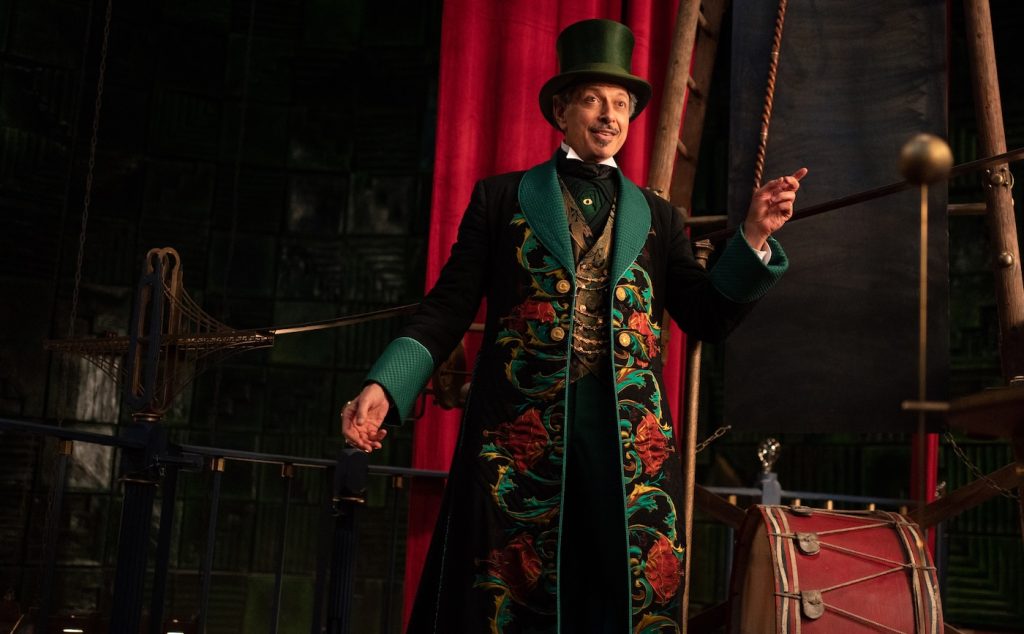
Jeff Goldblum, being a jazzman and pianist, did you see his musicality influence how he prepared for “Wonderful”?
All the time. One of my favorite moments in this movie was when I played some Frank Sinatra and Jeff and I tap-danced together, back-freestyling. I wanted to see how he moves and how he embodies music in a physical form. I watched him get lost in the music and tap dancing, and that’s vulnerable for a lot of actors on day one. It was the first day I was with Jeff. It opened up a whole bunch of doors, and I was like, “Oh, yeah, he’s me. He’s like me. He’s a tap dancer. We’ll find the nuance in the music and see what we get.”
How about finding nuances with Ariana Grande and Cynthia Erivo? With their arcs over the course of the films, how’d you all want the choreography to tell their stories?
They are so tapped into those characters, so it made it easy. As a movie, it has tons of ingredients, but as a dance, as a piece, as a musical number, we have a lot of little ingredients. One of the first things I try to throw into the pot is the actors’ intentions — the way they see the scene, the way they feel their character. I’ll have choreography started, but before I work with them at all, I talk to them about how they see their characters. We were always choreographing with that in mind.
When you first started this process with Cynthia, she said to you, “Go hard on me.” What doors does that request open up as a choreographer?
When she was like, “Go hard on me,” I took it to mean she was going to give this the time it deserves to uphold the level we want to achieve. She goes hard. That woman goes hard. I asked a lot out of her. For “The Wizard and I,” for example, I asked Cynthia to run through this maze that we had created for her and sing the song for me four or five times. That song is not easy to sing. There are actors who are just like, “Okay, I’ll do it once.”
When an actor like Cynthia performs a piece like “The Wizard and I” several times in pre-production, what qualities are you looking for?
I’m learning. I’m taking it all in. It’s helping me create and prepare for the real staging of it, the real moments that we’re going to build together. It’s all that work, man. It was a very intimate process, and we’re going over and over again. It’s repetition. She was like, “You can tell me again because it’s not good enough.” The fear is, sometimes you don’t want to push an actor too far.
How so?
They get a lot of pressure, and you don’t want to break an actor. It happens all the time, and it’s not their fault — it’s just a hard thing to do, period. So I knew when Cynthia said that to me, I knew who she was. I know we’re going to get through this. I don’t need to really worry about her. She’ll tell me. Every time you’re like, “Can you do it again?” “Yep, let’s do it.”
Wicked: For Good is in theaters everywhere.
Featured image: L to R: Cynthia Erivo is Elphaba, Ariana Grande is Glinda, and Jeff Goldblum is The Wizard of Oz in WICKED FOR GOOD, directed by Jon M. Chu.