How James Cameron’s “Avatar: Fire and Ash” Uses Practical Filmmaking You’ve Never Seen Before
It has been three years since Avatar: The Way of Water became the third-highest-grossing movie, with $2.3 billion worldwide. The much-anticipated third installment in James Cameron’s cinematic spectacle, Avatar: Fire and Ash, launched this past Friday, once again immersing audiences in the lush forests and pristine oceans of the exomoon Pandora. The epic sci-fi from 20th Century Studios picks up after Jake (Sam Worthington), Neytiri (Zoe Saldaña), and their family from the blue-skinned Na’vi tribe found refuge with the aquatic Metkayina clan in the midst of war against the RDA (Resources Development Administration), which is led by a cloned version of the late Colonel Miles Quaritch (Stephen Lang). The visually stunning adventure is another technological marvel that wows audiences with flying whales (Tulkuns), dragon-like pterodactyls (Ikrans), and underwater creatures such as the long-necked reptilian Ilus.
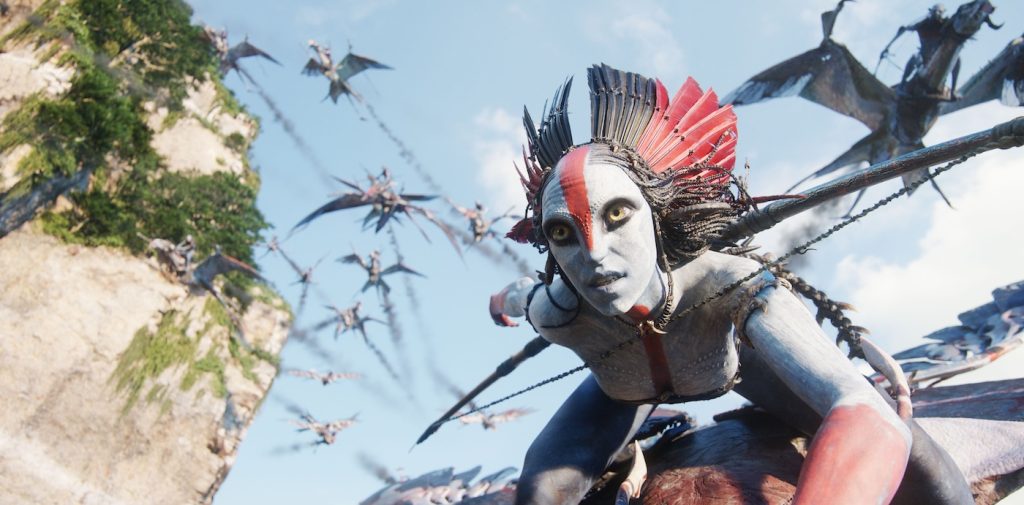
The sensory and visual feast is achieved through cutting-edge motion and performance capture technology that meticulously translates every sinew of emotion and movement onto humanoid characters and creatures alike; there would be no movie at all without the actors’ performances behind every frame. “Some people think that Avatar is very digital or animated, but it’s not animated at all. If there’s a wolf, that’s a human being on all fours acting like a wolf,” reveals stunt coordinator and second unit director on all three films, Garrett Warren (Road House, Logan). “The Tulkuns in the water are water performers from Cirque du Soleil. This movie is shot with practical, in-camera action; it’s all real. We’re sinking a ship for real. When someone flies a bird, we’re not animating that; we capture it on a rig. When a character is riding underwater on an Ilu, we built a jet machine that flies underwater with someone piloting it and another person grabbing onto the back of his neck, flying underwater at 20 knots. The stuff that we’re doing, you’ve never seen done practically in a film before.”
To show audiences the practical filmmaking inherent in these films, Cameron released a two-part documentary weeks ahead of the film’s release: available on Disney+, Fire And Water: Making The Avatar Films includes exclusive behind-the-scenes footage, concept art, and interviews with the filmmakers and cast. For years, these details were kept under wraps because “Jim wants people to believe what they’re seeing and think they’re on Pandora with these nine-foot-tall creatures. But many think that’s all digital and animated. But Zoe is really flying on these creatures and fighting people with a bow and arrows. Stephen Lang is really out there fighting Jake. It’s all practical,” the five-time SAG stunt ensemble nominee reveals. “We don’t want to ruin it for anybody — we want the magic to still be there — but some don’t believe in the magic because they think it’s all animated. These movies don’t look like any other animated movie because they’re not animated,” Warren remarks.
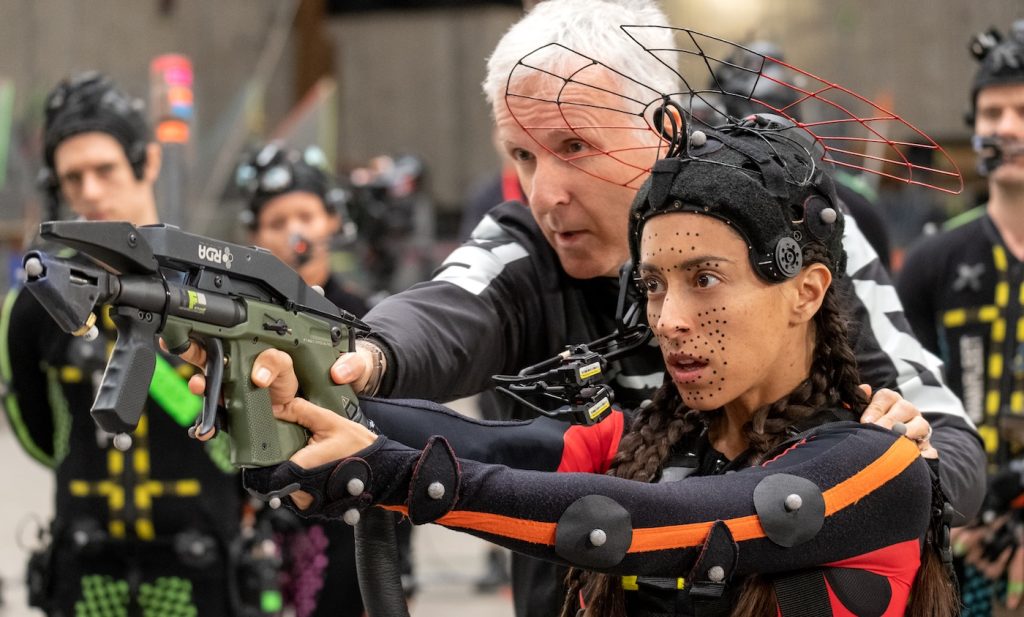
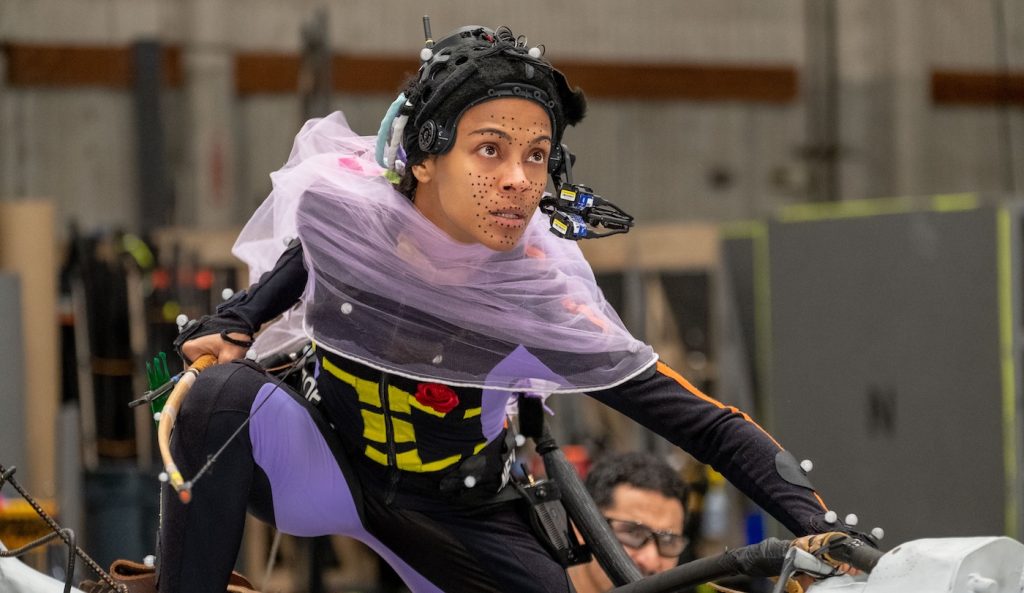
Oscar-nominated editor of all three Avatar films, Stephen Rivkin (Alita: Battle Angel, Pirates of the Caribbean) concurs: “Everything you see is performed by the actors and the stunt crew. We edit the film at least twice. First, we take the raw performances and create performance edits to pick the best takes, which are then played back to create the shots that go into the sequences,” he explains of the laborious editorial process to construct the film. “The performance capture is done in what’s called a ‘volume’ on the sound stage, where the actors perform, and every movement of their bodies and faces is captured. We have video reference cameras to give us a way to review and edit the performances. After Jim picks the takes he wants from the dailies, we combine the actors’ performances from different takes to assemble the best pieces. The digital characters represent the actors’ exact performance. They’re CG characters, but the performance is not computer-generated — it’s like wearing makeup — but the actors’ performances drive everything.”
“Jim often talks about the limitations of live-action shooting; some actors get it right the first time, others might peak on the sixth take,” Rivkin continues. “But here, we’re able to put every actor’s best performance in the same scene so that everybody’s at their very best. Every line is perfect, and everybody hits their marks because it’s all been pre-selected and edited.” These performance edits are then combined with the characters’ CG models in the lab, where digital artists create shootable files with inputs from production design, environments, wardrobe, creatures, and anything needed in the scene for the rough camera pass, which informs “how it’s going to be lit and shot, in preparation for Jim to do final virtual camera shooting. The performances can be played back on the volume as many times as needed, when the actors are no longer present, and used to create the coverage of virtual shots that go into the final edit of each scene.”
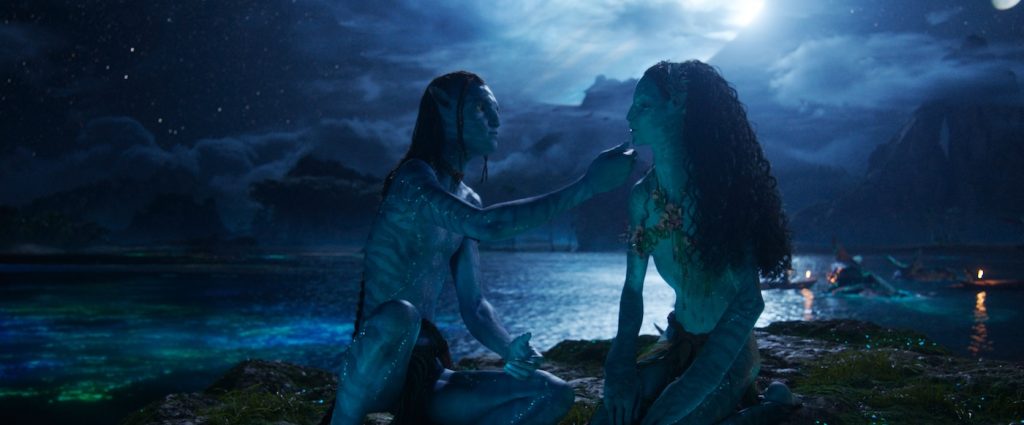
Despite the digital embellishments, every shred of emotion on-screen is driven by human performance. “I think after two films, there is still the misconception that these actors are not performing every second on the screen, and that is not true. Some people think there is a voice track with the actors voicing the characters in a booth, like for an animated film. But nothing could be further from the truth,” Rivkin points out, adding that: “As the side-by-side final render in the documentary shows, you can see the actors’ performance. Hopefully, audiences will begin to understand the complex, painstaking process of reproducing that actor’s performance in all its nuance. Nowadays, with the level of photorealism in CG animation, I can understand why people might think this is an animated CG character, but it’s not. These films are purely driven by actors. Once Jim has completed his final pass of cameras and editing, only then does it go to WETA. They apply the facial capture data to the high-res model, where every muscle in the face is accounted for and accurately reproduced on the CG model.”
“It goes performance capture, editorial performance edit, back to stage for virtual cameras, then back to editorial, then onto our post process. It’s an unusual cycle that creates a paradigm shift in the filmmaking process,” shares two-time Oscar-winning VFX Supervisor for the first two Avatar films, Richard Baneham (who was also on The Lord of the Rings films). “We call it performance capture, as opposed to motion capture, because we are wholly invested in the performance of the actor, including the cadences and idiosyncrasies of the selected take,” he says of the precise process. In terms of constructing every shot, “we shoot reference cameras from every conceivable angle. The capture system allows us to record the complete performance, both motion and facial, in the volume. We don’t shoot unless it has been calibrated down to less than a millimeter of fidelity. We really want to get to the very essence of the performers and make sure that’s recorded in a manner that we carry it through the pipeline all the way to final delivery, because our process is completely dependent on the audience buying these characters. I work directly with WETA to protect these performances so that we have that connection from inception through to the final moment. I review every piece of motion and performance all the way through and constantly check it against the actor’s performance.”
There are four types of cameras in this demanding process, as Baneham explains. “The optical sensors record the motion with infrared light at about 240 Hz. Then, we turn that motion into kinematic data. The second cameras are witness or reference cameras; we shoot them almost as if they were coverage. We live and die by the close-ups, as we need to understand the idiosyncrasies of each performance so that Jim and Editorial can choose the ones that’ll have the most narrative impact. The editorial process is one of the paradigm shifts, since in our process, we introduce editorial before we ever have shots, which was a crazy concept in 2005,” he says of the groundbreaking filmmaking technique when the first Avatar film was made. “Camera #3 includes two head-mounted cameras on the head rig, or the HMC, that builds the topography of the face on a frame-by-frame basis. The value of what we put on-screen is based on these specific performances. With Camera #4, we do the rough camera pass. The first pass stands up all the basic angles, and we do an editorial pass before reviewing with Jim. He conducts a fully fledged camera pass, making decisions about close-ups and two-shots and setting the scene’s rhythm. In some ways, this mimics the live-action paradigm, except that we get the advantage of choosing the very best performances. So, we naturally have continuity since the performances have already been chosen to work well together.”
With Fire and Ash, Baneham is particularly excited about sharing the new characters with the audience. “I think we’ve touched on something special with the relationship between Oona [Chaplin] and her character, Varang, which I’m really anticipating the audience enjoying.” As for Rivkin, “my hope is that there’s a new appreciation and respect for the actors’ performances, which have existed in all three films, but I think they’ve been underestimated and overlooked because of a misconception about how these films are made. I really hope there’s a much wider acceptance of the actors’ contribution and the diligence that our team takes to reproduce that performance in all its glory and detail onto the screen.” Baneham agrees: “Zoe’s performance was so strong: her effort, energy, and commitment to the character was every bit as powerful had we shot her live action.”
Avatar: Fire and Ash is in theaters everywhere, and Fire And Water: Making The Avatar Films is streaming now on Disney+.
Featured image: Varang (Oona Chaplin) in 20th Century Studios’ AVATAR: FIRE AND ASH. Photo courtesy of 20th Century Studios. © 2025 20th Century Studios. All Rights Reserved.