No Good Deed Goes Unscored: The Musical Masterminds Behind “Wicked: For Good”
Stephen Oremus was there at the beginning, playing piano at Wicked‘s first showcase in the basement of Los Angeles’ Coronet Theater. Also in attendance: composer-lyricist Stephen Schwartz, writer Winnie Holzman, and ten singers who performed the musical’s first act for producer Marc Platt. “Even before there was a director attached or anything, we pieced together this very early version of Act One,” recalls executive music producer Oremus. “It was about three hours long!” The group reunited a few months later on the Universal lot to run through the whole show, and in 2003, Wicked debuted on Broadway. There, the tale of two witches quickly secured an enduring perch in the pop culture firmament. Looking back, Oremus says, “It’s beyond my wildest dreams that we’re still talking about Wicked in these beautiful new incarnations.”
In Wicked: For Good, director Jon M. Chu‘s second installment of The Wizard of Oz prequel, Oscar-nominated British composer John Powell co-wrote the score with Schwartz, having previously contributed music cues to blockbusters like The Bourne Identity and How to Train Your Dragon. Teamed with Schwartz, producer Greg Wells, and orchestrator Jeff Atmajian, Powell and two-time Tony winner Oremus crafted a sumptuous and sometimes stormy soundscape tailored to the talents of powerhouse vocalists Ariana Grande and Cynthia Erivo.
Oremus, on vacation in his Missouri hometown, and Powell, speaking from Los Angeles, recount the pleasures of building out Schwartz’s intensely dramatic melodies with a little help from an 85-piece symphony orchestra.
Wicked: For Good works on so many levels, including the simple fact that the music sounds huge! How big was the orchestra?
Oremus: On Broadway, we had 24 musicians because the economics of using an orchestra every night, eight shows a week on Broadway, is very different. For the Wicked movies, we had about 85 musicians.
Powell: The studio puts so much money on the screen; they wanted it to sound expensive as well. Sometimes we went up to like nine horns. I mean, why not?
The flow between songs and the instrumental score feels so cohesive. How did you pull that off?
Oremus: The score team used slightly bigger brass sections for some of the action stuff, but we tried to keep [the instrumentation] very similar. We shared the same engineer and, for both the songs and the score, mostly the same players.
You recorded the music at AIR Studios in London. What kind of space is that?
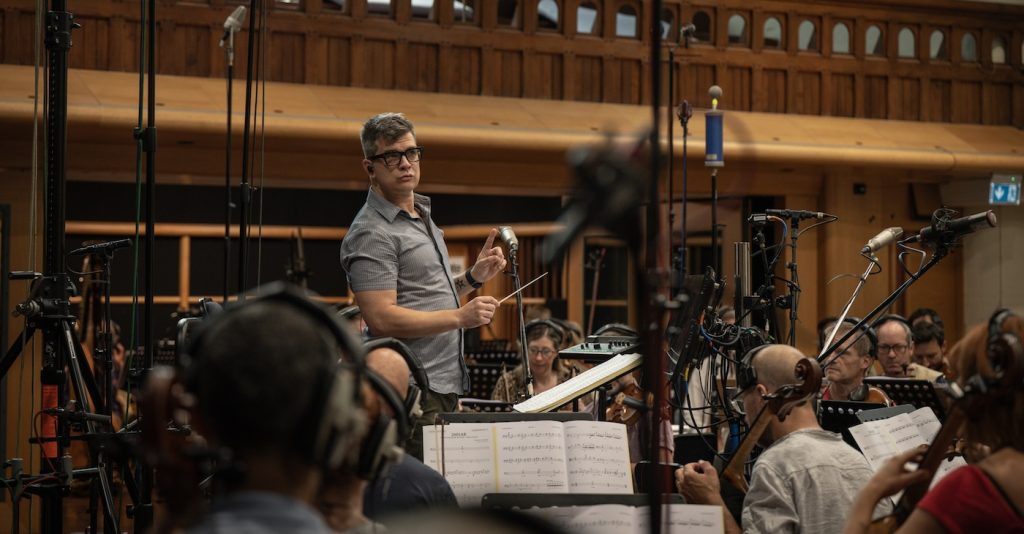
Powell: The thing about AIR is that it’s [formerly] a big church with this amazing ceiling that can be moved up and down. Based on what we were recording, they’d adjust the ceiling to make the music [sound] bigger or smaller. From the spot where I was conducting, you see this giant pipe organ in the wall, and then you have these monitors with the film on it. It was a beautiful experience.
The songs and the score share a common vocabulary in the way specific instruments are used to convey emotions.
Powell: We used quite a lot of chimes and a beautiful kind of flowery, metallic sounds for magic and Glinda. But the language very much starts with Stephen, who’s very specific about how he voices chords, and he gave me a couple of notes where he’s like, “Why are you putting thirds everywhere? It sounds so European.” Stephen [Schwartz] and the song team obviously knew this language, but I came into this not knowing much about Wicked, so I had to catch up quickly and adapt. Also, one of the glories of working with Jeff Atmajian is that he found really elegant ways of orchestrating things.
How did you develop the musical storytelling from the first film to Wicked: For Good?
Oremus: You can hear the evolution of the score as the second half of the story gets much darker. In film one, Glinda and Elphaba are younger, so we have more pop-based songs, whereas in For Good we have much more orchestral complexity. We encouraged Jeff to think outside the box with his orchestrations because we now had a much bigger world to support.
John, your score creates marvelous contrasts. For example, the opening music cue “Building a Golden Road” features a gloomy, bass-heavy motif. Then we go to “Bubbles and Rainbows,” which is light as a soufflé.
Powell: Well, the first few notes of the film are also the first two notes of “For Good,” the song, so I found that helpful riff [to underscore] the plight of the animals, being in the work camp, building the road. Then Glinda comes along, and she’s achieved a pinnacle of success beyond what she could ever have hoped for in her earlier life. So those first two tracks set up the essential elements we’ll be following throughout the film: the problems of Oz and Glinda’s Evolution. That’s what you hear in the score because that’s how the film is constructed.
“No Place Like Home” is one of two new songs Stephen Schwartz created for this movie. How did that come about?
Oremus: We went down many roads with that one, making many different demos in different styles. The original versions had a more pop vibe, but once we found out where the song would be used in the film, it happened pretty organically, giving it a more orchestral thrust.
Powell: The theme of “No Place Like Home” is very intentionally used in the overture of the first film before anyone knew what it was.
Oremus: We got a lot of mileage out of those beautiful melodies that Stephen wrote, and once the storytelling was solidified in the early cuts of the film, we were able to blow it up appropriately to become the more dynamic version that we have today.
It’s interesting in that “No Place Like Home” you’ve got your intro, then the verse, then the chorus, but then, unlike a conventional pop tune, the music goes off in a completely different direction. Can you talk about the restless quality that seems to infuse so many Stephen Schwartz songs?
Powell: Stephen is sort of an opera composer who writes tunes that people like and can sing along, and he also wanted to make money, so that’s why he ended up on Broadway. I’ve always been an opera composer who couldn’t write those sing-along tunes and desperately uses film to let me try and do that [laughing]. So, the songs and the score are always coming from the point of view of drama and emotion and narrative, which is why Stephen uses amazing key changes for his bridges, or sometimes it’ll be a complete modulation. Every time he does that, I’ll look at the words and realize they’re pushing the song forward, and then he expresses that same idea in the music.
“The Girl in the Bubble” is the other new song written for Wicked: For Good. How did that develop?
Oremus: Once they decided to split Wicked into two movies, Stephen and Winnie pinpointed this moment for Glinda toward the end of the story, when she gets to reflect on the gravity of what she’s been going through. On stage [in the Broadway musical], we didn’t have time to tell all these little pieces, but now we’ve been able to focus in on this devastatingly vulnerable moment for our beautiful soprano Ariana.
John, was it challenging to find a voice in a project so strongly defined by songs written by another composer?
Powell: Oh yeah. Stephen knew exactly how to score every scene, but sometimes the language of film requires a different viewpoint about where the audience’s head is at and where the camera leads you. With the score, part of my job was to make themes disappear, to sublimate them and make sure they were [coming through] in the subconscious, but not in the conscious.
It sounds kind of like the Hippocratic Oath for doctors: “First, do no harm.”
Powell: Well, mine is always “Don’t f*** it up.” [laughing]. That was kind of our motto for both films, right?
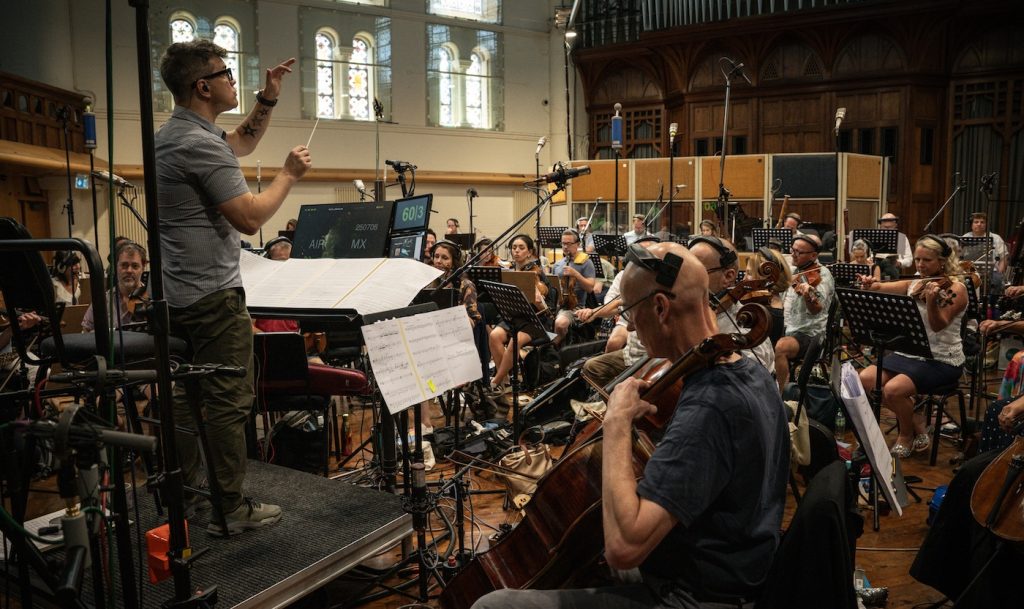
You guys talked earlier about working with an ensemble nearly as large as a full-scale symphony orchestra, complete with strings, woodwinds, brass, and percussion. How did it feel to lead 85 classical musicians through these stirring arrangements?
Oremus: I will never forget conducting that orchestra for as long as I live. I mean, John does it all the time because he scores films, but for me, getting to do big, exhilarating songs like “No Good Deed” was one of the greatest joys of my life.
Did you use these orchestral recordings to back up Cynthia and Ariana when they sang?
Oremus: No, we did the orchestra at the end. All of the vocals were recorded on set when they shot it. Producer Greg Wells compiled demo recordings made with synthesizers so the actors could sing along to the MIDI tracks.
Powell: They had in-ears [monitors], didn’t they?
Oremus: Yeah.
Powell: And for “No Good Deed,” Cynthia was hoisted up in the air, and they’re blowing her with a fan, and she’s singing to basically nothing but a green screen. All those monkeys were added later. It was incredible.
Oremus: It was such a thrill to see them really doing it on set because Cynthia and Ariana are two of the most extraordinary vocalists we have on this planet.
Wicked: For Good is in theaters now.
Featured image: L to R: Ariana Grande is Glinda and Cynthia Erivo is Elphaba in WICKED FOR GOOD, directed by Jon M. Chu.