
“Hamnet” Costume Designer Malgosia Turzanska Reveals How Leather Wounds and Clay Tell Shakespeare’s Story
Chloé Zhao’s period drama Hamnet follows a spirited young couple in 16th-century England — the earthy, radiant Agnes (a superb Jessie Buckley) and her besotted, occasionally brooding husband Will (an also excellent Paul Mescal), who channels his own formidable gifts onto the page (and becomes, of course, the Bard). Their love is tested in the most extreme ways, as Will’s career aspirations and the death of their young son, Hamnet (Jacobi Jupe), threaten to tear the family apart. In the first part of our conversation with costume designer Malgosia Turzanska, she talked about how her team of textile artists, cutters, designers, and leather makers conveyed the full spectrum of Agnes’ emotional makeup through her costumes. Now, let’s turn our focus to Will and the rest of the Shakespeare household.
This film was shot mainly in Ireland and the UK. Was your core team based there?
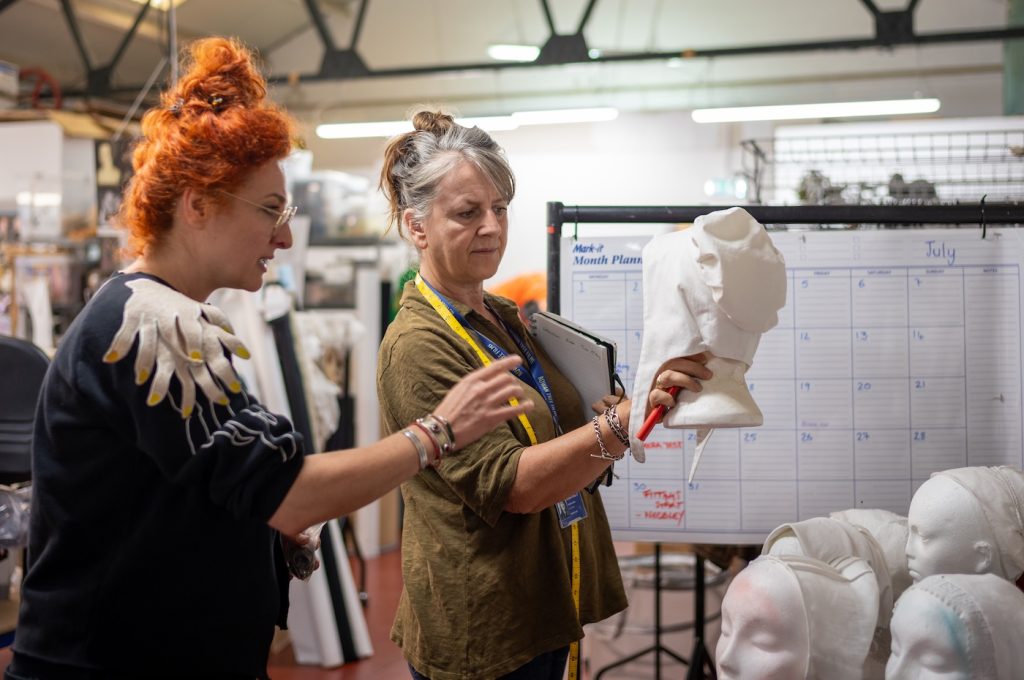
They were all UK-based – I lucked out and got the absolute top-notch team. That was soon after the strikes ended, and there wasn’t a lot of shooting in England. So, I got the A-list team. Charlotte Finlay is the costume supervisor who worked on Barbie; she’s now working on Narnia. She is fantastic and very knowledgeable about the resources there, so she pulled the team together. Our assistant designer Rosie Grant, cutters Vikki Medhurst and Malin Anderson, chief textile artist Richard Sweryda, and leather maker Tamzin Lillywhite are all top-notch — I’d love to work with them again.
Credit: Courtesy of Focus Features / © 2025 FOCUS FEATURES LLC
Were most of the costumes fabricated in-house, or did you rent some too?
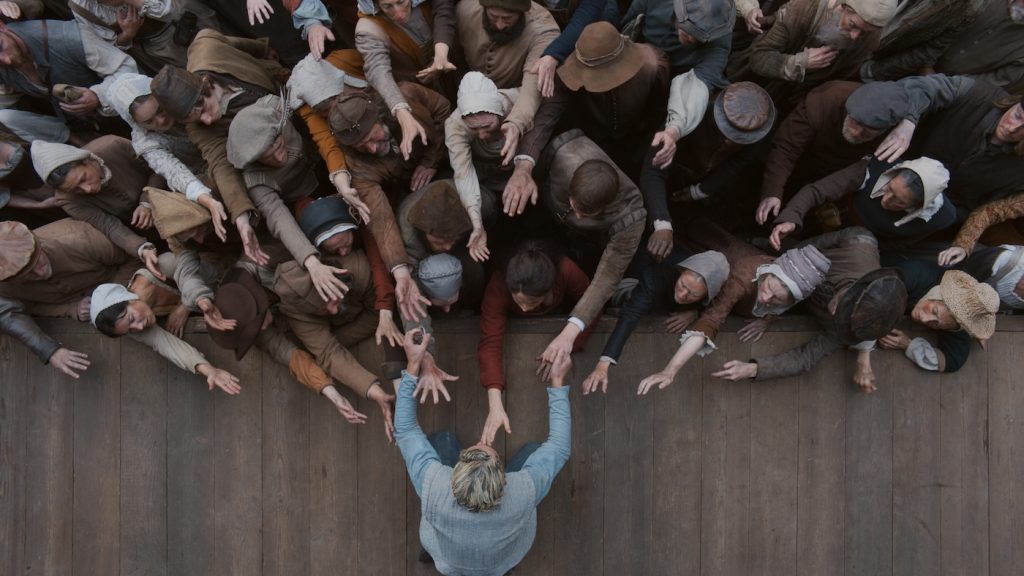
Our in-house shop had unbelievable makers – a men’s clothing maker team and a female clothing team built the principal characters’ costumes mostly from scratch. For the 500 background actors, we rented costumes and added bits and bobs to them. We also had a fantastic milliner, Sophie Lambe, who is actually Charlotte’s sister; she made the hats from Wicked. We had amazing leather workers – that was my first time having custom-made leather materials. There were workshops on aging and dying, leather, millinery, and a workshop for the background actors’ costumes to add aprons, hats, additional sleeves, etc. It was a big team, approximately 85 people.
What were some of the considerations for Will’s wardrobe?
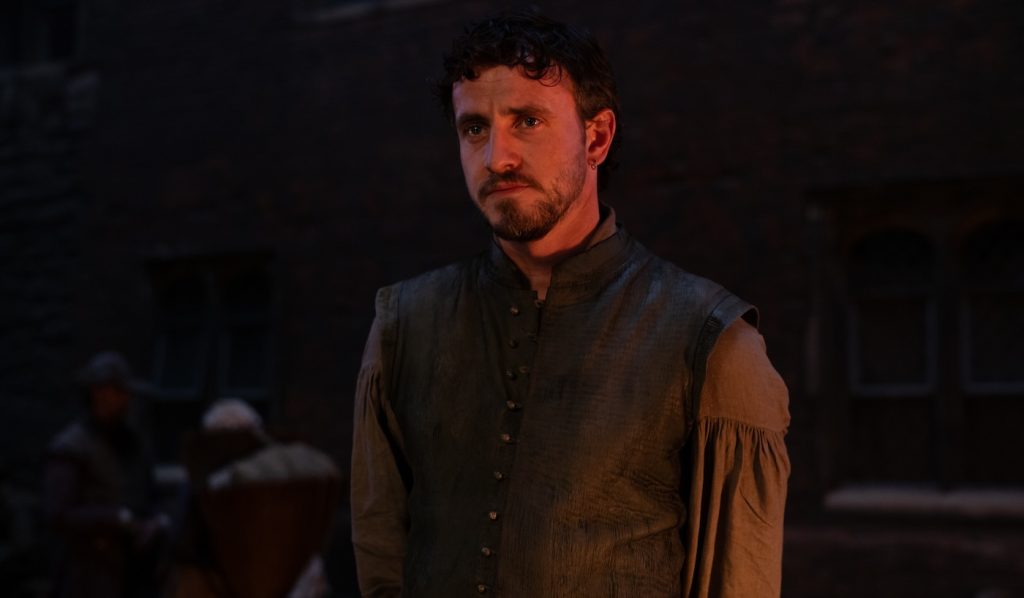
He wears a lot of leather from an Italian company, D’Alesio Galliano. One of my favorite pieces on him was made out of what we called ‘mushroom leather’ — it’s laser-cut leather that looks like the underside of a mushroom. The surface is uneven and has little scratches; it looked really cool. We used a lot of fabric from Hopkins [Costume Trust] in London for the Shakespeare household. We also bought some vintage fabrics from antique markets. We had to make sure we had enough of it because there was no way to produce more.
Growing up in an austere household, Will is quite rigid. After their first child was born, he soon grows frustrated because he is unable to pursue his career as a playwright in the countryside. What inspired his wardrobe and what qualities did you want to convey through his costumes?
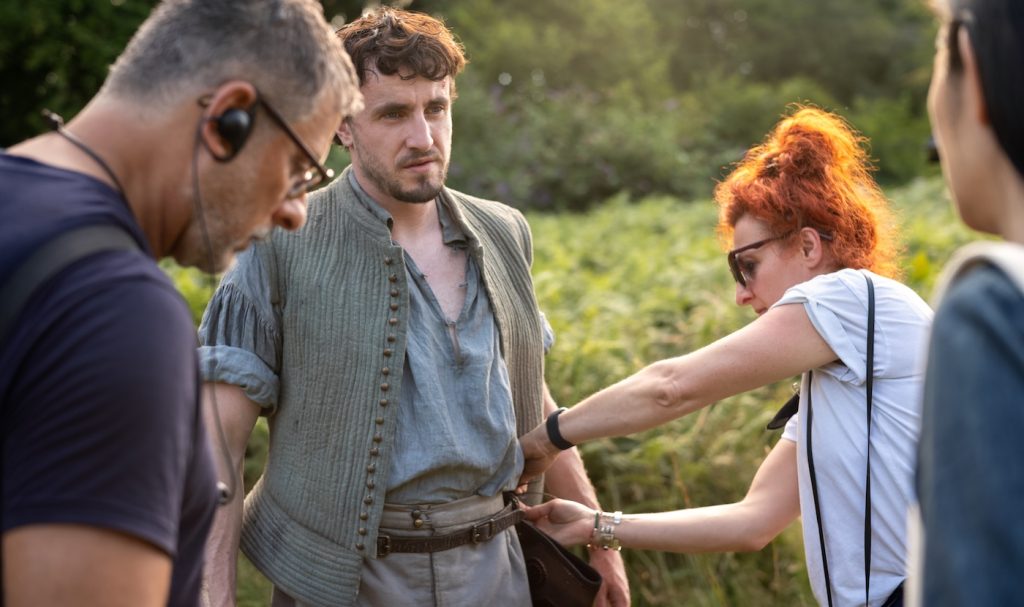
A few elements influenced his costumes. The first has to do with his father: what do you do when you live with a person who could strike you at any point and you can’t fight back? So, I thought about protection and looked at vintage sports padding. That’s why lot of their clothes has more cushion like quilting and padding, even though Elizabethan clothing already has volume and padding.
Credit: Agata Grzybowska / © 2025 FOCUS FEATURES LLC
What were some of the highlights from his wardrobe?
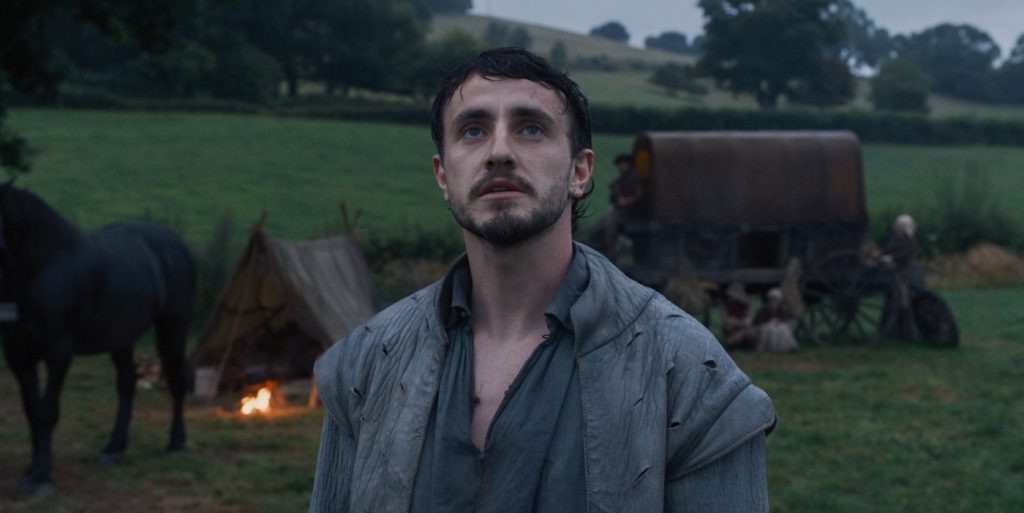
He wears this linen doublet quilted in slightly irregular lines, which symbolizes water — a few times throughout the film, he processes his emotions either by swimming or by standing above water and looking out at it. Then there’s the ink — we actually got the iron gall or oak gold ink that Shakespeare actually used, which was made of lesions from an oak tree mixed with rusty nails to give it that dark gray, blackish ink. So, his gray-scale outfits are based on that. The blues and grays are from the river. Even though it was customary to wear a dagger, we opted for a penner, the little container of ink and quill that hangs over your belt. It’s like he’s wearing his writing tools on him. It was Paul’s decision not to have the dagger and only have that, which I thought was a very cool choice.
What went into dressing the rest of the Shakespeare household?
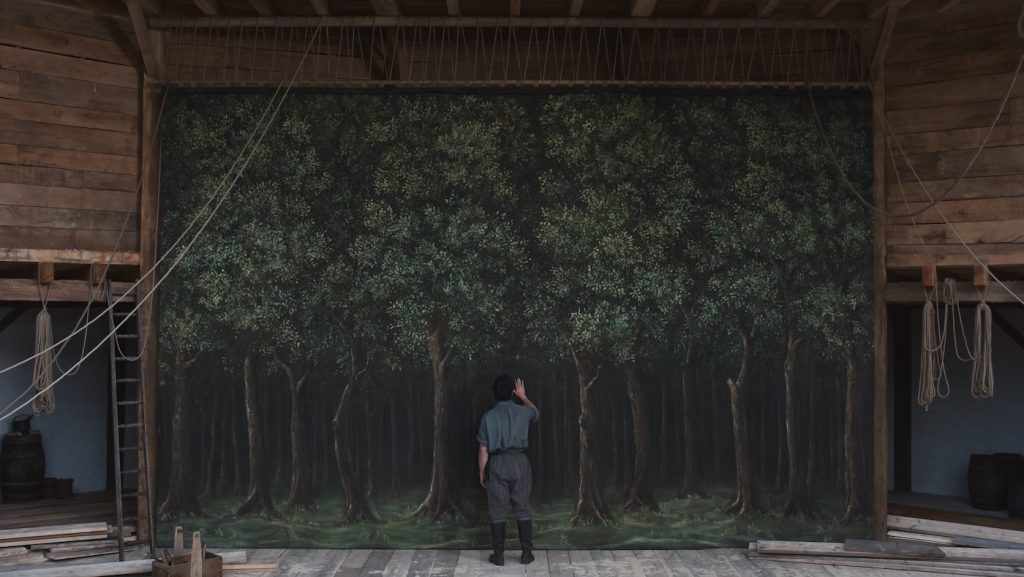
His father, John, wears a necklace that is actually a toothpick, which is period-accurate — at the time, many people wore their personal toothpicks on a necklace. It’s such a violent shape that I loved for his character — it’s like he’s poking at Will and the family with this sharp claw, I saw it more as an emotional object that embellishes his costume. As Will grows more frustrated, he changes from the mushroom leather to a thicker leather shell with some pinking or little slashes, which is characteristic of that period. It shows his frustration — his garment’s “wounds” on the leather show his emotional state. After Hamnet’s death, he wears a doublet with giant chunks of the leather cut, it’s no longer just little slashes, again symbolizing his growing wounds. At the end, when he plays the ghost in Hamlet, he wears a linen sheath covered in clay that is cracking. So, we go from little scratches to larger ones until finally, the whole shell cracks. When he washes it off [after the climactic play and Agnes’ cathartic response to it], that releases his pain and frustrations.
Credit: Agata Grzybowska / © 2025 FOCUS FEATURES LLC
Credit: Courtesy of Focus Features / © 2025 FOCUS FEATURES LLC
Let’s talk about dressing Hamnet and his twin sister, Judith (Olivia Lynes).
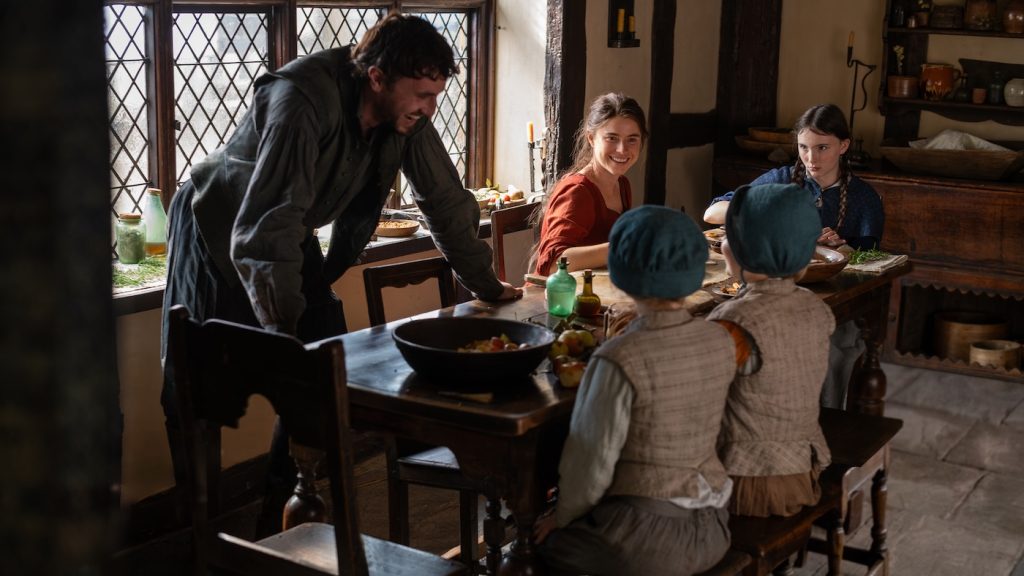
The twins look nothing alike, and yet they dress in similar ways because they believe they look the same. Their little jerkins were made of vintage fabric from an antique store; we couldn’t get more of it if they grew significantly taller during production! It was a gently-striped linen that was very beautiful — hers was horizontally striped and his was vertical. The sleeves are modular. I love the scene where they swap out each other’s clothes, he was in her skirt and she was in his pants. At the end, when he takes her place when she is dying, their nightgowns were made of a cream windowpane cotton, which combines their previous individual horizontal and vertical lines into one. In the final sequence during the Hamlet play, the actor playing Hamlet (Noah Jupe, Jacobi’s real-life older brother) wears a quilted version of what Hamnet wore, but slightly more textural.

Credit: Agata Grzybowska / © 2025 FOCUS FEATURES LLC
What struck you when you saw the final cut – did anything surprise you with how it came across on the screen?
I’m very taken with the fact that people seem to really respond to the movie with an open heart, which is incredible because I love this movie deeply. It’s a very important film to me. Costume-wise, my favorite is Will’s ghost outfit at the Globe Theater. It was the last piece I designed, and we were already shooting. For a long time, I seriously didn’t know if it was going to work out. I didn’t want to force it and told myself that it would all come together. And then it did!
You hoped the inspiration would come to you organically once production began?
Exactly. I had a photograph of this clay-covered art piece. I didn’t know why I was drawn to it, but I felt that was the direction. Seeing it in the film now, I know it was the right decision.
Hamnet is playing in theaters now.
Featured image: Jessie Buckley stars as Agnes and Paul Mescal as William Shakespeare in director Chloé Zhao’s HAMNET, a Focus Features release. Credit: Agata Grzybowska / © 2025 FOCUS FEATURES LLC