
From Basement Bandmates to “Resident Evil”: Composers Hays & Ryan Holladay on Reuniting With Zach Cregger
He’s done it again. Following his breakthrough horror hit Weapons, filmmaker Zach Cregger defied the odds in a sub-genre that rarely thrills critics or the general public: video game movie adaptations. But Cregger made Resident Evil his own, and moviegoers clearly appreciated the vision, generating $108 million at the worldwide box office during the movie’s opening weekend.
In reviving the eight-movie franchise, director/co-writer Cregger reunited with Austin Abrams, who played the drug addict in Weapons. Here, he stars as hapless organ-courier Bryan, bloodily bewildered by tentacle-infested zombies. Cregger also re-teams with Weapons composers Hays and Ryan Holladay. Hays says, “We learned a lot from scoring Weapons, especially on the jump scare stuff. Sometimes, less can be more, and sometimes you need that big bang of a sound. I don’t think there’s any real formula, except that when you hear it, it feels scary.”
The Holladay brothers started making music together as kids in Washington, D.C. Later, in New York, the brothers met School of Visual Arts student Cregger while attending NYU Tisch School of the Arts. Now in Los Angeles, Hays and Ryan Holladay produce, compose, and create experimental projects, including a geo-location music app that plays site-specific sounds for visitors to Central Park and the National Mall.
Speaking from L.A., the Holladay brothers explain how Miles Davis’s music, dogs, and Cregger’s all-hands-on-deck love approach to collaboration inspired their Resident Evil score.
I know nothing about the “Resident Evil” video games, but this movie totally works as a free-standing horror movie. Are you guys into the video games?
Ryan: We’re casual fans. I’ve played a handful of the games, but the fact that you hadn’t played the game and Resident Evil still felt like a movie, I think that’s great. The idea that someone can go in blindly, not knowing anything about the franchise, and still enjoy the movie…that’s the whole thing.
You two have been making music together since you were kids?
Hays: Yeah, we started out in our parents’ basement and then played in bands in New York.
Did your band make any records?
Ryan: We made a few different EPs.
Who’s ‘we’?
Hays: The band was called Sirhan Sirhan.
You were just asking for trouble.
Hays: When you’re 19, you make different choices [laughing]. Ryan was on bass, I played guitar, Zach sang, and this guy named Malachi DeLorenzo played drums. We played out all over New York and had a great time writing songs together.
Wait. Before he became a filmmaker, Zach Cregger was the frontman in your rock band?
Ryan: I feel like people have not really discovered this, so you could break this story, but yeah, Zach was the singer in our band. Our recordings exist online. All of us had other projects, and Zach certainly got pulled into comedy, then film. The cool thing about doing music for Weapons and Resident Evil is that these movies gave us a permission structure and outlet to do what we’ve always done. It’s better than lugging a bass amp up a set of stairs.
Hays: And getting [paid in] drink tickets.
Your Resident Evil score begins with this bass-heavy pulse as a foundation. From there, little by little, you layer in additional sounds. What was your process for building out the score?
Hays: As soon as Zach jumped into post-production, we set up there and saw the edit evolve. We tried a lot of different ideas, but working with Zach, we realized a certain kind of simplicity really lends to the storytelling, so we started muting things
Would you put musical ideas into the mix early on and then take them out?
Hays: Exactly. But I think what we couldn’t take out was that pulse, which has a lot of real low end. Sometimes you don’t even notice it, but you feel it because we’re activating the subwoofer. That low pulse keeps Austin’s character moving. Then, as you’re introduced to these new horrible creatures, more colorful sounds appear in the score and chaos ensues.
Ryan: Zach doesn’t use temp music from other films as a placeholder, so we made all the music at the same time Zach and the editor, Joe Murphy, were finding the pacing in the edit. That can be more challenging in the beginning because we really don’t know what we’re looking for.
Hays: Originally, Zach’s directive was, “Let’s do a lot of the score with trumpet.” We talked about Miles Davis albums like “Bitches Brew” and “Dark Magus” as a jumping-off point. We recorded a trumpet player, Aaron Esposito, and built a whole score with very bombastic horns.
Ryan: Then, a lot of that got stripped out. But what’s cool is that there are remnants of that [trumpet]. We recorded our trumpet player doing a ton of stuff, and afterward, we would mangle it beyond recognition.
Hays: Each sound really goes through a journey, and things that sound synthetic are often [coming from] this trumpet. We’re reversing sounds and stretching them out to the point where you’re going, “What was that originally?… Oh, wait, that’s our trumpet.”

Just to circle back for a moment, you guys physically brought your musical gear into the post-production office and worked in the same space with Zach and the editor?
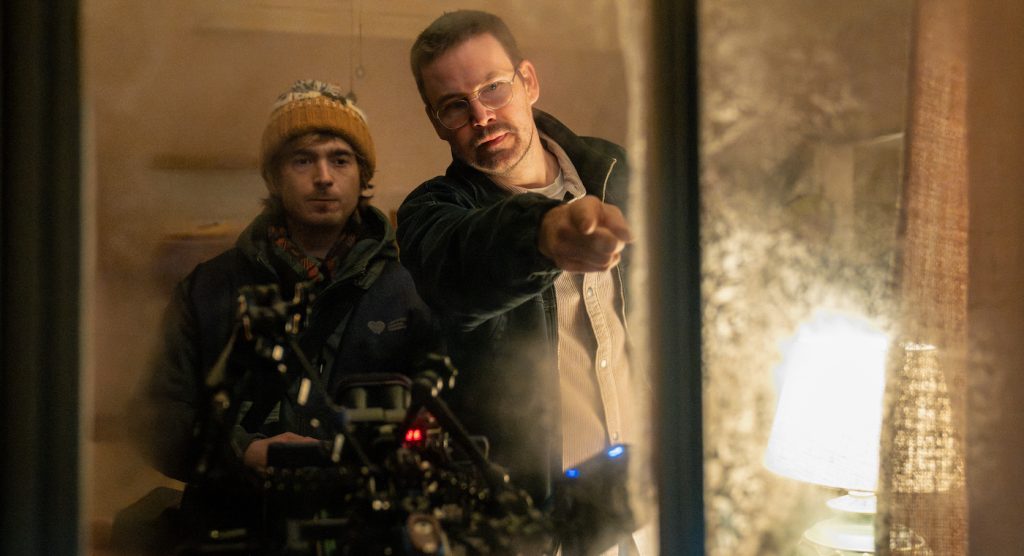
Hays: Yeah. Fortunately, we’re based in L.A., so we basically moved our entire studio into Pivotal Post in Hollywood. We were next door to the music editors, next door to the VFX supervisor, the editor’s down the hall…
Ryan: And Zach is literally jumping between VFX, and the edit, and being with us, working on all these things simultaneously. He likes everything tightly woven into the entire process from the beginning.
The soundscape is woven together in the sense that it can be hard to tell sometimes if a rumble or a whoosh comes from sound design rather than music. Was there back and forth on that front?
Ryan: It’s a handoff sometimes. There’s one sound that actually came from a drum that Hays pitched really far down and put in a convolution reverb, so it sounds like a dog barking. It plays the first time we see the dog and then becomes a weird theme of the film where you hear this “woof” again and again. Technically, I guess that doesn’t fall into sound design, but the dog sound is a little bit of both.
Hays: Another time, we brought in a singer named Shannon Lay to perform this big cacophony of voices that became the thematic DNA for the “rolling ball,” without saying too much about what that is. When you first see this thing in the woods, you might think the creature is making that sound, but really, it’s in the score. We had her emulate a baby crying, for example, and then each layer takes on a different persona, which gives the creature this sense of being a split personality.
Sometimes, the movie gets very quiet.
Ryan: It’s a fine art because you can create a subtle sense of unease. Like when Austin first goes into the abandoned house, that black noise washes away; you feel, “Oh, it’s okay.” But then it sneaks back in and operates on a subconscious level.
Final question, a two-parter. First of all, who’s the older brother?
Hays: Ryan is, though when I was younger, I wished it were me, and now, when people think I’m older, I’m dismayed.
Part two, what was the most challenging sequence?
Hays: That would be the finale.
How so?
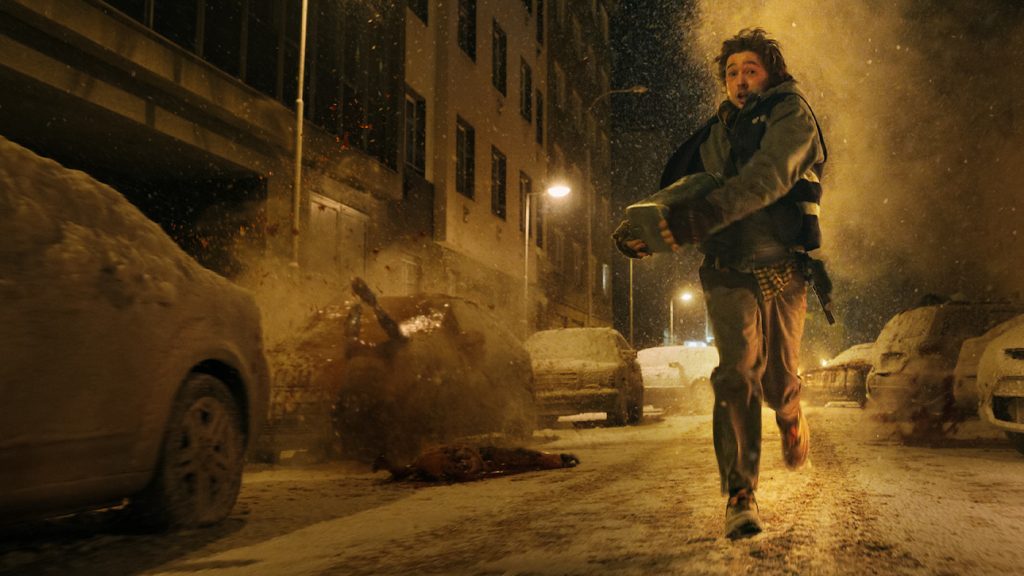
Ryan: Originally, we had rising strings as Bryan ran toward the window, with a big King Kong finish. [kettle drum sound] “Dong, dong, dong.” It was cool, but then our music editor Scott Hedrick suggested doing something a little brighter. We had written [unused] stuff for other parts of the movie, so we set that in a major key and put the female vocals on top. Now we have a different color and a new temperature.
Hays: We left behind the idea of doing something bombastic and very dark.
Ryan: For a movie of this relatively short length, it was important to Zach that we tell people that things are reaching the end. In going to a major key there, which hadn’t happened before in the film, we want the audience to feel that something new is arriving. Something has changed. When we found that music cue, it was like, “Oh, this is different. This is cool.”
Resident Evil is in theaters now.
Featured image: Austin Abrams stars in Constantin Film and TriStar Pictures RESIDENT EVIL, directed by Zach Cregger. Photo by: Courtesy of Sony Pictures