Dolly’s First Day at the Office: Revisiting Dolly Parton’s Brilliant “9 to 5” Film Debut
Effervescent. Luminous. Tough. Funny. Authentic before “authenticity” became something the culture at large demanded and has become nearly meaningless. Dolly Parton, the one and only, passed away on August 25, leaving a legacy that cannot be repeated and a void that cannot be replaced. But grim sentiment is the exact wrong tone to strike when talking about Dolly, even her passing.
Parton was, of course, a legendary musician long before she made her film debut. Her rise to superstardom in the world of country music and then to the kind of once-in-a-generation cultural ubiquity few artists ever achieve is best left tallied and analyzed by proper music journalists and fellow musicians. She would be inducted into the Country Music Hall of Fame, the Songwriters Hall of Fame, the Rock and Roll Hall of Fame, and the Musicians Hall of Fame. If you want her story, “She Come By It Natural” by author Sarah Smarsh is a great place to start. Amanda Petrusich, one of the best music writers in the business, has written about Parton before and just posted this lovely piece on her legacy. Or Kathryn Schulz, another stellar writer, who penned a beautifully written tribute with a subhed that gets right at the heart of Dolly’s true place in the American pantheon: “She was commonly called the Queen of Country Music, but that is exactly wrong: she was democratic to her bones.” Schulz also wrote, “If there were a Fame Hall of Fame, she would be in that, too.” Amen. Or this piece from Casey Cep about Parton’s faith, which was centered completely on love.
We can speak a bit more eloquently about Parton’s film career, which was its own remarkable story. There’s the great story of Parton’s first foray into film, when Jane Fonda was developing the fantastic 1980 workplace comedy 9 to 5. Fonda was inspired by the 9to5 National Association of Working Women, a grassroots labor movement founded in Boston in 1973 by female office workers fighting workplace discrimination, low pay, and the near impossibility of advancement. Fonda, no stranger to activism at the time (she was a very vocal, very famous anti-Vietnam War activist), was friends with a member of the 9to5 movement, a labor organizer named Karen Nussbaum, a Boston clerical worker, and Fonda set out to make a serious drama about the conditions 9to5 was fighting against.
As Fonda shaped her film project, she landed the excellent director Colin Higgins, known for movies that are a little less serious but no less striking; he directed the cult classic Harold and Maude and the Goldie Hawn/Chevy Chase comedy Foul Play. So Higgins, along with co-writer Patricia Resnick, reshaped 9 to 5 into something different: a workplace satire rather than a straight social-issue drama.
The cast already included two stars who would play women in the secretarial pool who are harassed and disrespected by their sexist boss, Franklin Hart Jr.; Fonda plays Judy Bernly, a newly separated woman entering the workforce for the first time. Lily Tomlin plays Violet Newstead, the highly competent longtime office supervisor who is continually denied the promotion and raise she’s earned. Dabney Coleman plays the smug, tyrannical boss, Franklin Hart Jr. Producer Bruce Gilbert thought they needed a third female lead who could broaden the film’s appeal from urban liberals to a wider audience that would still understand the plight of working women. Enter Dolly Parton.
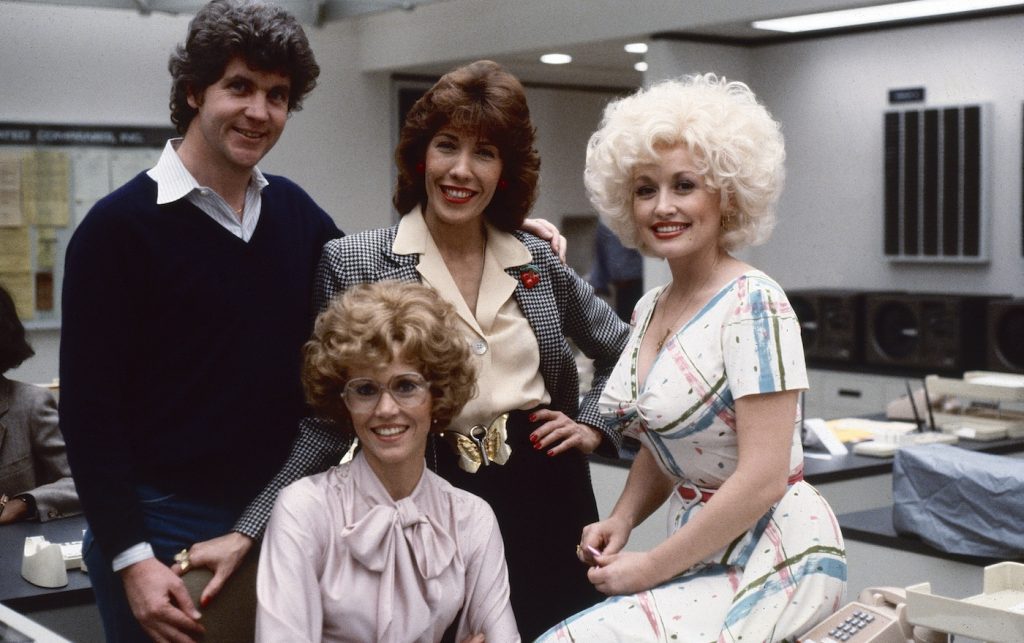
Dolly plays Doralee Rhodes, Hart’s secretary, who is unfairly sexualized by office gossip thanks to Hart’s constant harassment and lies. As 9 to 5 begins, Hart has the upper hand, exploiting Violet, harassing Doralee, and condescending to newbie Judy. Once the three women realize they’re allies, they turn the tables on him and expose his depravity. They also institute changes in the company, creating a proper meritocracy with flexible scheduling, childcare support, and a more humane workplace environment.
The film plays broadly as a farce, but the combustible chemistry between Fonda, Tomlin, and Parton is seriously electric. Acting next to two bona fide stars in Fonda and Tomlin, Parton was simply magnetic. It didn’t hurt that she’d been on screen plenty before; she’d hosted her own variety series, award shows and specials, and had been on The Porter Wagoner Show, but 9 to 5 proved that film was yet another medium that Dolly Parton could command. Simply put, Dolly had it. She had it in spades. As Wesley Morris wrote in the New York Times, “Nobody in movies talked the way she did, with a stagy candescence. ‘You know what burns my ass?’ she asks Burt Reynolds in their popular 1982 musical comedy The Best Little Whorehouse in Texas, ‘A flame about three feet high.'”
9 to 5 was a mega-hit. It grossed $103 million in an era when a movie centered on three women and workplace empowerment was, to put it mildly, not the usual cinematic fare. It set the table for the hit films that would follow years and even decades later, including The First Wives Club and The Devil Wears Prada.
Parton didn’t just have a key role in 9 to 5; she also wrote and performed the film’s iconic theme song, which became a massive hit. Parton didn’t have her guitar handy between takes on the set to work out the song, so to keep a steady tempo and build a beat, she began clicking her long acrylic fingernails and realized it sounded like an old office typewriter. That percussive rhythm made it into the final recording. In the liner notes to the album “9 to 5 and Odd Jobs,” her manicure receives an official musical credit: “Nails by Dolly.”
Dolly’s theme song reached No. 1 on the Billboard Hot 100, Hot Country Songs, and Adult Contemporary charts in early 1981. Parton’s hit became associated with working women and earned her Grammys for Best Country Song and Best Country Vocal Performance, Female. It was nominated for an Academy Award for Best Original Song.
She worked steadily in film after 9 to 5, with major roles in The Best Little Whorehouse in Texas (1982), Rhinestone (1984), Steel Magnolias (1989), Straight Talk (1992), and The Beverly Hillbillies (1993). She proved she wasn’t a novelty casting choice, but could also, as Steel Magnolias proved, be a winning part of an acclaimed dramatic-comedic ensemble. Her film tenure was brief but potent. She came, she starred, she conquered.
Dolly Parton’s gifts were many. Her musical chops were truly the stuff of legend, and in her film roles she brought the commitment and courage she gave her first love to a very different art form, investing her roles with warmth and wit in overflowing abundance. Many musicians cross into film and do a wonderful job. Dolly Parton was different, though, in that she never seemed to be trying to become a different type of star. She just brought the spark that lit up her music to the screen. She made it look easy; she made it look natural, but as any committed artist will tell you, that’s what it can look like when you work really damn hard.
Featured image: DECEMBER 1980: Country singer Dolly Parton acts in a scene from the movie “9 to 5” which was released on December 19, 1980. (Photo by Michael Ochs Archives/Getty Images)