
How “Sunday Night Football” Is Made: Fred Gaudelli on America’s Most-Watched Show and a Catch for the Ages
NBC‘s Sunday Night Football has been primetime television’s top-rated program for 15 consecutive years, and executive producer Fred Gaudelli plans to keep it that way. Of course, he has help. Lots of help. Every week, a crew of some 200 camera operators, editors, producers, replay operators, graphics artists, researchers, audio engineers, and other staffers converge on a major American city and set up shop in six or seven mobile studio trucks packed with state-of-the-art gear.
“It takes an army, really,” says Gaudelli, speaking from his office at NBC Sports Production Operations Center in Stamford, Connecticut. “When you are collectively preparing for a three-hour event, week after week after week, you want your preparation to pay off, and you want your execution to be flawless.”
A 29-time Emmy Award-winning producer of 34 consecutive NFL seasons, Gaudelli has worked with legendary sportscaster John Madden and witnessed quantum leaps in technology since his early days at ESPN, when cameras still used videotape and had to be rewound in order to show not-so-instant replays.
In conjunction with World IP Day on April 26, which celebrates efforts to protect intellectual property rights by blocking pirated streaming sites, Gaudelli talks football. He describes the rigors of pre-production homework and talks about the unsung heroes working behind the scenes to capture football magic, including the catch that is arguably the most famous in NFL history.
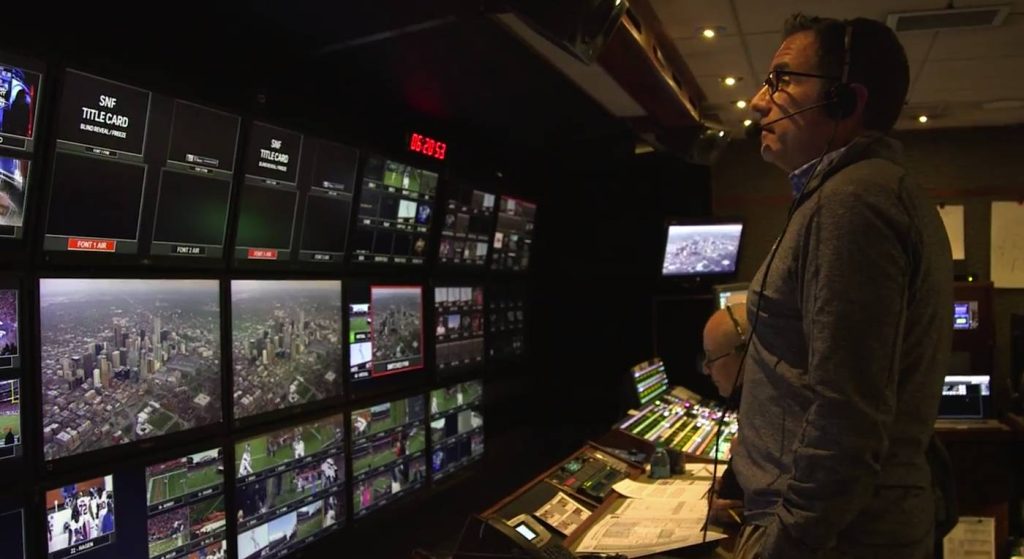
Sunday Night Football feels like such a seamless broadcast experience, with the only visible mistakes committed by athletes on the field or coaches on the sidelines. But it must require an enormous amount of planning to build a live telecast from scratch every seven days. With Rob Hyland now handling the day-to-day, you’ve moved into the show’s executive producer slot. But during your decades-long tenure as lead producer, what did your work week look like?
For me personally, it was seven days a week, 105 hours. There are about 30 [core] people who also work on Sunday Night Football seven days a week, and probably another 175 who work on the technical and operational end.
So how would the schedule play out?
Sunday night, we’d fly back home, and on Monday, I’d watch the game we just broadcast and grade it, identifying what we did well and what we need to improve. I’d address that with each individual group, whether it be the edit group, the camera, the replay group, or the announcers.
Middle of the week?
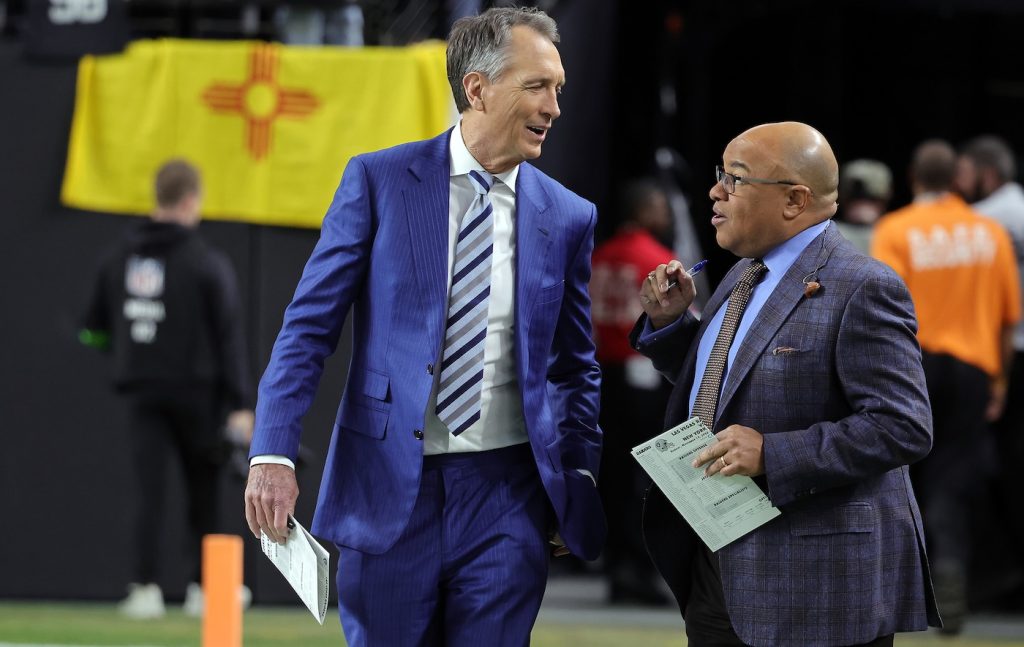
On Wednesday, we’d have a three-hour meeting with the entire production team. The first hour and a half, everybody would do what we called “One up, one down”—One thing we did well and why, and then one thing we didn’t do well or could have done better and why. Then I would give an overall critique.
What’s the second half of the meeting?
We move into this week. If it’s New England versus Indianapolis, for example, we’d obviously focus on Peyton Manning and Tom Brady. Everybody has to come to the room with three non-statistical ideas per team that would make for good storytelling.
Thursday?
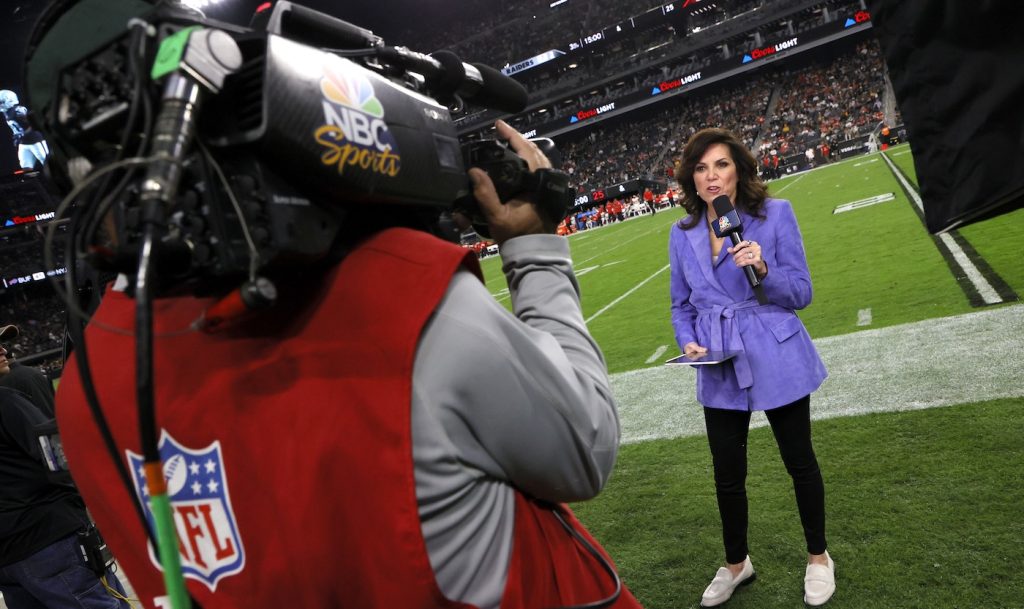
Thursday, I meet with the sideline team. Either Andrea Kramer for the first six years or Michele Tafoya for the next 11 years, and her producers. We identify the people she should be speaking to and the stories to pursue. We also do the initial coverage plan for replays and isolation [shots]. Then we’d fly out on Thursday night.
So, on Friday, how do you capitalize on being in the home team’s city?
We go to the home team practice and meet with the head coach, the quarterback, and two other players. Then we’d go back to the hotel and watch two hours of the home team’s previous game to get a sense of who was playing well and who wasn’t. We’d have a quick production meeting to make sure everybody knows their responsibilities now that we’re in the town of the game. Also on Friday, the trucks would pull in and start getting set up.
How many trucks?
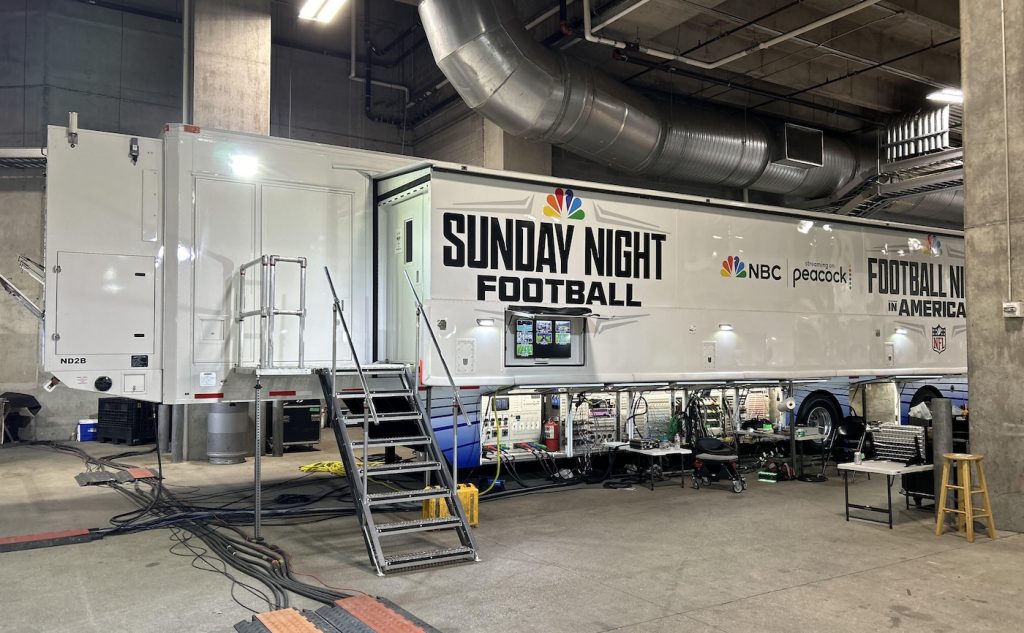
It takes about seven trucks to do Sunday Night Football. There’s the main unit, with the control room where the producer, director, and associate director sit. There’s the video truck, which houses all the control units for the cameras. There’s a truck where the audio submix guy mixes sounds from the field. There’s a replay truck with all the replay equipment in it. There’s a truck for virtual graphics like the “First and 10” line. And there’s a maintenance truck for when things need fixing.
Quite a contrast from when you started out at ESPN!
At ESPN [in the 90s], we’d probably have two or three trucks, maximum. Now it’s a good two-day setup to do it right.
What happens on Saturday?
We watch the coach’s tape of the visiting team, solidify our isolation replay plan, meet with the sideline team to see what stories they were able to obtain, and figure out what Michele or Andrea would do in the opening of the show. Next, we’d meet the visiting team’s head coach, the quarterback, and two players. Then I’d go to my room and try to put the entire thing together, kind of playing this game out in my mind.
Game day Sunday, how many camera operators do you have on the field?
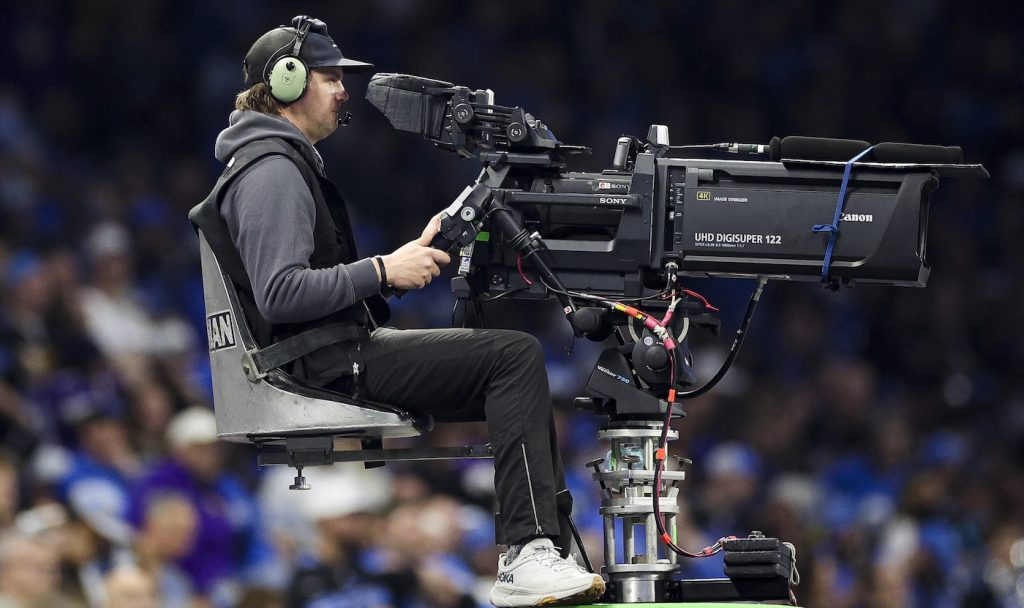
There are probably 25 to 30 cameras that are actually shooting the game.
Is there a director of photography overseeing the camera crew?
No. Our director, Drew Esocoff, is the supervisor of the cameras. They’re executing his commands and executing the collective vision of the production team. Each camera operator knows their responsibilities on every single play.
For example?
Camera 2, at the 50-yard line, would have play-by-play coverage from snap to tackle when the ball is between the 35-yard lines. As soon as he wasn’t the game camera, the replay producer might tell him, “Camera 2, follow [player] 83 white.” That’s his responsibility, unless 83 leaves the game, and then he has to know his next responsibility. These [camera] guys really have to understand the game, they have to study, and they have to execute in the moment. It’s not easy.
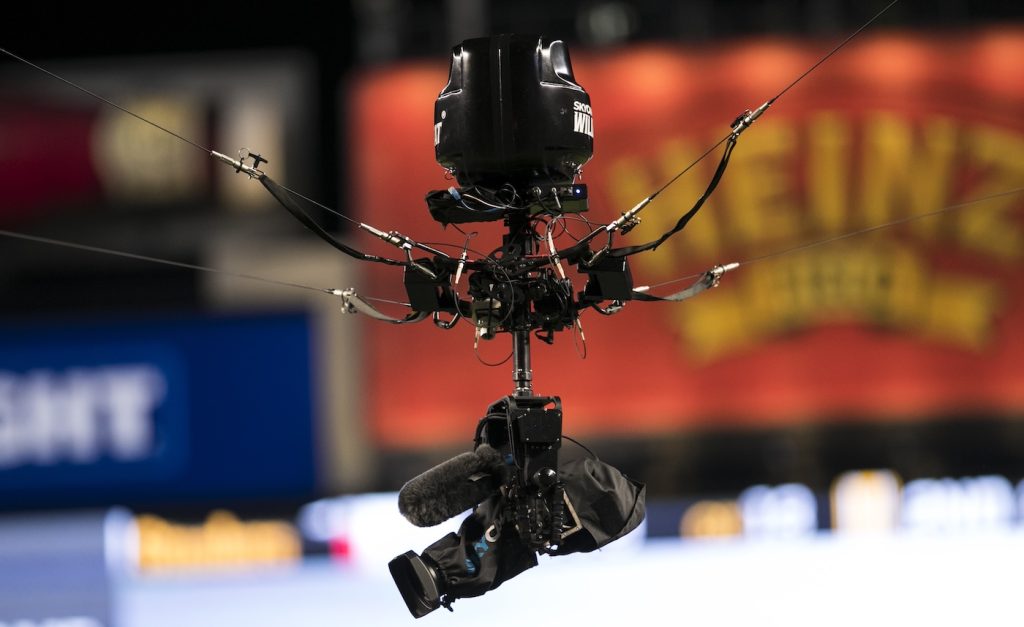
So you have camera operators on the ground and in the air, the SkyCam, which revolutionized football coverage when it was introduced around 2002. How do you get that system up and running?
SkyCam has eight riggers. It’s mounted at four corners of the stadium, so they have to install a pulley system, rig the camera, and set up the cables, which are smart in that they generate data. Then there’s a pilot who actually flies the camera, an operator who’s got two joysticks to operate it, and a couple of technicians.
You mentioned a dedicated truck for sound mixing. How does that work?
We have a submixer sitting in his own control room who gets sounds from four parabolic mic operators. They’re the guys on the sidelines holding dishes with the mic in the middle, pointing at the action to pick up the sounds of pads, the sounds of the quarterback, sounds that are organic to the game. Also, the NFL provides a feed from a microphone on the back of the center or a guard, so we can hear the quarterback at the line of scrimmage. The submixer takes all that and makes a composite sound, which he sends to the A1 overall mixer. He blends it with the announcer mics, the crowd mics, any music that he might be playing, and sound effects for graphics. It’s not a simple system.
It seems almost like a Wizard of Oz behind-the-curtain type guy orchestrating all these audio levels in the moment.
There’s definitely an art to it. Our A sound mixer is a gentleman named Wendel Stevens, and we think he’s the best. Whether it’s his music selection or something to pump the crowd, Wendel’s very nuanced and very good at running our audio operation.
By the time the coin flip happens on Sunday night, you’ve organized all these high-tech tools to capture the live game visually and sonically. But as you mentioned earlier, it’s also important to be prepared with storylines that add depth to the event. What comes to mind as an instance where pre-production research paid off?
I’ll give you a good one from the past. We did a Giants game [in 2014], and it was Odell Beckham Jr.’s rookie season. When we went to practice on Friday, Al Michaels asked the coach, Tom Coughlin, “I know it’s been a terrible year, but give me a bright spot.” Tom said, “Odell Beckham.” We noticed in pregame warmups [from previous games] that Odell liked to put on a show, catching balls with one hand and jumping, like, 48 inches in the air. So, when he came out at our game for the warm-up, we had all the cameras on him. We edited it together, put it to music, I think it was Frank Sinatra, “Come Fly with Me.” We ran that package near the end of the first quarter, and it was amazing. No one had done that before.
And then NFL history happens…
Then, in the second quarter, Odell made the one-handed catch that is probably the most famous catch in NFL history. Well, because we had spoken to Beckham at our Friday meeting, he told us that his dad’s roommate at LSU was Shaquille O’Neill, his mom was a champion sprinter, he’d gone to the same high school in Louisiana as Peyton and Eli Manning, and he played on the U.S. Junior National soccer team. Now, we’ve already set up the fact that he’s got crazy skills, and then he makes that catch, which we cover like eight different ways, and then we can also talk about his personal life. We were able to tell a complete story about a player that most of the country [at the time] didn’t know about. That’s where storylines and preparation meet. When you do what we do, that’s what you live for.
Preparation, preparation, preparation. If you had not done the homework…
You would have just shown the replay, and that would be it. But because we’d been alerted to the fact that this guy has special skills, and then to also illuminate the person behind the athletic achievement? I mean, that’s what it’s about.
Featured image: November 23, 2014: New York Giants wide receiver Odell Beckham (13) pulls in a 43 yard touchdown catch during the second quarter of a NFL game between the Dallas Cowboys and New York Giants at MetLife Stadium in East Rutherford, NJ (Photo by Rich Kane/Icon Sportswire/Corbis/Icon Sportswire via Getty Images)