
How the Oscars Production Designers Misty Buckley & Alana Billingsley Prep the Stage Long Before Movies’ Biggest Night
The production designers Misty Buckley and Alana Billingsley are the creative force behind the look of major live television extravaganzas, including the Grammys, the Super Bowl halftime show, and numerous Academy Awards. The two artists, who had crossed paths for years before teaming up, took home an Emmy Award in 2024 for their exceptional design work on the Oscars. As crucial members of the production team for live telecasts, they are responsible for creating the show’s visual environment. They choose everything from the set design and virtual scenery to the program’s overall look and feel, ensuring it aligns with the event’s creative vision and technical requirements.
Buckley (who’s based in the U.K.) and Billingsley (who lives in Burbank, Calif.) acknowledged that a large-scale award show, like the 97th Oscars last year, is a lengthy process that can take up to 10 months to plan and involve a core team of art directors, illustrators, concept artists and a department coordinator, which is why the pair communicate daily via WhatsApp while putting the Academy Awards “on its feet,” as they say. “Our team has been working together on this show for more than eight years, and that leads to an understanding of the rhythm of the event, which has been key to our ability to be more creative inside the parameters of a live three-hour ceremony,” said Billingsley, who started out designing scenery for plays. “There’s a lot of overlap between theater and live television because the parameters are the same: you’re working to a proscenium and to an audience, and you have to solve design challenges to execute in real time.”
No one wants something like the set malfunction that was the centerpiece of an extended bit at the recent Oscars. While making his entrance from beneath the stage, presenter Ben Stiller got stuck and graciously tried to go back down, but was then forced to climb out of a stalled elevator. What made it funnier was that Stiller was presenting the award for production design. Moments like that not only helped the 97th Oscars rack up more than 104.2 million total social interactions (making it the No. 1 most social TV program, season to date), but also delivered a five-year high in total viewers (19.69 million), according to Disney-ABC.
“There’s a sense of relief when the show has gone smoothly, and all the set elements and moving parts behaved themselves,” said Buckley, whose credits include world tours for Ariana Grande and Kacey Musgraves. “We just have to get on with it and work around any issues.”
The Credits recently spoke with Buckley and Billingsley about their favorite looks from the 97th Oscars, collaborating with screen producers and the nuances of a live television production.
I have to ask about what you created for the production design category, presented by Ben Stiller. His hilarious introduction, with a deliberately glitchy stage elevator, highlighted the importance of meticulous planning and execution in production design. That had to be fun. Did you guys pitch that idea?
Billingsley: Ideas for moments in the show come from all over. We’re not always in the writers’ room or the executive producers’ talent meeting. This idea was pitched to us, like, hey, we have a comic beat of him with the elevator in the theater, can we play with the existing infrastructure in this way?
Does that kind of live-television epic fail keep you up at night?
Buckley: Generally, in live TV shows, we all prefer as few mechanical parts as possible. Human power is definitely preferable.
Billingsley: Anytime anything is moving, you need a backup plan. You call things like that “show stoppers.” On any show, you always want a contingency plan, which is why I love being in a full fly house [that’s the area of the theater above the stage, typically with a grid of metal bars, used to store and lift scenery], like the Dolby Theatre. It has a counterweight system, and you can build scenery in a way that’s very theatrical. The other thing worth noting is the virtual scenery you see extended in the LED screens behind Stiller. It’s this sort of circular gold tile mosaic that was so beautiful. That was created by a gentleman named Mark Allen. He’s the screen producer, an important creative collaborator on many live television event shows. We have the physical architecture; we have the space; we understand how we’re going to use this stage; and some of those surfaces are effectively identified as LED screens. To put it simply, that’s the canvas where we get to play digitally. It’s a critical part of the creative process in terms of, as we refer to it, “putting the show on its feet.”
What was the theme or inspiration for the 97th Oscars?
Buckley: The theme was “The Alchemy of Filmmaking.” Inspired by that brief, our stage was designed as a temple-like space to celebrate the process of connected creation. The dramatic modern structure begins with the broad base of the pyramid shape, allowing space for the many unique crafts that combine to make a truly exceptional film. The pinnacle achievement of those myriad voices is celebrated at the peak of the pyramid, haloed by the marquee header.
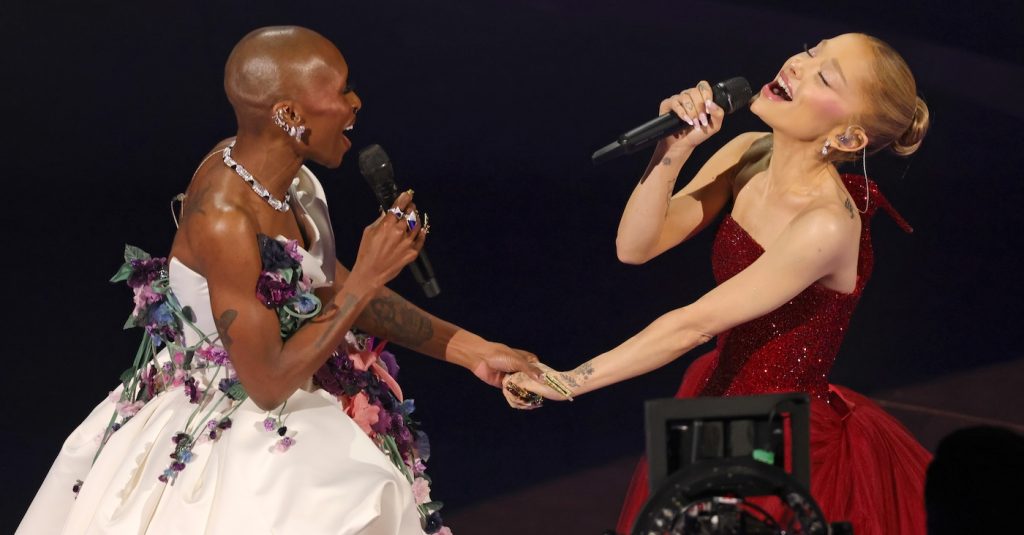
Is that your favorite look?
Billingsley: Yes, within the environment of the primary stage architecture, there was a particular scenic element that really spoke to the theme of alchemy. There’s the puddle of gold at the bottom, and Oscar’s sort of emerging from it, along with veins of gold rising optimistically through fields of blossoming reds. It was designed to be both celebratory and inspiring.
For the costume category, when presenters from each nominated film took the stage, it looked like giant stage curtains were falling from above, with sketches of the character costumes.
Buckley: With the different categories, we try to communicate the skill and craft into the award presentation on stage. Costume drawing is a very difficult skill because you not only have to be able to convey the actual design details, the historical accuracy, and the colour palette of the costume, but you also need to capture the character’s personality, gestures, and mood – all in one little sketch. It’s really hard, and I have the utmost respect for this skill. It’s important to draw attention to this as the costume is not just about the finished garment. There are hundreds of decisions that go into that one little drawing. It’s important to all of us on the Oscars that we celebrate the process.
What was the idea behind this ancient-looking symbol for the editing category?
Billingsley: “We also developed this content in collaboration with our screen production team. The brief here was to imagine a digital project timeline, such as an edit session, rendered in ancient materials. We wanted this to feel like a ruin or some mystical codex that would unlock the story hidden within any rough cut of a film, if you could just adjust the pins properly.
Speaking of timelines, what were the major phases involved for you on the 97th Oscars, and when did your work begin?
Buckley: Creative meetings began in May of 2024. The major design development work happened over the summer of 2024. Technical drawings were completed and set to bid in Fall 2024. Construction began right around Christmas of 2024, and installation in the Dolby Theater began in the first week of February.
Two years ago, you decided to move the orchestra pit, which had lived under the stage for years. What inspired that move?
Buckley: The placement of the orchestra onstage is a great example of one of the changes we were confident bringing to the show, only after our many years of experience with how the orchestra related to the show. Once the conceptual adjustment was agreed upon, the technical execution was a matter of working with our trusted staging vendor, All Access Staging. With their expertise, we designed a structure that both supported the entire orchestra and provided ample, clear working space under the loft for the infrastructure of the rest of the show.
What did musical director Michael Bearden and his 43 musicians think of their new digs?
Billingsley: Honestly, I think they loved it. It’s far roomier than the actual orchestra pit at the Dolby. Misty and I were interested in finding a creative way to honor and use the orchestra, not just for the sound it makes; we wanted to bring them to the forefront. We wanted the moments we were with them to be high-quality visual moments, and to make them more important on the air. The show benefits so much from the life of the orchestra. That music carries us through the show, and it tells the story of the movies, and I think it brings a level of entertainment that makes the night fun for the people in the room. You see [the British singer] Raye and the relationship shots of the person singing and the musicians behind them just feel so natural.
You are both part of the often unseen yet essential infrastructure that makes Hollywood the world’s production capital. Can you talk a little bit about some of the local vendors and crew you hire for what’s going to be a really tough job, and what makes Hollywood a great place to make film and television?
Buckley: As a British designer in L.A., I am still in awe of Hollywood, its history, talent, and imagination. The scenic artists, sculptors, carpenters, and makers at the set shops are so wonderful to work with. I love going into their workshops, which are like a wonderland of paint samples, glitter, textures, and an array of finishes, and then you’ll spot a photo on the wall from a texture from a famous movie or a maquette for a recognizable piece of scenery. It’s still so thrilling.
Billingsley: Yeah, I mean, one of the reasons I chose to live here is because I felt like it was an industry town, and we have the privilege, on the Oscars in particular, of designing and creating some really fun fantasy spaces. In any given year, 95% of anything you see on the show is built by vendors within an hour’s drive of the Dolby Theatre. So we get to work with these amazing artisans, like sculptors. There’s always a lot of foam sculpting and beautiful scenic finishes. There are scenic painters who are completely inspiring and there are people that, at other times of the year, work on feature films or big commercials or television shows and when Oscars time rolls around, they lend their skills to the crafting of the show so that, hopefully, everything you see on the awards show is up to the same standard that anyone would expect for a feature film.
What happens to all these stunning sets after the show?
Billingsley: There are many infrastructure elements that we save in a warehouse in L.A. for use over multiple years. Examples include the marquee header and the stage where winners accept their awards. The other elements that are not practical for reuse are broken down and disposed of or recycled, particularly steel.
So what do you do during the show? Do you get to watch it?
Buckley: The Oscars is the one show where I’ll sit in the audience and just soak it in. I usually go and watch a show from the back of the room. It’s such an intimate space, and everyone is really rooting for each other; it’s a warm and beautiful environment.
Billingsley: Last year, I spent about half the time backstage. I just love watching how the show functions after spending weeks there installing it. It’s gratifying to see it come to life, and then I sort of make my rounds and thank all the people. I have no physical work to do. I’m just there to enjoy the night.
Featured image: Conan O’Brien at the 97th Oscars held at the Dolby Theatre on March 2, 2025 in Hollywood, California. (Photo by Rich Polk/Penske Media via Getty Images)