From Bauhaus to Frankenstein: Production Designer Karen Murphy’s Radical World-Building in “The Bride!”
For production designer Karen Murphy, one of the perks of the job is all the history lessons. The Oscar-nominated production designer behind Elvis returns to the past with The Bride! — immersing herself in photography and modernist architecture from the 1930s. Solarized portraits by Man Ray and the avant-garde photography of Marianne Brandt were among the many influences on her work in writer/director Maggie Gyllenhaal’s monster romp.
The artist began her career as an architect. She studied in Sydney, Australia, before ultimately joining Catherine Martin’s art department on Moulin Rouge! and became a frequent collaborator of Baz Luhrmann. After her days as an art director on The Matrix and Star Wars franchises, she went on to become the production designer on films such as A Star Is Born and Queen & Slim.
For The Bride!, Murphy creates a lived-in, crumpled, and imperfect yet forward-moving world for Ida (Jessie Buckley). Following her resurrection at the hands of Dr. Euphronius (Annette Bening), she goes on a journey of self-discovery and violence with her love, Frank (Christian Bale). Ida experiences the wonders and wickedness of Chicago, New York City, and life on the road, all of which Murphy crafts with history and style.
Here’s how the talented world-builder set the stage for Gyllenhaal’s electric second film.
The film was shot extensively in New York, so how was it turning the Big Apple into Chicago?
In the end, we didn’t use a huge amount of New York for New York. We built a lot of sets, but we were trying to find the Euphronius house. The minute I started reading the script, I was just thinking about the 1930s. To me, the 1930s are a real time of change. The US was a little late to international architecture, such as modernism, because it was still stuck in the revival period through the 1920s. When a lot of the European immigrants started coming over in the ’30s, it’s when things really started to change.
Where’d you find the exterior for Dr. Euphronius’ house?
I thought we wouldn’t find a single piece of modernist architecture on the exterior of Euphronius’s house. There are examples of 1930s houses in New York City, but the problem with those is that they already look old. They should have been brand new during this period. We went up to Riverside Drive, near Columbia University. There are many larger homes in that revivalist or early 20th-century style. We found a gothic revival house on a corner, and I knew we needed a corner for these iconic shots.
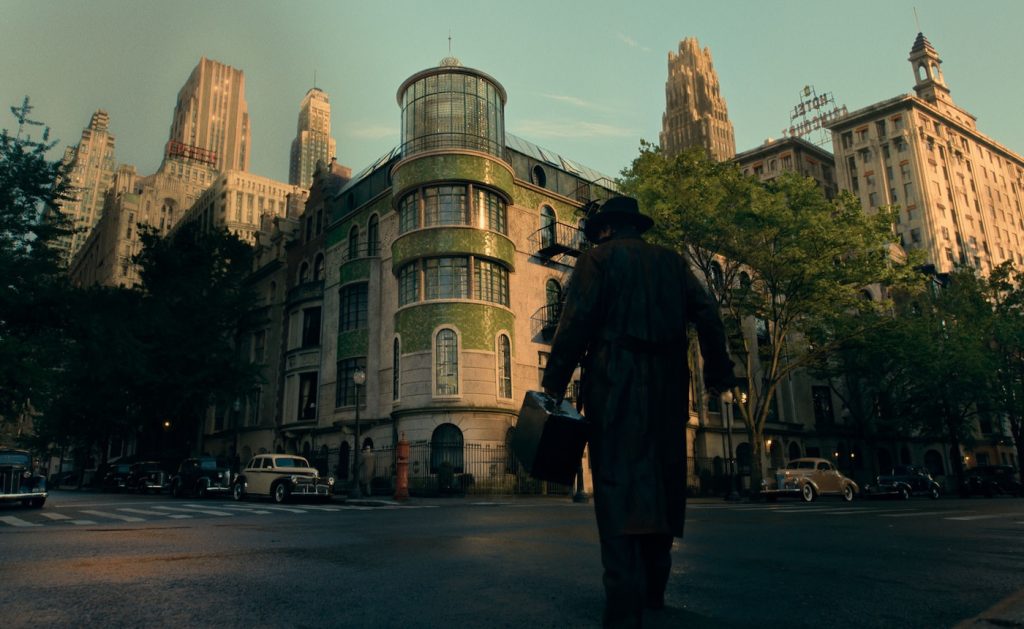
It’s a nice mix of the past and the future, especially with its tower.
I was always going to put something modern on top of it. We could imagine this modernist thing Euphronius did to the top of the house in the late ’20s, early ’30s. She’s got this old house that’s sort of falling down, and then she’s put all these modernist elements within it.
What about the interior of Dr. Euphronius’s house and lab? When you read a character such as her on the page, how do you want the space to tell her story?
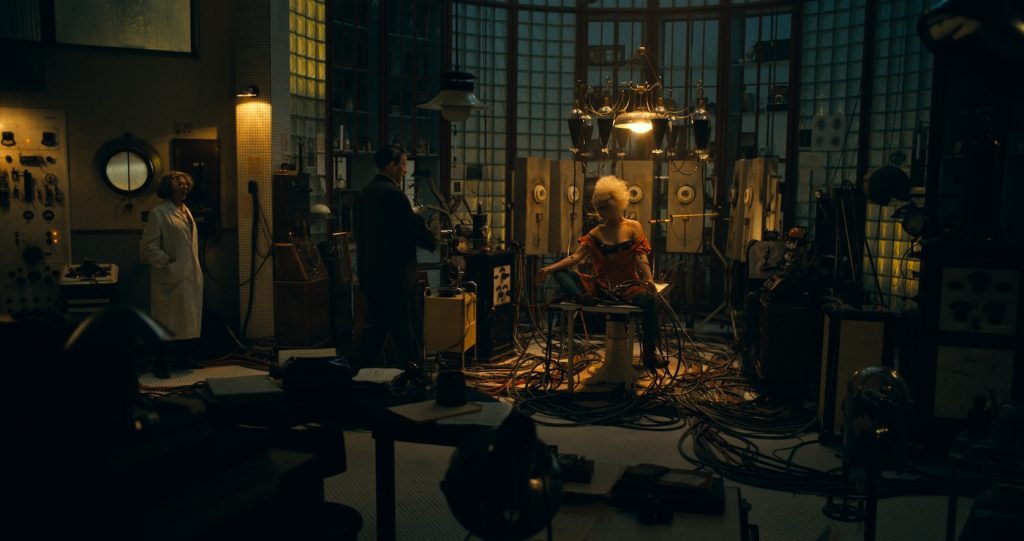
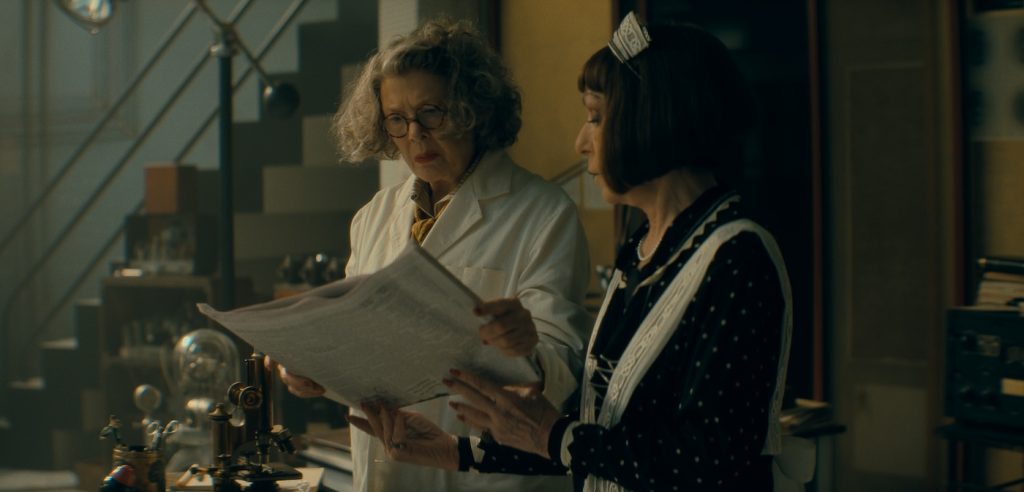
In the movie, they mention a black hole. It was a period when quantum physics was discussed. We were leading up to the Manhattan Project and the atomic bomb. It was this incredible, verdant period of science, design, and art. That’s what got me going. Who is this woman? She is writing books on singularity, which is maybe a little anachronistic, in that those were written later. This woman is a woman of science, but I bet she’s friends with all these photographers, these women who were coming up in art and design out of Europe.
Such as?
Florence Henri and people like that, who were doing contemporary things with photography. Eileen Gray, the Irish designer who worked alongside Le Corbusier, was doing her own furniture and design. I kept thinking of these women on the cutting edge of international design at the time. To me, that’s Euphronius. Her place is filled with all of her friends, all these people. Even the teacups she’s using at the table are these avant-garde, Art Deco, clear, translucent teacups. Everything that had to do with her world was about now and modernism in terms of the ’30s.
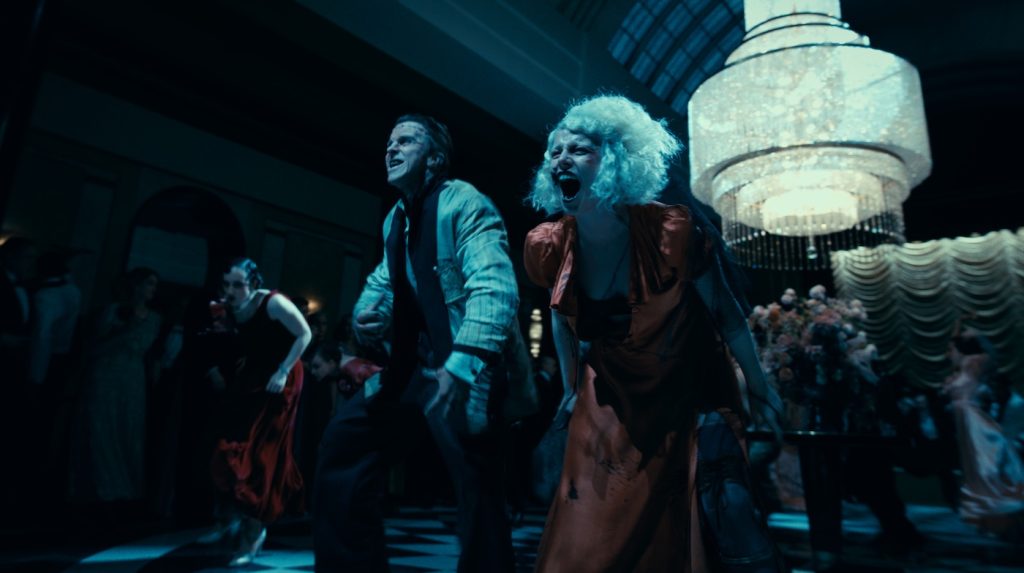
Maggie Gyllenhaal wanted to create a punk piece of art. You can especially see that in the underground club. How’d you want to go more punk with that setting?
One of the first times we were able to really dig into the punk of it all was when Frank walked past that underground club. When they later go into that club, The Bride connects with that. She wants to go there. To us, that was a place like, if you know, you know. It’s a bit like the Mud Club in Tribeca in New York, or the Caravan Club, which was a queer club [in London] that got shut down in the 1930s. I found all these old photographs of the Caravan Club and then mashed that up with these New York underground clubs from the 1980s, where misfits and weirdos would go.
What about the graffiti and colors you wanted for the club?
There’s graffiti, but it was 1920s, ’30s graffiti. The music is also slightly anachronistic. Everything that was going on in that space, design-wise, costume-wise, music — everything bleeds into that territory between the punk aesthetic of the 1980s and the subversive nature of the 1930s. These underground clubs that were in existence that you read about, but really, they existed for maybe a year or two before they were shut down, and everyone was arrested.
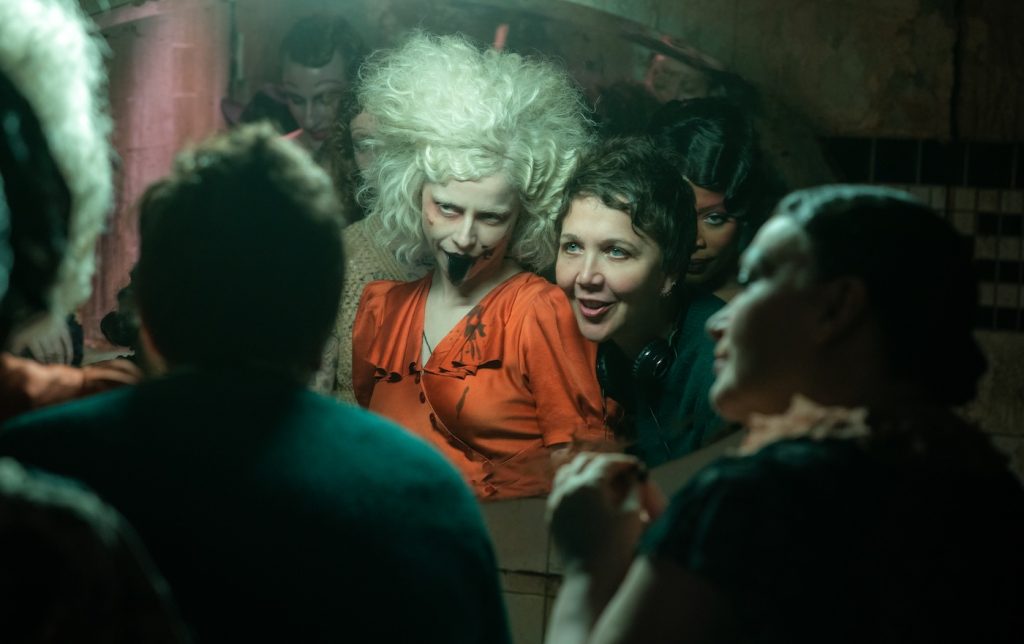
Where’d you source some of those club photographs? How else did they inspire your work?
The National Archives in the UK have photographs of the Caravan Club. There are very few of them, just black and white, but they’re great. They’re so evocative because they look like photographs taken after a night there. There are drinks on these tables, pieces of tapestry fabric hanging from the wall in this tiny space. There’s also hand-built furniture, so we went for that aesthetic. My set decorator, Rena DeAngelo, and I focused on making that space feel DIY. They had taken over a space and made it their own, this underground club, which is exactly the vibe of the Caravan Club.
You got to make Times Square your own, which sounds like great wish-fulfillment for a former architect. Did a part of you think, ‘I want to make a ’30s Times Square that I want to step into?’
We were trying to bring some of the European influence into it. If you look at all the Times Square equivalents around the world — Piccadilly Circus, or parts of Berlin, or Paris — there is so much neon signage and color and modernism in those cities. Everyone knows what Times Square looked like at the time. There are plenty of photographs of it. There’s even old footage of it, blinking lights and all of that. We were trying to retain that, but we also wanted it modern, our own thing, because no one can shoot in Times Square these days. We had to create a backlot, and we needed the cinemas to be where they needed to be for the action and story. It’s a mismatch of ideas. It’s run-down, but it’s still this incredible, bright space of cinema and creativity.
The Bride! is in theaters now.
Featured image: Caption: Jessie Buckley as The Bride in Warner Bros. Pictures “THE BRIDE!” a Warner Bros. Pictures release. Photo Credit: Courtesy of Warner Bros. Pictures