
Oscar Winner Jenny Beavan on “The Choral,” Ralph Fiennes, and Her Mother’s Wartime Love Story
Screenwriter Alan Bennett has given us The Madness of King George and The History Boys, and his latest film, The Choral, stays true to the writer’s oeuvre of zeitgeist-shifting English epic. Set in 1916 in Ramsden, a fictional Yorkshire mill town, the film follows the travails of the local Choral Society, which is determined to boost wartime morale by inviting young men to join their ranks and engaging a new choir master, Dr. Henry Guthrie (Ralph Fiennes). But Dr. Guthrie has something to hide, and two years into World War I, Ramsden cannot escape the war’s tragic effects, from telegrams delivering the worst possible news to the anticipatory dread felt by local boys like Lofty (Oliver Briscombe) and Ellis (Taylor Uttley) as their 18th birthdays draw near.
Directed by Nicholas Hytner (The Crucible, The History Boys), with Dr. Guthrie’s choice of Edward Elgar’s “The Dream of Gerontius” as the film’s musical crux, The Choral’s characters deal with repressed passions and young love as much as they confront the threat of war. For Clyde (Jacob Dudman) and Bella (Emily Fairn), the two issues are all tied up in one another — Clyde loses an arm at the front, and returns to Ramsden, only to discover he’s lost his fiancée, too, who thought he’d died. Their unusual love story resonated for costume designer Jenny Beavan (Mad Max: Fury Road, Furiosa, The King’s Speech), whose own mother was engaged to a soldier in World War II, who was led to believe he’d perished, and ended up having an affair, however legitimately, with Beavan’s father.
The Choral did not have an extensive budget, and Beavan outfitted the film’s cast almost entirely through the legacy UK rental house John Bright. Working with photography of the era as inspiration, Beavan relied on a muted color palette and accessories to convey Ramsden’s working-class roots, which was further illustrated by the fact that many of the characters didn’t have many clothes at all. We spoke with Beavan about making The Choral work on a tight budget, outfitting Ralph Fiennes, and how her personal connection to the film influenced her process.
For a period piece set in 1916, where do you start your historical research?
There’s a lot of photographic evidence. There are pictures of millworkers in mill towns in Yorkshire in 1916, even some film footage of them coming out of the mill. That was really interesting, because they were wearing a lot more boaters, and some were in bowler hats, which I didn’t do because they would have been slightly startling. With a film like this, in a funny way, you don’t want to notice the costumes. You really want to know the characters.
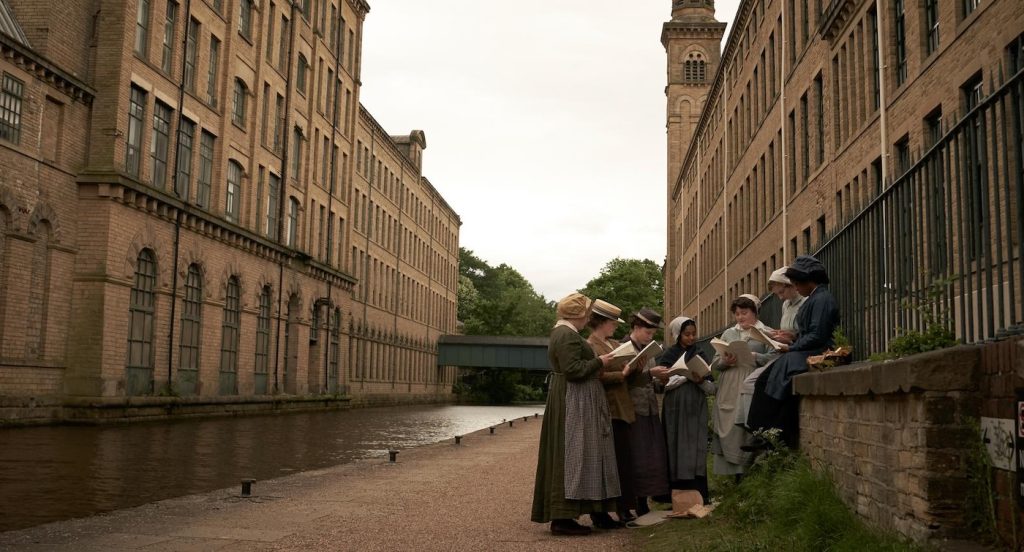
Was it challenging to outfit the characters so credibly, in line with photographic evidence of the time?
I had a bit of a problem finding civilian clothing because so much attention has been paid to the military in the First World War, and we had an incredibly small budget. The costume house I always work with is John Bright, who was my design partner and is still one of my best friends. It was best to stick with one. They do have the best stock. It’s incredible, that place. That was my source of the actual costumes. The research was great. Our director, Nick, was sending me photographs he found in books, and we had shared albums where we could put our thoughts, share information, and list locations. The minute you’re into photography, there really is some great, really valuable stuff out there.
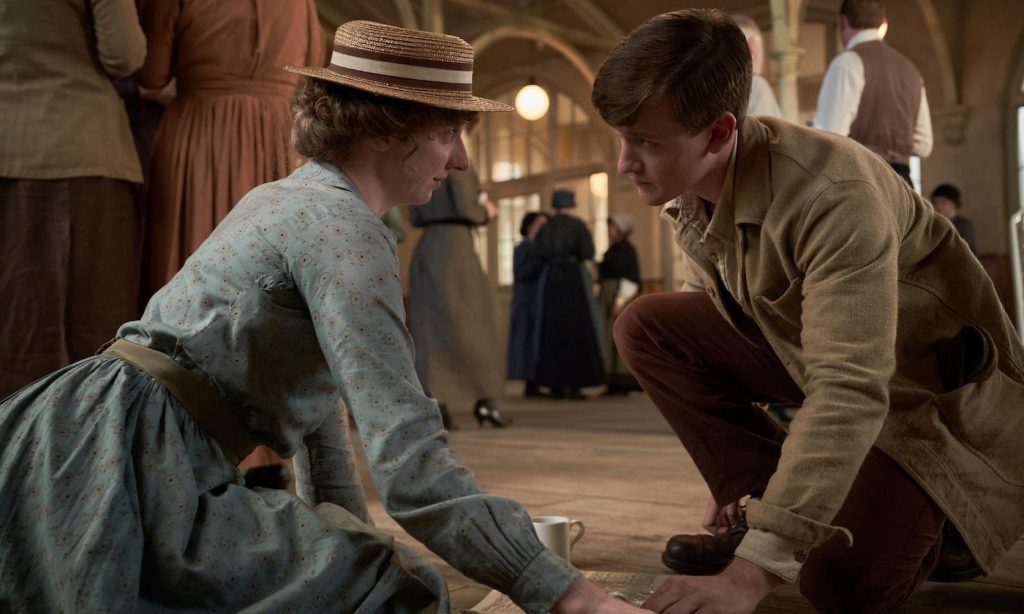
With the film set in Yorkshire, were there costume aspects you either went for or avoided to make it clear to viewers that this isn’t London?
Alan Bennett came to visit us on the set, and I said, I’m so glad you wrote this about a town in Yorkshire in 1916 and the working class, because people didn’t have many clothes. That meant you gave it truth by not overloading people with different changes. They got two outfits each, and then you ran the changes around cardigans, small differences, which is very much what they would have done. It probably shows any working-class community, not particularly Yorkshire. But I have an instinct, when I look at a piece of clothing, as to whether it’s the right feel, and I knew my colors were going to be grays and blues and browns. We were very lucky, because it wasn’t very sunny, and it doesn’t want to be a bright sunny happy film. It’s hilarious, but there’s tragedy and the whole background of the war.
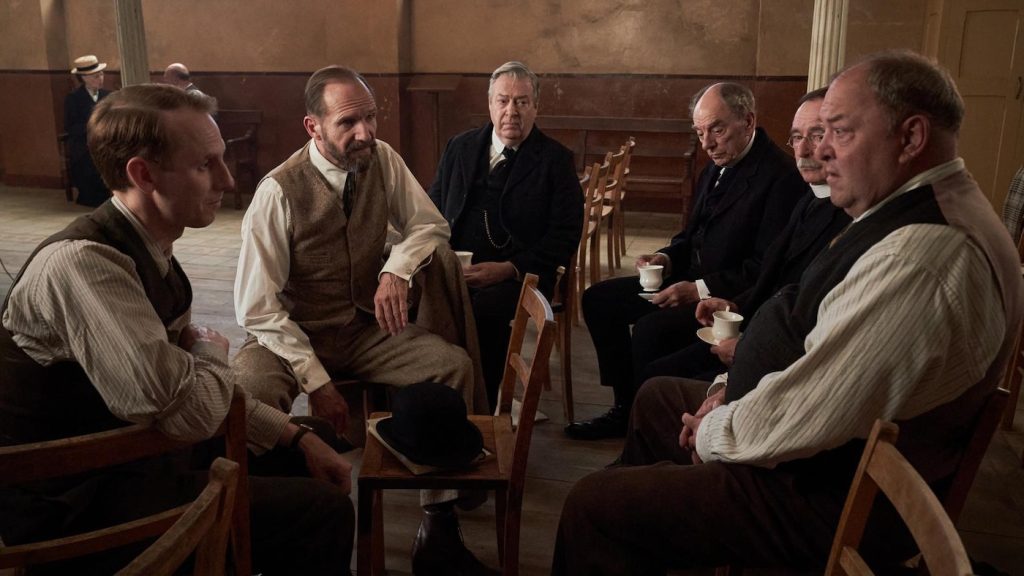
How was outfitting Ralph Fiennes and hinting at his life in Germany?
I was so lucky with that suit. That’s a cos-prop suit, really quite old. When you use old stock, it’s got a life. It doesn’t look brand spanking new. I was looking for something that didn’t overtly say German, but something you could’ve bought in Germany. He was thrilled with it. Then we gave him a black outfit for performing. Not a full evening suit, but a nice black jacket and trousers. He came on one day, and he’d worn this black outfit before, and he went, Jenny, you’ve given me trousers without pockets! My wonderful assistant, Lauren Reyhani, shopped pockets in them overnight, and he was very grateful. He’s definitely incredibly hardworking, committed, serious about the work. I think this performance is one of the best I’ve seen him do.
How was Bella and Clyde’s story reminiscent of an aspect of your own family history?
My mother was engaged to a fellow musician. He went off to the Second World War, and I think she thought he’d died. Then she met my father, a cellist, and they went off on a tour to Australia and New Zealand and completely fell in love. When they got back, she heard that no, her fiancé was still alive and in fact was coming back to England. She went down to Southampton to meet the boat, and he was so badly injured, she couldn’t tell him she’d met someone else, so she married him. Eventually, it all worked out fine. They all played quartets together. He married another woman and had two daughters, who are not dissimilar in age to my sister and me. So it has a very happy ending. Of course, the story in the film is similar. I just found that really wonderful in a way, and sad.
It seems special to take on a project where art inadvertently imitates life.
It is, because what we do is storytelling. It’s not about the clothes, it’s about the stories you tell with the clothes. That’s the key to the whole trick of it. It’s a natural thing if you let yourself be sensitive to the story.
And this is such a moving story — what were the emotions like on set?
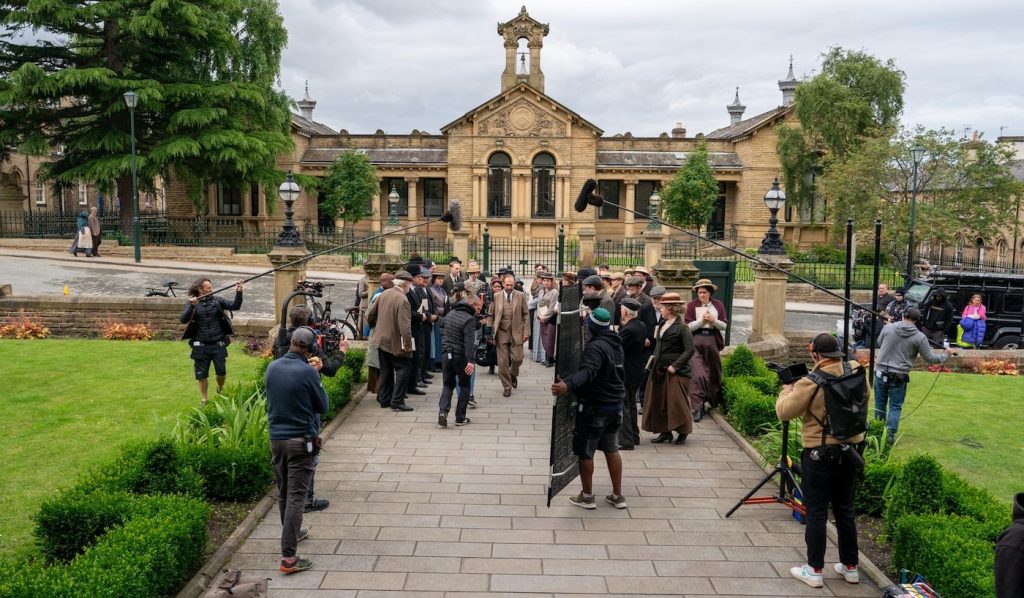
It was made on a modest budget, and our director Nick Hytner was just incredible. He’s very self-effacing about his own talent, and he really kept us all together. He’s also wonderful at casting, so we had people who were just right for the character, which really helps. There was a spirit in that film that was just like a family, and everybody felt it. At the end, we were dispensing pastoral care, tea, and tissues, off the back of the costume truck, because they were bereft that the film was over. I haven’t had that feeling for years. Even though it’s a very sad story, it was a really happy experience.
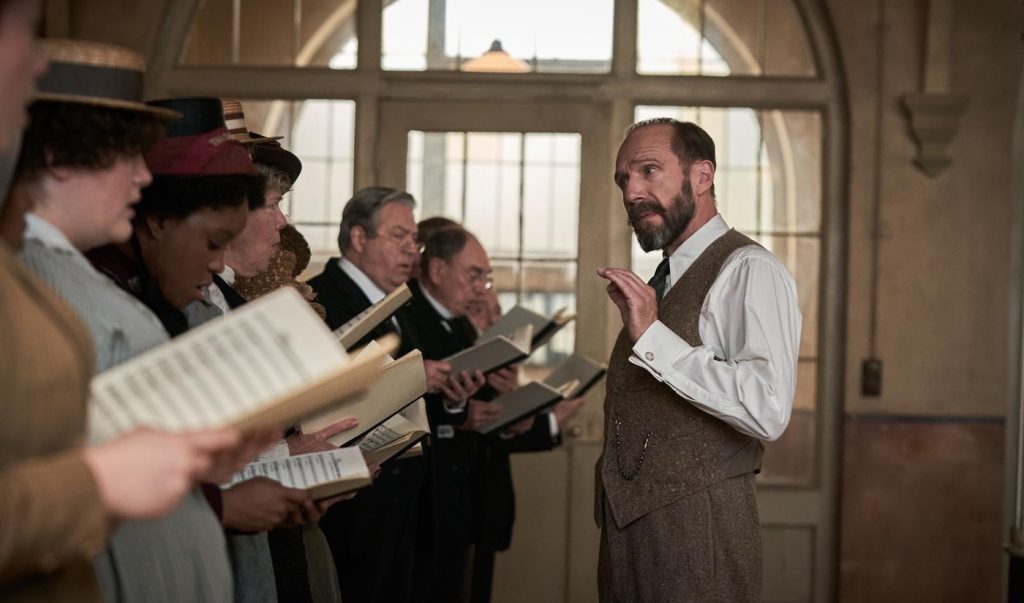
Featured image: RALPH FIENNES as Dr. Henry Guthrie in ‘The Choral.’ Image: Nicola Dove. Courtesy of Sony Pictures Classics