
How “Hamnet” Costume Designer Malgosia Turzanska Used Color to Chart Grief
A poetic exercise in healing through art, Chloé Zhao’s Hamnet, a cinematic meditation on grief, forgiveness, loss, and love, makes for a visually stunning period drama. Based on Maggie O’Farrell’s novel — who also co-wrote the screenplay with Zhao — Hamnet imagines that William Shakespeare’s (Paul Mescal) renowned stage play Hamlet was inspired by the death of his son, Hamnet (Jacobi Jupe). This story centers on his wife, Agnes (in an excruciatingly raw and powerful portrayal by Jessie Buckley), the herbalist healer whose entire existence is anchored by her deep connection to the forest and nature. Juxtaposed against Will’s regimented upbringing, her explosion of energy, color, and life sparks something in him, and they fall madly in love.
Unfortunately, marital bliss soon dissipates into the banality of everyday life, and when Will moves to London to become a playwright, the marriage falters. When tragedy strikes the family, the chasm in their relationship widens even further. Towards the end, in one of the most agonizing portrayals of grief on the screen, Agnes finally understands how Will has been dealing with his own sorrow as she watches the stage debut of Hamlet at the famed Globe Theater. Throughout the film, costume designer Malgosia Turzanska’s (Train Dreams, Hell or High Water) sartorial sensibilities chart the characters’ emotional scaffolding as the family moves from love and marriage to dealing with Hamnet’s death.
Turzanska spoke with The Credits about the meticulous wardrobe choices that conveyed the harrowing emotional journey of these characters, including what the orange and red hues in Agnes’ costumes symbolize and how bark cloth was used to accentuate her fascination with nature.
Hamnet is about real-life characters surrounding William Shakespeare at a very specific time in history. How did you research this project?
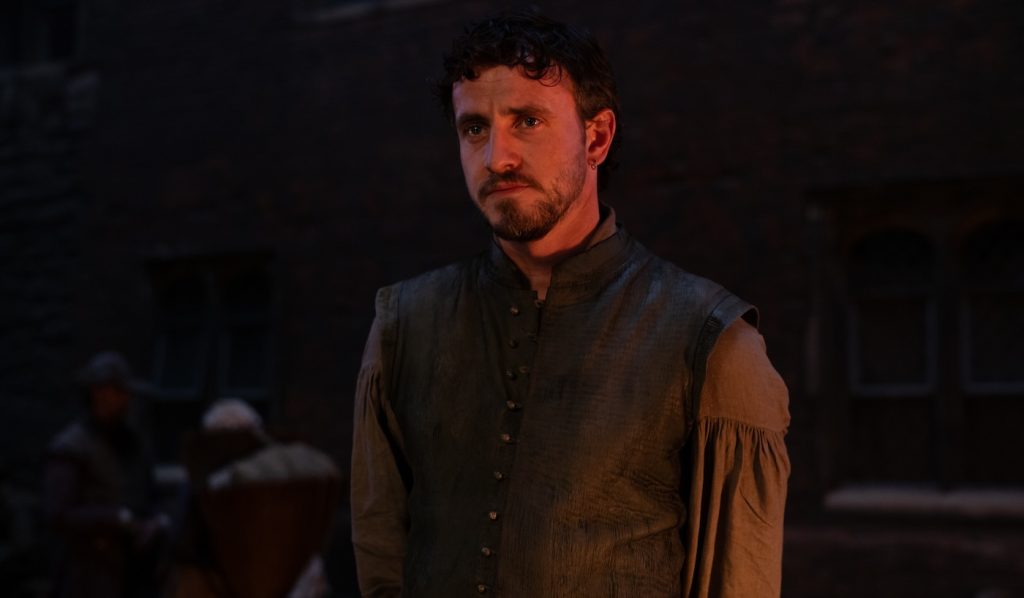
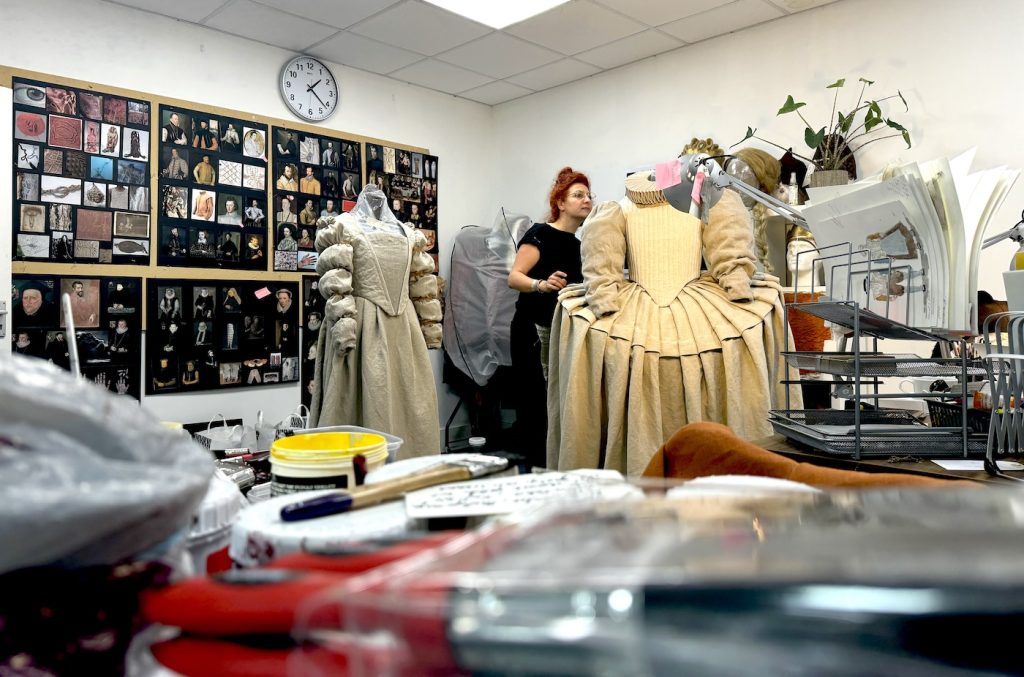
Researching is one of my favorite parts of the process. I studied the history of garments with Ruth Goodman’s book, “How To Be a Tudor,” an in-depth look at how people in that era slept or what they ate, the fiber content of their clothing, etc. I also looked at many paintings, including the book “Citizen Portrait,” which is a collection of beautiful portraits of regular people and some nobles, but not the royals. I also visited museums, but there aren’t many garments around. I loved learning about the modularity of Tudor and Elizabethan clothing — the separate bodice and skirt you tie on, and the sleeves that are pinned on so you could change as you went.
Credit: Agata Grzybowska / © 2025 FOCUS FEATURES LLC
There must have been a functional reason for that design?
Part of it was for cleaning, and you could expand your closet this way. Even Queen Elizabeth had all these pieces so she could switch out her sleeves or skirt. So, it wasn’t only for the lower classes. There are many single pieces, pinned with silver pins, that you can find around older buildings in London. I believe Maggie gave Paul and Jesse one of those Elizabethan antique pins.
Credit: Malgosia Turzanska / © 2025 FOCUS FEATURES LLC
What were some of the things you learned that surprised you?
The portraits and paintings were the most helpful because clothing that survived is often from the upper classes, which are well-preserved. But the working class wore their clothes to shreds, so there’s barely any evidence of those. Sometimes you find garments in the mud of the Thames, for example, or a shoe or a sock in a shipwreck like the Mary Rose. But since most of these are not intact, you have to piece them together like a puzzle based on the paintings. The ones with peasants and the working class are the most fascinating to me. [Flemish Baroque war artist] Sebastiaen Vrancx’s paintings depict brutal, violent scenes of people getting killed in various ways. With all that movement, the dynamic poses when people fall over reveal layers of clothing that you don’t normally see – the shirts are hiked up so you see the top of their breeches. It was really cool to dig into the little elements that you can’t see in more posed, proper portraits.
Agnes’ wardrobe is mostly in orange and red hues. Is there any significance to that color palette, and how did that change as her character grows in the film?
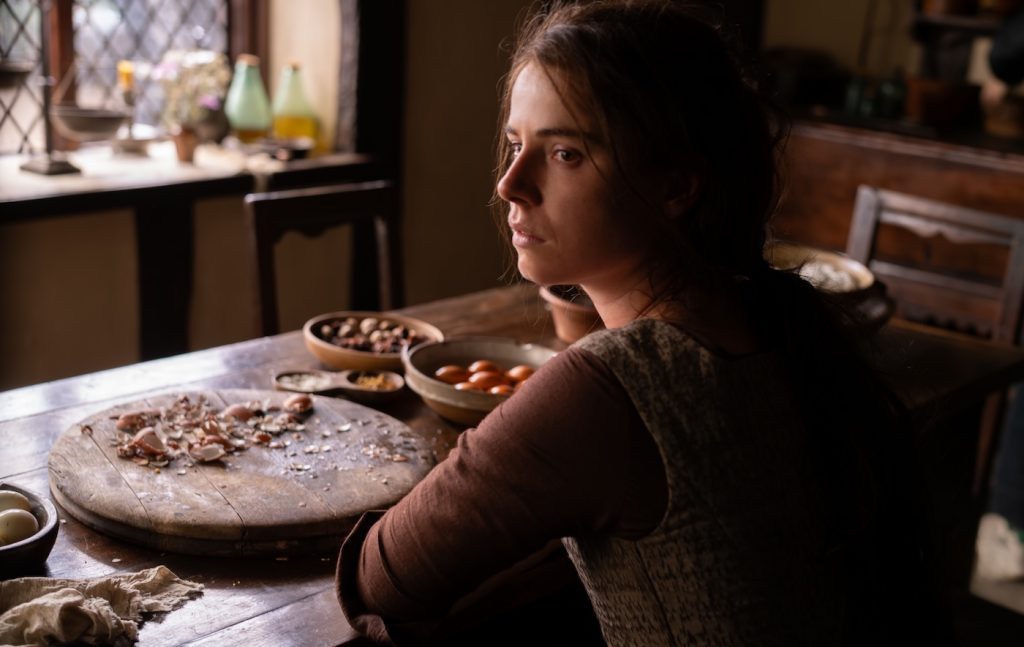
That was what jumped out at me when I first read the novel, before we even had a script. I imagined this beating heart and blood pulsating in the veins, because she’s so alive and unapologetic. It was about blood and a kind of life force. Will was very controlled in the beginning, that’s how I tried to see her through his eyes — she is an explosion of life force. Once they have kids, there is more of a rust tone, as if the blood was drying up on the edges, but still very alive. Then, after Hamnet’s death, we go into prunes, purples, browns, and grays, almost like a scab: by then, her life force is slowly waning until it disappears, and it’s painful to watch. At the end, when she is by the stage in the Globe Theater, she wears one of her oldest dresses to symbolize blood slowly flowing back into her veins. So that was my very abstract emotional response to her character.
Credit: Agata Grzybowska / © 2025 FOCUS FEATURES LLC
How about how the fabrics and textures reflect her character?
Agnes is a very practical, simple person, so there’s no ornamentation; everything is very simple with linens, a bit of wool, and leather. The embroidery wasn’t elaborate, and the fabrics are a little flowy, so it’s not just a flat surface.
In the opening shot, Agnes embraces the base of a tree in a fetal position. How does her deep connection to nature come into play with the designs?
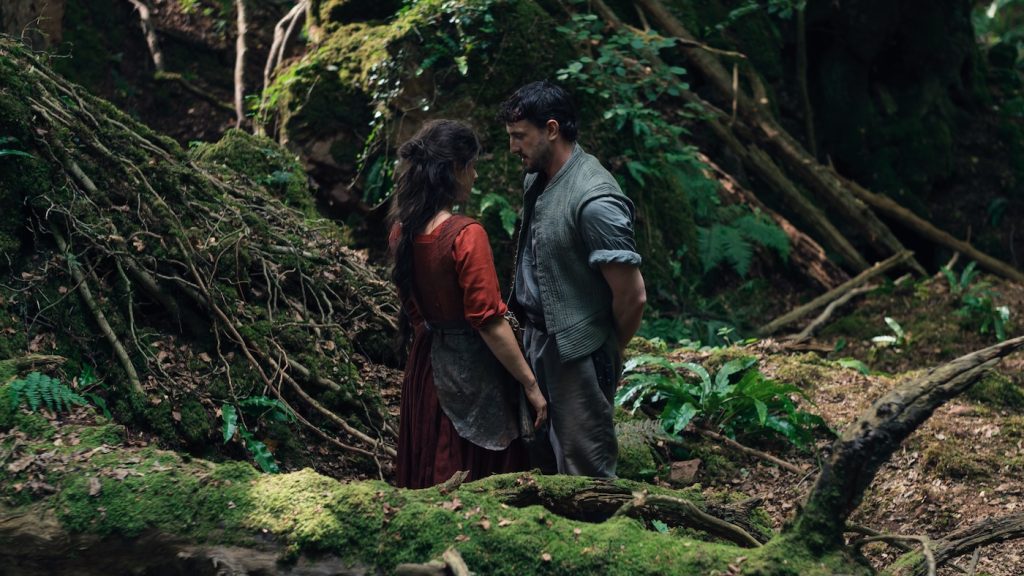
In that first shot, her bodice is made of bark cloth from an actual tree bark! Only certain trees work for this — between the bark and the core of the tree is a fibrous substance that has been used for clothing for centuries, especially in Africa. It looks like a thin layer of fibrous wood. So, when she’s lying around that tree, she is actually wearing a tree! I was so thrilled with how that came out. It’s not period-accurate, but it felt right for her character.
Credit: Agata Grzybowska / © 2025 FOCUS FEATURES LLC
It definitely feels very organic to her persona. Where do you even source bark cloth?
It’s from a Ugandan-German company, Barktex, that brings bark cloth from Africa in a sustainable, fair-trade way, so it felt good working with them. We got most of Agnes’ linens from the mountains of cloth houses in London. Especially in the beginning, she wears a cartridge-pleated underskirt and overskirt; there’s so much fabric. Her dresses start out voluminous, but her shape narrows down as the story progresses, when she becomes sad.
Check back tomorrow for the conclusion of our conversation, where Turzanska discusses the meticulous sartorial decisions behind Will’s wardrobe and how his abusive upbringing became one of the design considerations.
Hamnet is playing in theaters now.
Featured image: Jessie Buckley stars as Agnes and Joe Alwyn as Bartholomew in director Chloé Zhao’s HAMNET, a Focus Features release.
Credit: Agata Grzybowska / © 2025 FOCUS FEATURES LLC